
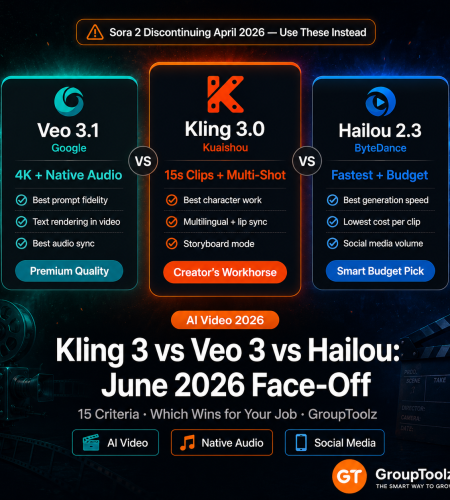
This kling 3 vs veo 3 ai video 2026 comparison covers every key difference between the three leading AI video generators — use cases, benchmarks, pricing, and the exact workflow I’d recommend.
AI video generation actually works now. That’s a change from 18 months ago. The question in June 2026 isn’t “which one produces usable output” — they all do. It’s “which one wins for the specific job you’re doing.” Veo 3.1 leads on audio and prompt fidelity. Kling 3.0 leads on longer clips and character work. Hailou 2.3 is the smart budget pick. All three are on GroupToolz.
By GroupToolz Team Updated: June 8, 2026
| ⚠️ Sora 2 update — April 26, 2026 OpenAI announced on April 26, 2026 that Sora’s web and app experiences are being discontinued. The API follows later in 2026 (September 24 target). Don’t start new long-running projects on Sora. This comparison focuses on Kling 3.0, Veo 3.1, and Hailou 2.3 — the three models with stable roadmaps right now. |
Where AI video actually stands in June 2026
Something shifted in early 2026. AI video went from “impressive but not production-ready” to “teams are actually shipping this in ads and e-commerce and social media.” The quality gap closed. What took heavy post-production work in 2024 now comes out of the generator usable.
So the best ai video generator june 2026 conversation has moved. Three models lead for production use: Google’s Veo 3.1, Kuaishou’s Kling 3.0, and ByteDance’s Hailou AI 2.3 (also called Hailuo 2.3). Each was built for different things. The right one depends entirely on what you’re making.
This ai video comparison pulls from June 2026 benchmark data across multiple independent sources: Atlas Cloud (May 21, 2026), Pixflow (May 2026), 3DAI Studio (June 2026), and Shhots AI (May 2026). Where sources disagree, I note it.
Head-to-head comparison: 15 criteria
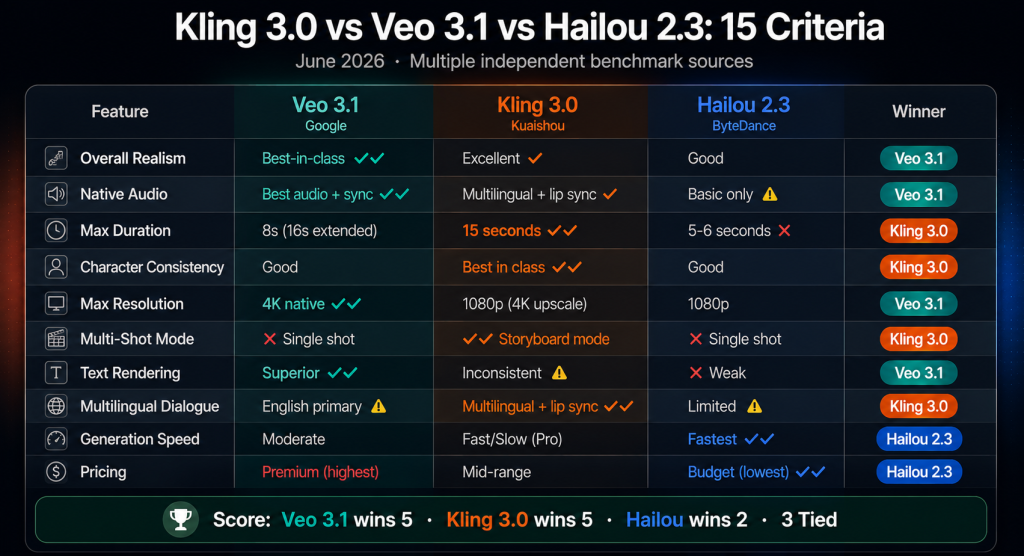
| Feature | Veo 3.1 | Kling 3.0 | Hailou 2.3 | Winner |
|---|---|---|---|---|
| Overall realism | Best-in-class for physics, lighting, material rendering | Excellent, especially cinematic lighting and complex motion (hair, fabric, liquids) | Good. Production-ready, not top-tier. | Veo 3.1 |
| Native audio | ✅ Best audio quality and sync of any current model | ✅ Native audio with multilingual dialogue + lip sync | ⚠️ Basic audio generation | Veo 3.1 |
| Prompt adherence | Best. Follows complex, multi-element prompts accurately. | Very good. Occasionally interprets loosely. | Good for simpler prompts | Veo 3.1 |
| Character consistency | Good | Excellent. Best in class for portrait animation and human motion. | Good | Kling 3.0 |
| Max duration | 8 seconds standard, up to 16s extended | 15 seconds. Longest in this comparison. | 5-6 seconds | Kling 3.0 |
| Max resolution | 4K (portrait and landscape) | 1080p (4K via upscaling) | 1080p | Veo 3.1 |
| Multi-shot mode | ❌ Single shot | ✅ Storyboard mode with native audio sync across cuts | ❌ Single shot | Kling 3.0 |
| Text rendering in video | ✅ Superior. Readable product labels, signs, text. | ⚠️ Inconsistent | ❌ Weak | Veo 3.1 |
| Multilingual dialogue | ⚠️ English primary | ✅ Multilingual with accurate lip sync | ❌ Limited | Kling 3.0 |
| Generation speed | Moderate. Premium quality costs time. | Fast for Standard, slower for Pro | Fast. Best speed-to-quality ratio. | Hailou 2.3 |
| Pricing | Premium. Highest per-second cost. | Mid-range. Good value at scale. | Budget. Lowest cost per clip. | Hailou 2.3 |
| Complex motion | Excellent | Excellent. Best for hair, fabric, liquid, natural motion. | Good | Tie (Veo/Kling) |
| Image-to-video | ✅ Strong with Nano Banana pairing | ✅ Strong | ✅ Good | Tie |
| Vertical (9:16) | ✅ Portrait 4K native | ✅ Full format support | ✅ Full format support | Tie |
| GroupToolz access | AI Plan ₹2,499 / Bundle with Nano Banana ₹599 | AI Plan ₹2,499 | AI Plan ₹2,499 | AI Plan covers all three |
Score: Veo 3.1 wins 5 categories. Kling 3.0 wins 5. Hailou 2.3 wins 2. 3 tied. That tells you something important about this kling 3 vs veo 3 ai video 2026 comparison: there’s no clean overall winner. It really depends on the task.
Veo 3.1: the one to use when quality can’t slip
Google’s Veo 3.1 is the safest choice when the output needs to be genuinely impressive. The veo 3.1 update has strong physical realism, the best native audio of any current model, 4K in both landscape and portrait, and the most accurate prompt following in this comparison.
The audio is where Veo 3.1 really separates itself. I’ve tested a lot of these models and the audio synchronization on Veo 3.1 is noticeably better. For talking-head content, product demos, or anything where synchronized audio matters, it’s not a small edge. It’s the difference between usable output and output that needs post-production audio work. The audio generates with the video, not as a separate step you have to sync manually afterward.
Text rendering is Veo 3.1’s most specific differentiator. If your video includes product labels, readable signs, or any text that needs to be legible within the frame, Veo 3.1 is the only viable choice here. The other two fail at this pretty consistently. For e-commerce product videos, branded content with visible labels, or anything requiring readable in-frame text, you’re using Veo 3.1 or you’re doing it in post.
Veo 3.1 works through Google’s Gemini app and their Flow AI video creator. Pairing it with Nano Banana Pro for image-to-video gives better results than working from text prompts alone. GroupToolz has both as a single bundle at ₹599/month. That’s the workflow I’d actually recommend if you’re doing premium product or brand content.
The weak spots: highest pricing per second at the API level, 8-second default clip length (nearly half Kling’s 15 seconds), no multi-shot storyboard mode, and limited multilingual dialogue. If you need a 15-second Hindi product walkthrough, Veo 3.1 isn’t your model.
Kling 3.0: the creator’s workhorse
Kuaishou’s Kling 3.0 is the model I’d reach for most often if I were producing video content regularly. It matches Veo 3.1 on cinematic quality for most real-world applications and wins on several specific things that matter a lot in practice.
The 15-second clip duration is genuinely useful. When a Veo 3.1 clip cuts at 8 seconds, Kling keeps going for nearly twice as long. For social media hooks, ad content, YouTube Shorts, Instagram Reels, a single 15-second Kling clip covers most format requirements without stitching multiple generations together. Less compositing, less post work.
Character consistency is Kling 3.0’s clearest technical win in this kling 3 review. Human motion looks natural, face transitions are smooth across movement, and portrait animation quality is noticeably better than Veo 3.1 on close-up or mid-shot human subjects. If you’re producing content with recognisable characters or human subjects you need to hold consistent, use Kling.
The multi-shot storyboard mode is unique in this comparison. You define a sequence (establishing shot, close-up, reaction) and Kling generates them with consistent audio sync across the cuts. This is a real workflow advantage for anyone producing structured video content rather than individual clips. I’ve seen this save 2-3 hours per video on structured content that used to require assembling multiple generations manually.
For Indian content creators specifically: Kling 3.0’s multilingual dialogue support with accurate lip sync makes it the right model for Hindi, Tamil, Telugu, and other regional language video. Veo 3.1’s audio is English-primary. That’s a clear call for regional content.
Hailou 2.3: when you need volume and speed
Hailou AI 2.3 (also called MiniMax’s Hailuo or Hailou) sits in a clear spot in the market: production-ready quality at a noticeably lower price than Veo 3.1 or Kling 3.0. This is the ai video comparison position across most of the benchmarks I’ve looked at — “Hailou and Kling are strong mid-tier options with good quality at lower price points.”
For Indian creators running high-volume social media workflows, producing 15-20 short clips per week across Instagram, YouTube Shorts, and TikTok, Hailou 2.3 makes sense financially. The quality is clearly production-ready for most social media. The gap between Hailou 2.3 and Veo 3.1 is obvious on a 4K monitor. On a phone screen where most of this content actually gets watched? Much harder to spot.
The generation speed is Hailou’s practical advantage for iteration. When you need to test 10-20 variations of a concept before committing to a final version, Hailou’s speed reduces the time cost significantly. Generate the concepts fast and cheap, pick the direction that works, then render the final on Kling or Veo if you need the premium quality. That’s a smart workflow. It’s how I’d approach the best ai video generator june 2026 question if I were running a lean content operation.
The honest weaknesses: 5-6 second clip limit (shortest here), limited audio quality compared to both Veo and Kling, no multi-shot mode, and text rendering that fails on anything requiring readable in-frame copy. For concept testing and social volume, it’s excellent. For anything requiring precision, it’s not the right tool.
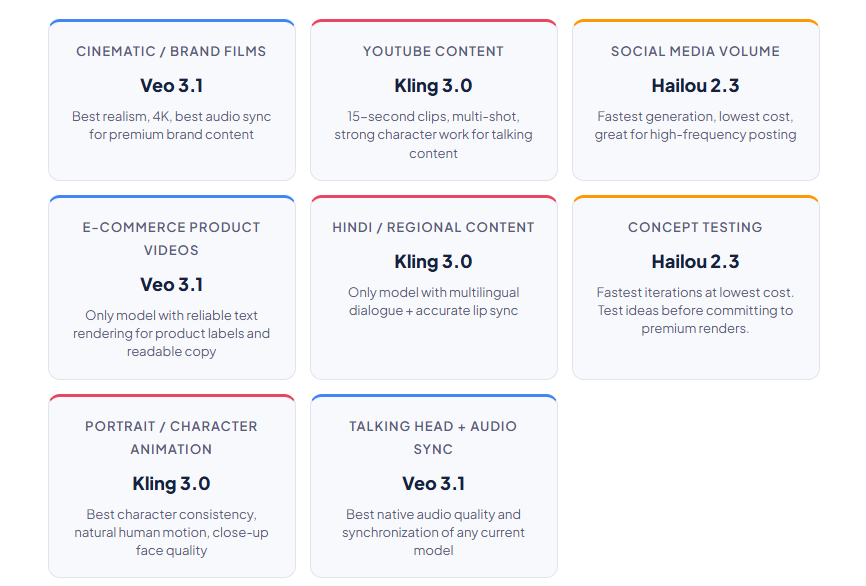
Which model for which job
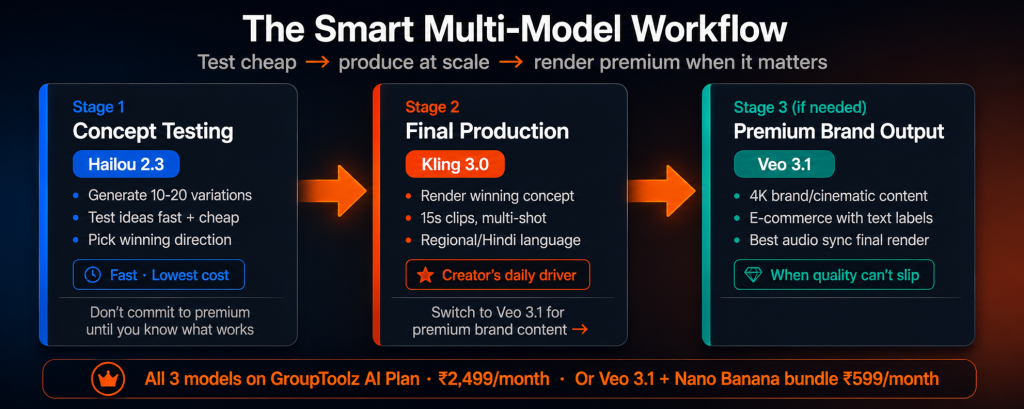
| The multi-model workflow that actually makes sense The smartest best ai video generator june 2026 approach doesn’t pick one model. It routes different tasks to different ones. Use Hailou 2.3 to sketch concepts and test 10 variations at low cost. Use Kling 3.0 to render the final version for YouTube, regional content, and anything needing multi-shot continuity. Use Veo 3.1 for premium brand content, e-commerce with readable text, and anything going on a large screen. On GroupToolz, all three are on the AI Plan at ₹2,499/month. Veo 3.1 + Nano Banana AI is also a standalone bundle at ₹599/month. |
What’s changed in the 2026 AI video landscape
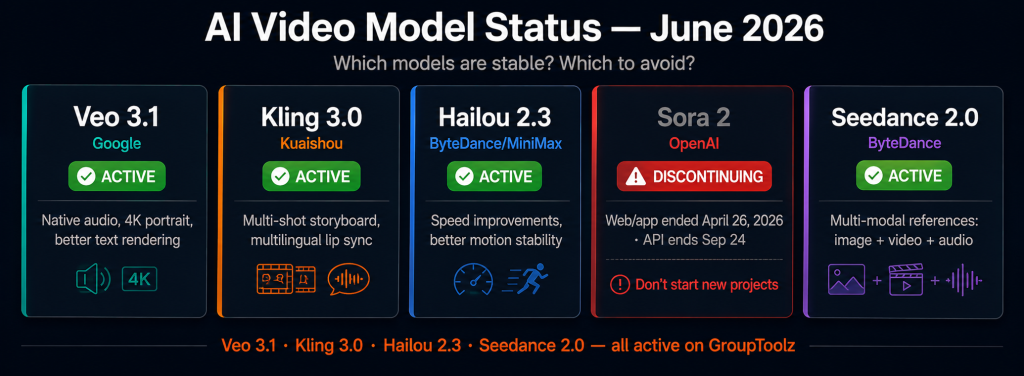
| Model | Status June 2026 | Key change from 2025 |
|---|---|---|
| Veo 3.1 | Active, improving | Native audio added, 4K portrait output, improved text rendering (veo 3.1 update) |
| Kling 3.0 | Active, improving | Multi-shot storyboard mode, multilingual dialogue + lip sync |
| Hailou 2.3 | Active, improving | Speed improvements, better motion stability over 2.1/2.2 |
| Sora 2 | ⚠️ Discontinuing | Web/app discontinued April 26, 2026. API ending September 24, 2026. Don’t start new projects here. |
| Runway Gen-4.5 | Active, pro-grade control tools | Multi-motion brush, frame-by-frame camera control. Professional tool, higher learning curve. |
| Seedance 2.0 | Active, best for reference-based generation | Multi-modal references (image + video + audio) in single generation |
AI video tools on GroupToolz
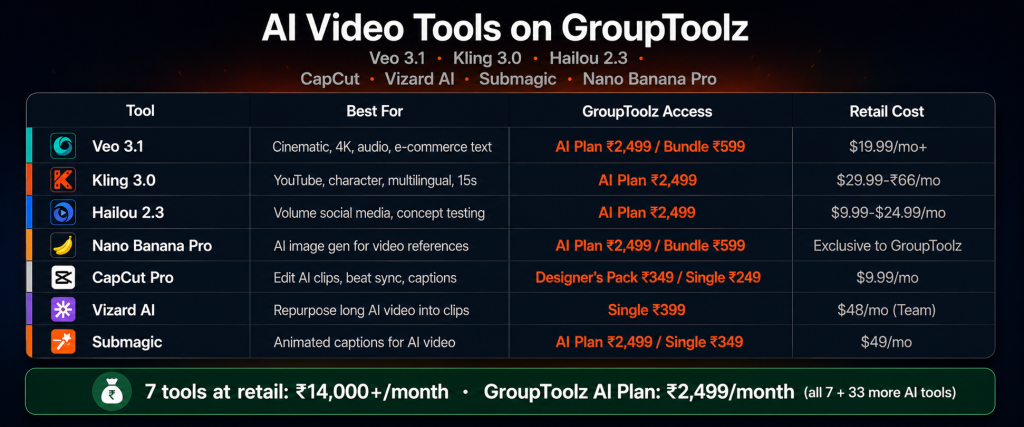
| Tool | Best for | GroupToolz access | Retail cost |
|---|---|---|---|
| Veo 3.1 | Cinematic quality, best audio, e-commerce text, 4K output | AI Plan ₹2,499 / Bundle with Nano Banana ₹599 | Google AI Pro $19.99/mo+ |
| Kling 3.0 | YouTube, character work, multilingual, 15s clips | AI Plan ₹2,499 | $29.99-$66/mo |
| Hailou 2.3 | Volume social media, concept testing, budget production | AI Plan ₹2,499 | $9.99-$24.99/mo |
| Nano Banana Pro | AI image generation for video reference inputs | AI Plan ₹2,499 / Bundle with Veo ₹599 | Exclusive |
| CapCut Pro | Edit AI video clips, beat sync, captions, export | Designer’s Pack ₹349 / Single ₹249 | $9.99/mo |
| Vizard AI | Repurpose long AI video into short clips | Single ₹399 | $48/mo (Team) |
| Submagic | Animated captions for AI video clips | AI Plan ₹2,499 / Single ₹349 | $49/mo |
| Retail total (7 tools) | ₹14,000+/mo | ||
| GroupToolz AI Plan | All 7 + 33 more AI tools | ₹2,499/mo |
| The June 2026 honest take Veo 3.1 is the pick when quality and audio can’t slip. Kling 3.0 is the creator’s daily driver: volume, character work, multilingual, longer clips. Hailou 2.3 is the production floor: fast, cheap, good enough for most social media. This kling 3 vs veo 3 ai video 2026 comparison doesn’t have a single clear winner because none of them wins everything. The GroupToolz AI Plan at ₹2,499/month includes all three alongside Nano Banana Pro, ChatGPT Plus, Perplexity, Leonardo AI, Flux, and 34 more AI tools. Veo 3 + Nano Banana bundle is ₹599/month if you want just those two. |
Frequently asked questions
What is the difference between Maestro and Artisan?
For the best ai video generator june 2026 question, there’s no single answer. Veo 3.1 leads on audio quality, 4K output, prompt accuracy, and text rendering. Kling 3.0 leads on 15-second clips, character consistency, multilingual dialogue, and multi-shot mode. Hailou 2.3 leads on speed and price for volume production. The smartest workflow uses all three for different jobs, which is why GroupToolz’s AI Plan covering all three at ₹2,499/month makes sense. Worth noting: the veo 3.1 update alone made it significantly more competitive for creators.
What happened to Sora in 2026?
OpenAI announced April 26, 2026 that Sora’s web and app experiences are being discontinued. The API ends September 24, 2026. Sora 2 produced genuinely impressive output while it lasted, but it’s not the right choice for anything new. Migrate existing Sora workflows to Veo 3.1 or Kling 3.0 depending on your use case.
Does Kling 3.0 support Hindi and Indian language video?
Yes, and it’s one of Kling’s clearest advantages in this kling 3 review. Kling 3.0 supports multilingual dialogue with accurate lip sync, which makes it the right AI video model for Hindi, Tamil, Telugu, and other Indian language content. Veo 3.1’s audio is primarily English-optimised. For Indian regional language content, the kling 3 vs veo 3 ai video 2026 answer is clearly Kling 3.0. And this ai video comparison makes that case pretty strongly.
Can I access all three AI video models on GroupToolz?
Yes. Veo 3.1, Kling 3.0, and Hailou 2.3 are all on the GroupToolz AI Plan at ₹2,499/month. Veo 3.1 is also available as a standalone bundle with Nano Banana Pro at ₹599/month. This ai video comparison is more useful when you can actually test the models yourself, which the GroupToolz access makes much easier than subscribing to each at retail.
What is the maximum clip length for each model?
Kling 3.0: 15 seconds. Veo 3.1: 8 seconds standard (up to 16s extended). Hailou 2.3: 5-6 seconds. For YouTube Shorts and Instagram Reels formats requiring clips up to 15 seconds, Kling 3.0 is the only one that can produce a full clip in a single generation. The veo 3.1 update extended output to 16s in extended mode, which helps, but 8s is still the standard output.
What is Nano Banana Pro and why does it pair with Veo 3.1?
Nano Banana Pro is an AI image generation model available exclusively on GroupToolz. When you pair it with Veo 3.1 for image-to-video work, you give Veo a high-quality reference image to generate from rather than working from text alone. The output quality noticeably improves. GroupToolz offers both as a ₹599/month bundle, or they’re included in the AI Plan at ₹2,499/month. For premium brand or e-commerce video, this combo is what I’d actually use.
Comments