
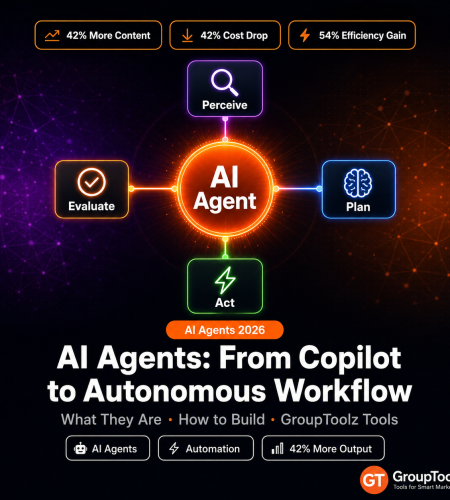
AI agents tools 2026 represent the biggest shift in how marketing work gets done — from answering questions to completing entire workflows autonomously.
In 2023, AI answered questions. In 2025, it drafted content. In 2026, it completes entire workflows on its own. The shift from AI copilot to AI autonomous agents is real and it’s happening fast. If you’ve been wondering what are ai agents in a practical marketing context, here’s the answer, and how to build your first one using GroupToolz tools this week.
By GroupToolz Team Updated: June 5, 2026
What is an AI agent, actually?
An AI agent is an autonomous system that can plan, execute, and iterate on multi-step tasks to reach a goal without someone approving every individual step along the way.
The difference from regular AI is specific. When you ask ChatGPT “write a blog post about SEO,” it writes the post and stops. It waited for your prompt, produced one output, finished. That’s an AI assistant. An AI autonomous agent given the same goal would do something different. It would research trending SEO topics, spot a keyword gap your site has, draft a post targeting that gap, check the draft against your previous content for consistency, write a title tag and meta description, suggest internal links, then flag everything for your review. All of that without you issuing separate instructions at each step.
What makes an agent an agent comes down to three things. Autonomy: it runs multi-step workflows without human sign-off at each stage. Adaptability: when something goes wrong (a data source is down, an approach isn’t working), it finds an alternative instead of just failing. And goal-directed reasoning: it checks whether each action is actually moving toward the goal and adjusts if not. Regular automation is fixed rules — same input, same output, every time. Agents reason about context and pick their actions accordingly. That’s a real difference.
AI assistant vs AI agent: one concrete example
You need a weekly SEO report. AI assistant approach: you gather the data, paste it into ChatGPT, ask for a summary. 30 minutes of your time every Monday. AI agent approach: you define what the report should cover once. Every Monday, the agent pulls rankings from Semrush, compares to the previous week, identifies the three biggest opportunities, drafts the report in your writing style, and sends it to your email. Your time: 5 minutes reviewing the output. That’s what an ai agent workflow actually buys you.
How ai autonomous agents work: the 4-stage loop
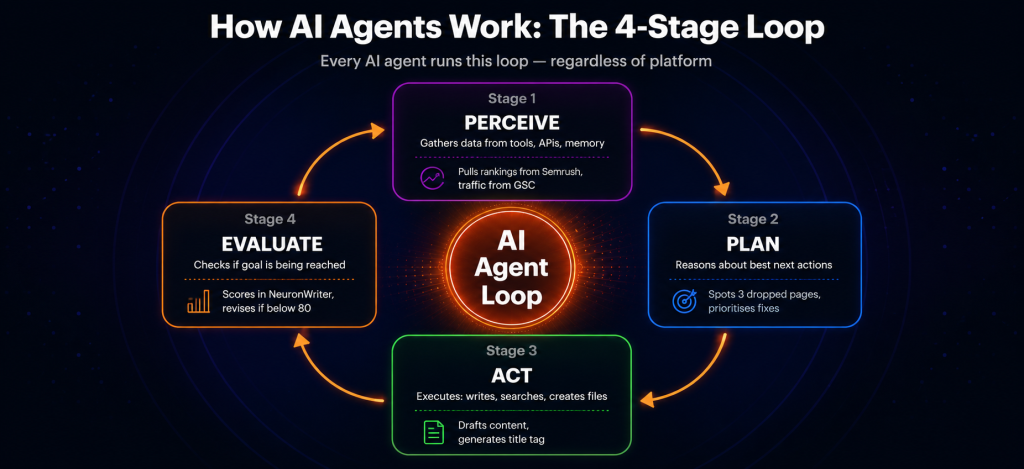
Every AI agent runs the same basic loop regardless of platform: Perceive, Plan, Act, Evaluate.
| Stage | What happens | Example: SEO agent |
|---|---|---|
| Perceive | Gathers information from tools, data sources, APIs, its own memory | Pulls ranking data from Semrush, traffic from GSC, competitor updates from BuzzSumo |
| Plan | Reasons about what actions will most effectively move toward the goal | Spots 3 pages that dropped in ranking, figures out likely causes, prioritises which to fix first |
| Act | Executes: writes, searches, calls tools, creates files | Drafts updated content for the top priority page, generates a new title tag, lists internal link suggestions |
| Evaluate | Checks whether the actions got closer to the goal; if not, tries again | Scores the content in NeuronWriter, revises if below 80, then prepares everything for human review |
What changed in 2026 is that this loop now runs reliably on complex, real-world tasks. Early ai agents tools 2026 predecessors (2023-2024) were impressive in demos and broke constantly in practice. They’d lose context, make wrong calls, and need constant babysitting. GPT-5.4, Claude Opus 4.6, and Gemini 3.1 are among the best ai agents tools 2026 has to offer. They’re now strong enough to hold the Perceive-Plan-Act-Evaluate loop together across 20-50 step workflows without falling apart. That reliability threshold is what makes agents useful for actual business work instead of just research demos.
The 5 types of AI agents in marketing
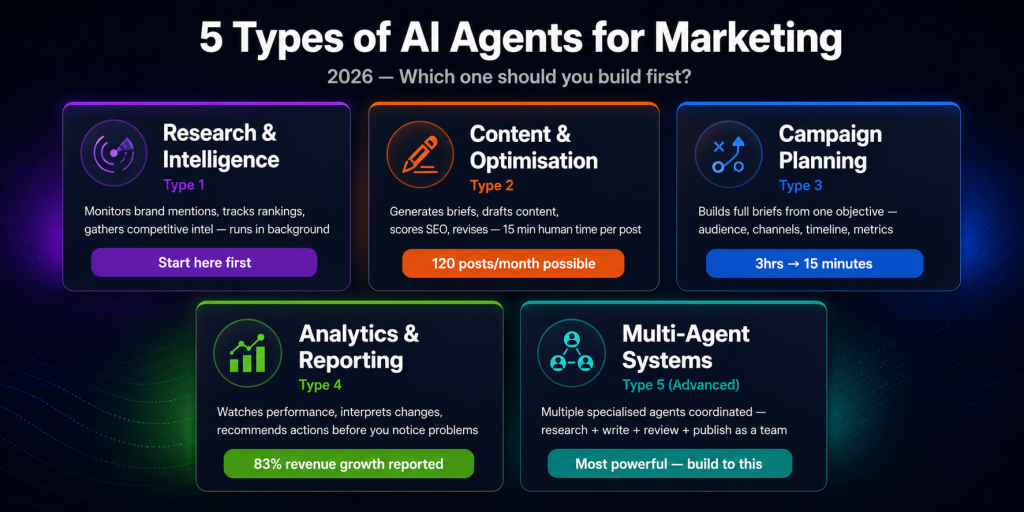
| Type 1 Research and intelligence agents These run in the background and surface things you’d otherwise miss. They monitor brand mentions, track ranking changes, gather competitive intelligence, analyse audience sentiment. Instead of you manually checking Semrush, BuzzSumo, and GSC every morning, a research agent does it and brings you the actionable bits. A good competitive intelligence agent monitors what competitors publish, finds content gaps, and flags when a competitor starts ranking for a term you should own. No daily prompt from you required. |
| Type 2 Content creation and optimisation agents This is the one most marketers try first. The agent generates briefs from research, drafts content, scores it against SEO targets, revises until quality thresholds are met, and gets it ready to publish. One documented case: a SaaS company used agentic content workflows to produce 120 blog posts in one month. They ranked for 340+ keywords within 90 days. The agent handled research, drafting, NeuronWriter scoring, revision, and metadata. A human reviewed and approved each post. Total human time per post: about 15 minutes. I think that ratio is realistic for most teams that set this up properly. |
| Type 3 Campaign planning and brief agents Give the agent a high-level marketing objective and it builds you a campaign brief. Target audience, channel mix, messaging hierarchy, content requirements, timeline, success metrics. It does this by drawing on historical performance data, competitive intelligence, and audience behaviour signals. A campaign brief that would take a senior marketer 3-4 hours to put together from scratch takes the agent 15 minutes to draft. The marketer reviews and refines instead of building from zero. Most people who try this don’t go back to building briefs manually. |
| Type 4 Analytics and reporting agents These watch performance data continuously and flag problems before you’d normally notice them. Traffic drops. Ranking changes. Conversion dips. But the useful part isn’t just the detection. These ai autonomous agents don’t just summarise the data; they interpret what changed, suggest why it likely changed (comparing against historical patterns and external signals), and recommend actions. The difference between getting a report and getting an insight. Companies running these agents report 83% measurable revenue growth vs 66% for teams without. That gap comes from speed of insight, not budget. |
| Type 5 Multi-agent systems (orchestrated teams) Multiple specialised agents working together, each handling one domain. One researches. One writes. One reviews. One publishes. An orchestrating agent coordinates them, delegates tasks, and integrates the outputs. Claude Opus 4.6’s Agent Teams feature is the best current implementation of this I’ve used. It handles tasks that a single agent can’t do well alone. If you’re thinking “this sounds complicated” — you’re right that setting this up well takes more than an afternoon. Start with Type 1 or 2. Get to this eventually. |
AI agents vs automation vs AI assistants: what’s actually different
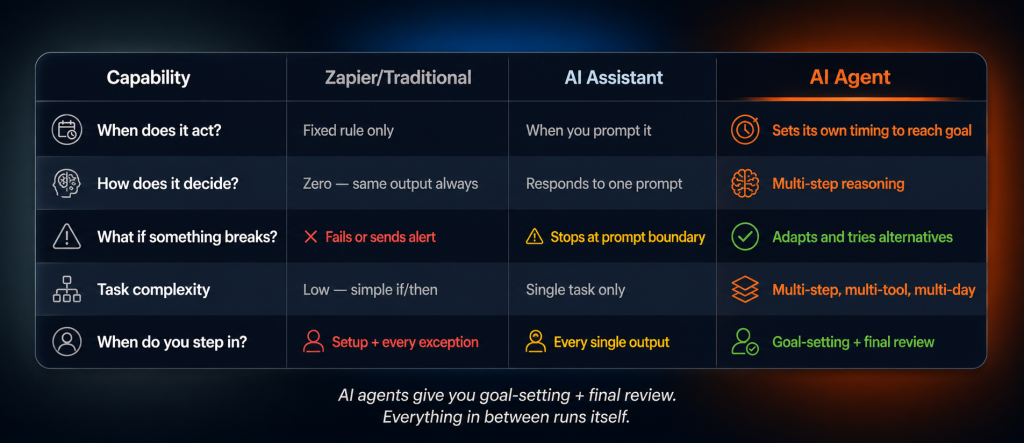
| Capability | Traditional automation (Zapier) | AI assistant (ChatGPT prompt) | AI agent |
|---|---|---|---|
| Trigger | Fixed rule (if X, then Y) | Human prompt every time | Goal-oriented. Decides when and how to act. |
| Decision-making | None. Same input, same output. | Responds to one prompt | Multi-step reasoning across the whole task |
| Tool use | Fixed integrations only | Limited (search, code) | Dynamic. Picks tools based on what the task needs. |
| Error handling | Fails or sends an alert | Stops at the prompt boundary | Spots errors, tries different approaches |
| Human involvement | Required to set up rules | Required for every output | Required at goal-setting and final review |
| Complexity | Low (simple if-then) | Single task | High. Multi-step, multi-tool, multi-day workflows. |
3 real ai agent workflow examples using GroupToolz tools
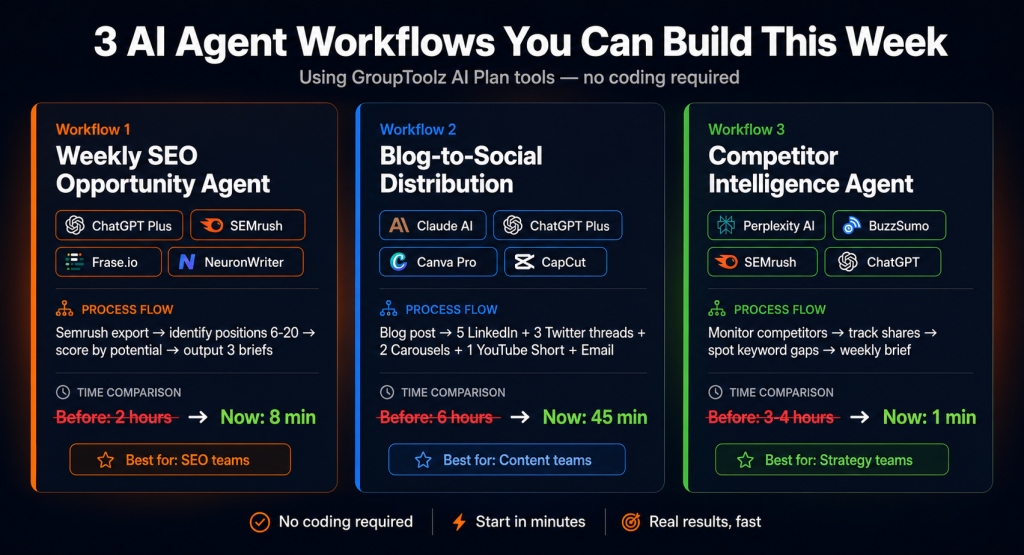
| Workflow 1 Weekly SEO opportunity agent ChatGPT Plus Semrush Frase.io NeuronWriter Goal: Every Monday, find the 3 highest-ROI content update opportunities and produce ready-to-use briefs. How to build it: Create a ChatGPT Plus custom GPT with instructions: “You are an SEO agent. When I give you a Semrush position tracking export, identify pages ranked positions 6-20 with 100+ impressions, score each by traffic gain potential, and output a content brief for the top 3. For each brief, specify which sections to add, update, or remove based on Frase.io topic analysis and NeuronWriter scoring criteria.” Your input: Paste that week’s Semrush export. 2 minutes. Output: 3 content briefs with keyword targets, sections to add, word count goals, and NeuronWriter score targets. An ai agent workflow that takes 8 minutes instead of 2 hours. I’ve run a version of this for months and it’s the one I’d recommend starting with. |
| Workflow 2 Blog-to-social distribution agent Claude AI ChatGPT Plus Canva Pro CapCut Goal: Take one published blog post and produce a complete social distribution package across all platforms. How to build it: Create a Claude AI project: “You are a content distribution agent. When I give you a blog post URL or text, produce: 5 LinkedIn posts (different angles), 3 Twitter/X threads (hook + 6 tweets each), 2 Instagram carousel scripts (10 slides), 1 YouTube Shorts script (60 seconds), 5 Facebook post variations, and an email newsletter summary (250 words). Use different hooks for each platform. LinkedIn is professional, Instagram is visual, Twitter is punchy.” Your input: Paste the blog URL or text. One prompt. Output: 16 pieces of platform-adapted social content. Use Canva Pro for the carousel slides, CapCut to record the Shorts. Total time: 45 minutes instead of 6 hours. The output needs light editing but the bones are solid. |
| Workflow 3 Competitor content intelligence agent Perplexity AI BuzzSumo Semrush ChatGPT Plus Goal: Weekly competitive intelligence report covering what competitors published, what got traction, and what content gaps appeared. How to build it: Build a Perplexity AI Pro research workflow (GroupToolz AI Plan ₹2,499). Perplexity’s real-time search makes it good for competitive monitoring. Set it to: search each competitor’s new content from the past 7 days, check BuzzSumo for their most-shared recent articles, search Semrush for keywords they started ranking for that you don’t, then output a brief with 3 competitor content themes getting traction, 3 keyword gaps, and 3 recommended topics. This is one of the ai agents for marketing use cases that pays back immediately. Your input: Run the prompt once a week. 1 minute. Output: Competitor intelligence brief with concrete content recommendations. Saves 3-4 hours of manual monitoring per week. |
The honest limitations (what ai autonomous agents can’t do yet)
Only 23.3% of companies have deployed true agentic workflows in 2026. The other 76.7% face real barriers worth knowing about before you start.
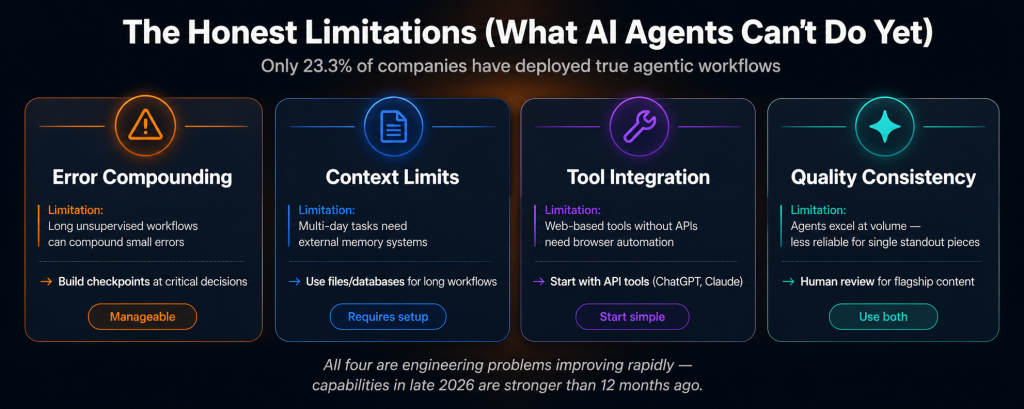
Error compounding in long workflows. The longer an agent runs without a human checkpoint, the more likely small errors stack up into bigger problems. A 5-step workflow carries low risk. A 50-step workflow has meaningful risk at each step. The fix: build checkpoints at critical decision points. Don’t let agents run completely unsupervised on high-stakes outputs. I’ve learned this through some painful experiments with content I thought was ready to publish.
Context limits for very long tasks. Even with 1M+ context windows, there are practical limits. For workflows spanning multiple days or needing recall of decisions made many steps back, agents need explicit memory systems: files, databases, structured notes. Setting this up is possible but it’s more work than most people budget for when they start.
Tool integration friction. Most GroupToolz tools are web-based platforms without formal API access for individual users. Agentic workflows using these tools require browser-based automation or copy-paste interfaces. True headless agent automation is available for tools that expose an API (ChatGPT Plus, Claude, Perplexity), but not for everything. This limits how hands-off you can be on some parts of the workflow.
Inconsistent quality on exceptional outputs. Agents produce excellent average quality. They’re less reliable at producing exceptional single outputs. For landing pages, flagship content, or anything that needs to be the best thing you’ve ever published, human creative involvement is still worth it. Agents are better at high-volume consistent work than single standout pieces.
AI agent tools on GroupToolz
| Tool | Agent capability | GroupToolz access |
|---|---|---|
| ChatGPT Plus | Custom GPTs for specific agent workflows, multi-step task execution, tool calling (search, code, files) | AI Plan ₹2,499 / Single ₹399 |
| Claude AI (Opus 4.6) | Agent Teams (multi-agent coordination), long-context document processing, structured output | AI Plan ₹2,499 |
| Perplexity AI | Real-time web research for monitoring agents, competitive intelligence | AI Plan ₹2,499 / Single ₹399 |
| Grok | Real-time social media and news monitoring, trend detection | AI Plan ₹2,499 / Single ₹349 |
| Gamma AI | Autonomous presentation generation from research or briefs | AI Plan ₹2,499 |
| Jasper AI | Content calendar agents, brand voice enforcement across high-volume output | Writer’s Pack ₹799 / Single ₹199 |
| Semrush (Guru) | Data source for SEO agents: keyword tracking, competitor analysis, site audit | Pro ₹399 / Advanced ₹499 / Single ₹199 |
| Frase.io | Content quality gate: topic coverage verification | Single ₹199 |
| NeuronWriter | Content scoring checkpoint: quality threshold enforcement | Single ₹299 |
| BuzzSumo | Content intelligence feed for research and competitive monitoring agents | Single ₹99 |
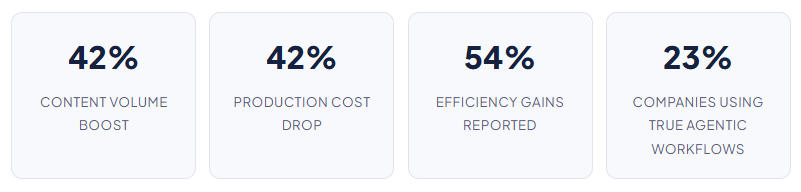
| Where to actually start Start with a simple 3-step workflow you already do manually every week. That’s the best entry point for any ai agents tools 2026 implementation. The weekly SEO opportunity check, the social media repurposing of one blog post, the competitor content monitoring. Don’t try to build a 30-step ai agent workflow on your first attempt. Get comfortable with simple agents. Build trust in their outputs. Then expand. The 42% content volume increase and 42% cost reduction documented in 2026 ai agents tools data came mostly from teams consistently using simple, well-designed agents. Not the most complex deployments. Simple, repeated, reliable. |
Frequently asked questions
What is an AI agent in simple terms?
An ai autonomous agent is a system that completes multi-step tasks toward a goal without someone approving every step. You give it a goal. It figures out how to get there and takes the actions needed. Regular AI assistants wait for each prompt and produce one output. Agents plan ahead, use tools, check their own work, and keep going until the goal is done.
Are AI agents available on GroupToolz?
Yes. ChatGPT Plus (Custom GPTs for agent workflows), Claude AI Opus 4.6 (Agent Teams for multi-agent coordination), Perplexity AI (real-time research agents), Grok (social monitoring agents), and Jasper AI (content calendar agents) are all on GroupToolz. The AI Plan at ₹2,499/month includes all of these alongside 36 more ai agents tools. The three workflows in this post can each be built using tools from that plan.
How is an AI agent different from Zapier automation?
Traditional automation follows fixed rules. Same input, same output, every time. It can’t handle anything outside the rules it was set up with. AI autonomous agents reason about what to do. Given the same input, they’ll choose different actions based on context. When something unexpected happens, they adapt instead of failing. The Zapier workflow breaks when the data format changes. The agent figures it out. That’s the difference in practice.
What are the real business results from AI agents?
2026 data on ai agents for marketing: 42% increase in content volume, 42% production cost decrease, 54% efficiency gains, and 83% of B2B teams using agents reporting measurable revenue growth vs 66% without. One documented case study: 120 blog posts in one month, ranking for 340+ keywords within 90 days, using agentic content workflows with roughly 15 minutes of human time per post.
What are the real limitations?
Four main ones. Errors can compound across long unsupervised workflows (build checkpoints). Context limits make very long multi-day tasks harder (use external memory files). Tool integration friction on web-based platforms without APIs limits how automated things can be. And quality inconsistency on single exceptional outputs (agents are better at volume than one-off standouts). Most of these are engineering problems that are improving fast. The capabilities in late 2026 are genuinely stronger than they were a year ago.
How do I start without technical knowledge?
ChatGPT Plus Custom GPTs. No coding. Create a custom GPT with instructions describing a specific multi-step task you do every week. The three ai agent workflow examples in this article can each be built in under 30 minutes using ChatGPT Plus. Start with the SEO opportunity agent (Workflow 1). It’s the easiest to set up and the most immediately useful. GroupToolz AI Plan at ₹2,499/month has ChatGPT Plus, or you can grab it as a single tool at ₹399/month.
Comments