
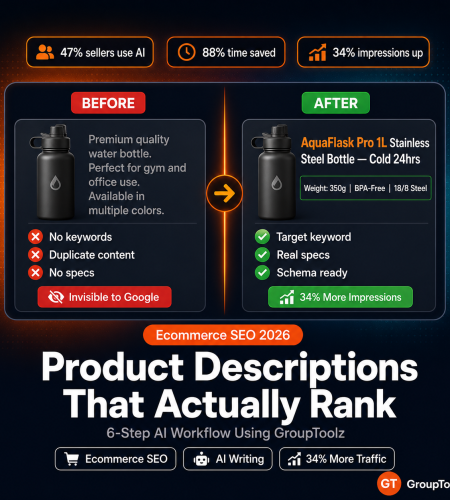
Nearly half of online sellers now use AI to write ecommerce product descriptions. The ones who’ve rewritten their catalogs with proper product description SEO are seeing 34% more organic impressions within 60 days and a 7% conversion bump in the first month. Here’s the exact 6-step workflow we use with GroupToolz.
By GroupToolz Team Updated: May 14, 2026
| 47% Sellers use AI for product copy | 88% Time saved vs manual writing | 34% Organic impressions increase | 7% Conversion lift in 30 days |
Why most ecommerce product descriptions are invisible to Google
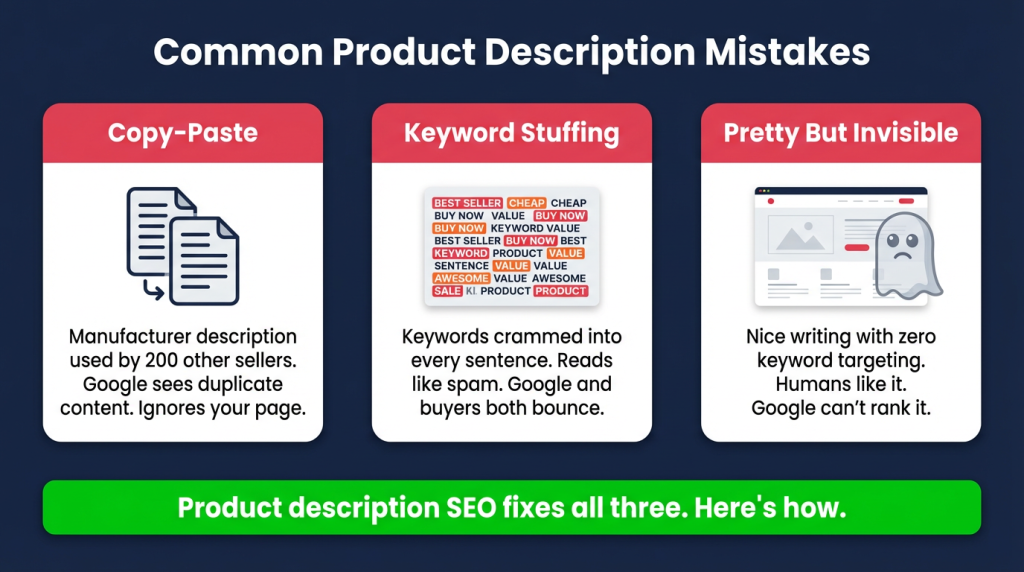
Here’s what we see constantly: store owners either copy the manufacturer’s description word-for-word (duplicate content, Google ignores it), stuff keywords until the text reads like a spam email, or write something pleasant for humans that Google can’t figure out how to rank. All three approaches lose traffic.
Good product description SEO in 2026 has to do several things at once. The description needs to rank for the main product keyword and its long-tail variations. It needs to convince someone to click “add to cart.” It has to include enough structured data for rich snippets and AI Overviews. For Indian markets, it should read naturally in English while making sense to buyers who think in Hindi or regional languages. And every description in your catalog needs to be different enough that your own pages don’t cannibalise each other.
Writing that by hand for 100+ products? Takes weeks. Maybe months. Using the ecommerce SEO tools on GroupToolz, the same work takes days. The workflow below works whether you have 10 products or 10,000. Only the batch size changes.
The 6-step ecommerce product description workflow
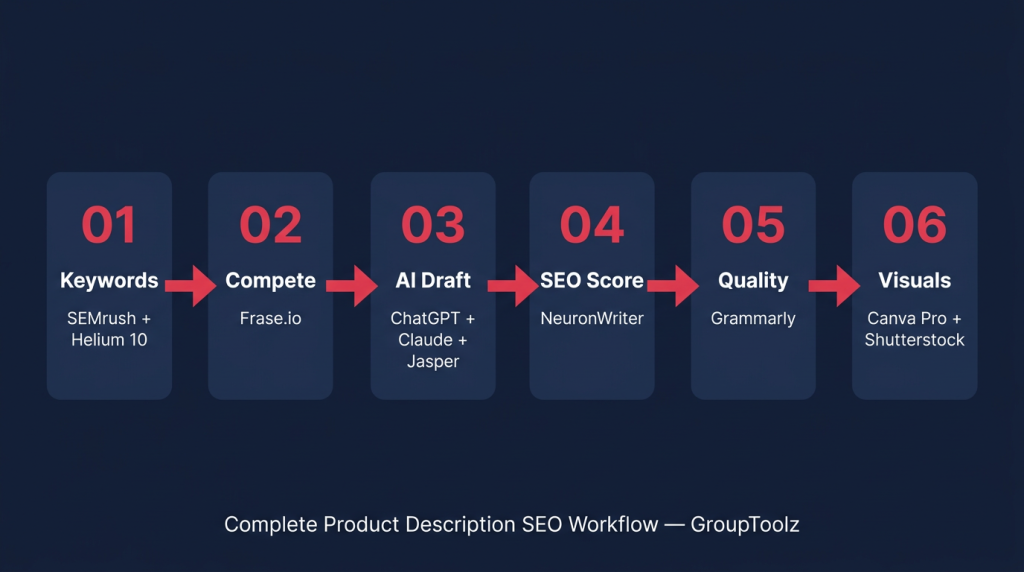
| Step 1 of 6 Keyword research: find out what buyers actually type SEMrush Helium 10 SpyFu Product keywords are nothing like blog keywords. Someone searching for a product types specific, transactional stuff: “Nike Air Max 270 men black size 10” or “stainless steel water bottle 1 litre BPA free” or “wireless earbuds under 2000 with mic.” Each of these long-tail queries gets less traffic on its own, but they convert at 3-5x the rate of vague terms like “water bottle.” In SEMrush, start with your product category keyword. Filter for commercial and transactional intent. Export everything, including the modifier words (colour, size, material, brand, price range). Group these keywords into clusters where each cluster maps to one product page. Pay special attention to “People Also Ask” questions. Those become your FAQ section, and that’s where Product schema and FAQ schema overlap to get you rich snippet eligibility. This is the backbone of your keyword strategy for product pages. If you sell on Amazon, Helium 10 is non-negotiable. Use Cerebro to do reverse ASIN lookup: plug in a competitor’s ASIN and see every keyword they rank for. Use Magnet for broader discovery. Amazon’s search algorithm (A10) weighs keywords differently than Google does. What ranks well on Google may flop on Amazon. Separate research, separate descriptions. SpyFu fills a gap neither SEMrush nor Helium 10 covers well: it shows what keywords your competitors are paying for in Google Ads. If a competitor bids Rs 20-50 per click on a keyword, that keyword makes them money. Target those same terms organically in your ecommerce product descriptions and you capture the same buyer intent without the ad spend. |
| Step 2 of 6 Competitor analysis: study what already ranks SEMrush Frase.io Before you write a single word, look at what the top-ranking product pages for your target keyword actually say. Not to copy. To understand what Google considers “complete” for that product category. Frase.io does the heavy lifting here. Enter your target keyword, and it analyses the top 10-20 results. It builds a map showing what topics they all cover, what questions they answer, and where the gaps are. For ecommerce product descriptions specifically, look at: which specs get mentioned (weight, dimensions, material, compatibility), which benefits get highlighted (durability, ease of use, value for money), which objections get addressed (warranty, returns, shipping), and which schema types the top pages use (Product, Review, FAQ). The gap analysis is where you find your angle. If every competing product page talks about material quality but none mention sustainability certifications, and your product has one, that’s unique content Google hasn’t seen on competing pages. That’s how you outrank established sellers. |
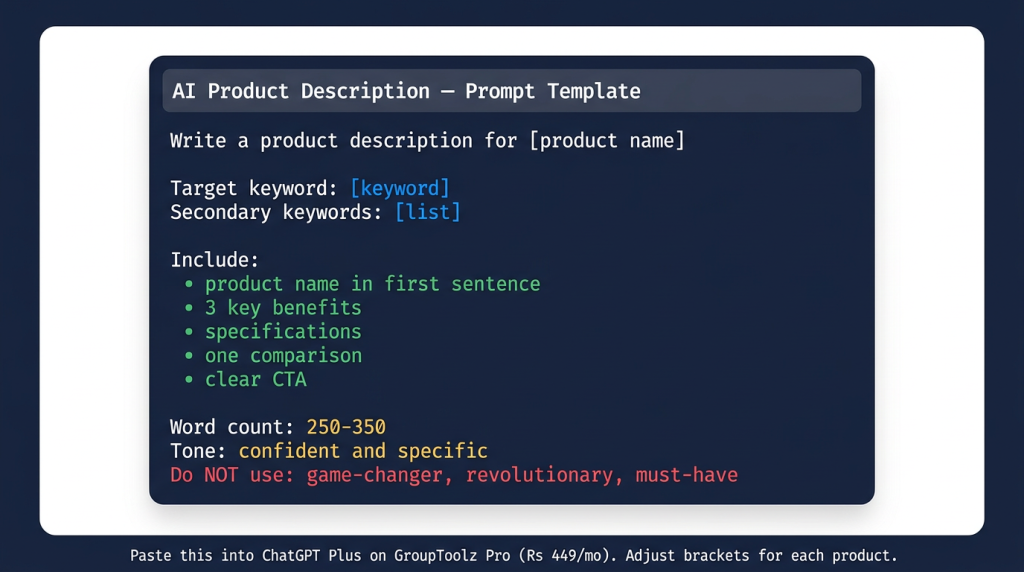
| Step 3 of 6 AI draft: get the first version down fast ChatGPT Plus Claude AI Jasper AI This is where AI saves you 88% of the time compared to writing from scratch. The AI product description you get here is raw material, not a finished piece. Steps 4 and 5 turn it into something that actually ranks. Here’s the prompt template we use in ChatGPT Plus: “Write a product description for [product name]. Target keyword: [keyword]. Secondary keywords: [list]. Include: product name in the first sentence, 3 key benefits (not features), specifications in a scannable format, one comparison to alternatives, and a clear call to action. Word count: 250-350 words. Tone: confident and specific, not salesy. Do not use words like ‘game-changer’, ‘revolutionary’, or ‘must-have’.” That last line matters more than you’d think. Without it, every AI product description sounds like a late-night infomercial. Claude works better for complex products where the buyer needs to understand how something works before purchasing. Electronics, SaaS tools, health products. Claude’s 200K context window also lets you feed it your entire product catalog and ask for unique descriptions across all of them, so you don’t end up with 50 pages that Google sees as near-duplicates. Jasper is the speed option for large catalogs. Its Brand Voice feature learns your existing copy style and keeps it consistent across hundreds of descriptions. One test we saw had a store regenerating 1,400 ecommerce product descriptions in 3 weeks (the manual version took 3 months), with that 34% impressions increase we mentioned in the intro following within 60 days. |
| Step 4 of 6 SEO scoring: make the AI draft rankable NeuronWriter The AI draft from Step 3 reads well. It probably won’t rank. NeuronWriter closes that gap by scoring your content against whatever currently ranks for your target keyword. Paste your AI product description into NeuronWriter, enter the target keyword, and it scores you 0-100 based on how well you cover the same semantic territory as the current top-ranking pages. It tells you which specific terms to add, flags over-optimization, and highlights topic gaps. This is product page optimization that goes beyond basic keyword density. NeuronWriter is looking at entity coverage, semantic relationships, and topical completeness. Aim for 80+ before publishing. In our experience, ecommerce product descriptions scoring below 60 almost never make page one for commercial keywords. The refinement process takes about 10-15 minutes per product. Add a few specific terms, restructure a sentence, include a specification the AI missed. Not hard, just necessary. |
| Step 5 of 6 Quality control: catch what AI gets wrong Grammarly Premium Every ecommerce product description goes through Grammarly before it goes live. AI-generated text has predictable quality issues: inconsistent capitalisation of brand names, passive voice overuse, comma splices, repetitive phrasing. Grammarly catches most of these in one pass. But here’s the thing Grammarly can’t do: verify facts. AI tools hallucinate product specs. Wrong weights. Invented dimensions. Certifications that don’t exist. If your product description says “BPA-free” and the product isn’t certified, you’ll eat the returns and the negative reviews. Check every spec against the actual data sheet. Every single one. Also run a readability check. Grade 7-8 reading level for consumer products. Grade 10-12 for B2B or technical gear. If the AI wrote at Grade 14 (it happens, especially with Claude), simplify. Mobile shoppers spend 4-8 seconds deciding whether to read further or keep scrolling. A product description written like an academic paper loses them instantly. |
| Step 6 of 6 Visual assets: the images around your description matter Canva Pro Shutterstock An ecommerce product description doesn’t exist alone on a page. The images around it affect both product description SEO (through alt text and structured data) and conversion rates. Google Shopping, AI Overviews, and visual search (65% of Gen Z shoppers use it in 2026) all prioritise products with good images and accurate metadata. Canva Pro handles most of the visual work: lifestyle mockups, comparison graphics (“our bottle vs competitor”), size reference images, feature highlight graphics with text overlays. Use Canva’s Brand Kit to keep styling consistent across your catalog. Shutterstock fills in when you need professional photography that DIY or AI-generated images can’t match. Their commercial photo library is the largest available and it’s included on the GroupToolz Ultimate plan. One thing people skip: alt text. Every image needs descriptive alt text with the product name and a feature. “Blue stainless steel water bottle 1 litre with bamboo lid” beats “product-image-001.jpg” for both accessibility and SEO. AI can generate alt text for you, but double-check it. We’ve seen AI describe a silver bottle as blue. That kind of error hurts you twice. |
Before and after: generic vs optimised
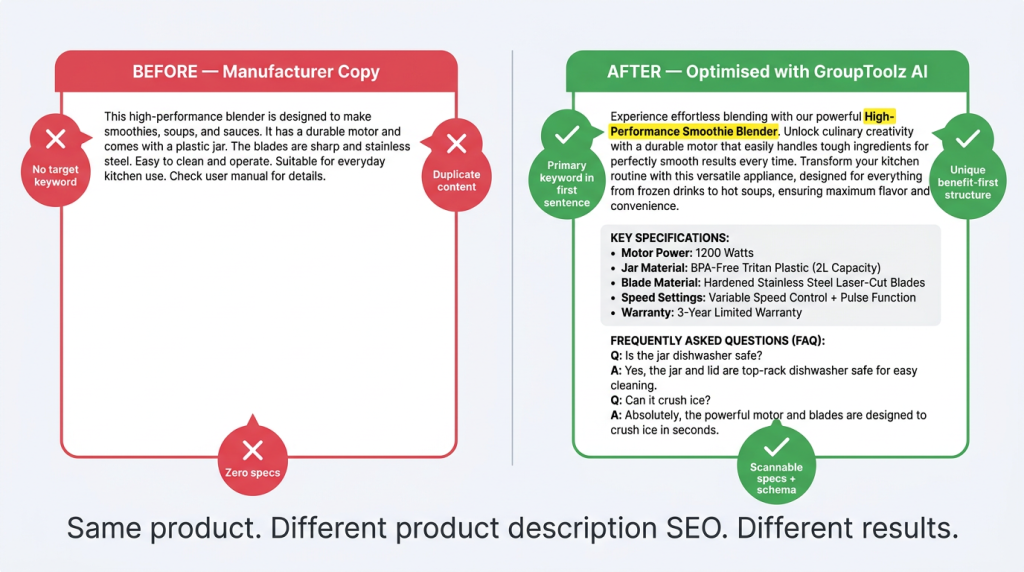
| Before: manufacturer copy-paste “This premium water bottle is made of high-quality stainless steel. It features a leak-proof lid and double-wall insulation. Perfect for gym, office, or outdoor use. Available in multiple colours. Order now and stay hydrated!” Problems: no target keyword, no specifications, duplicate content (200 other sellers have this exact text), lists features instead of benefits, no schema, no FAQ. Google has no reason to rank this over anyone else. |
| After: optimised with GroupToolz AI “The AquaFlask Pro 1-Litre Stainless Steel Water Bottle keeps drinks cold for 24 hours and hot for 12 hours using vacuum-insulated double-wall 18/8 food-grade stainless steel. At 350g, it’s 40% lighter than comparable 1L insulated bottles, with a BPA-free bamboo screw cap that seals leak-proof in any orientation. Capacity: 1,000ml. Height: 28cm. Diameter: 7.5cm. Material: 304 (18/8) stainless steel, food-grade. Insulation: Double-wall vacuum. Weight: 350g. Dishwasher-safe body (hand-wash lid recommended).” What changed: target keyword in the first sentence, real specs with numbers, benefit-first structure (cold 24h, hot 12h), unique comparison (40% lighter), certification noted, scannable spec block. That’s how you do it properly. |
Platform-specific product page optimization tips
Shopify
Shopify’s built-in SEO fields (title tag, meta description, URL handle) are where you start. The title tag should include your primary keyword plus a benefit: “AquaFlask Pro 1L Stainless Steel Water Bottle | 24-Hour Cold” instead of just the product name. Keep URL handles clean: /products/aquaflask-pro-1l-stainless-steel-water-bottle, not /products/12345. Shopify Magic can generate initial descriptions for free, but it doesn’t do targeted keyword optimization the way SEMrush + NeuronWriter do. Treat it as a rough starting point, then optimise with GroupToolz ecommerce SEO tools.
WooCommerce
WooCommerce with Rank Math or Yoast gives you full schema control that Shopify doesn’t offer natively. Add Product schema with GTIN, price, availability, and aggregate rating. Add FAQ schema to the product page FAQ section. Use the short description for your hook (first 2 sentences, primary keyword included) and the long description for the full optimised copy. Internal linking between related products helps crawlability and session duration. Make sure WooCommerce’s Related Products section links to products in the same category, not random items. This is basic product page optimization that a surprising number of stores get wrong.
Amazon
Amazon’s A10 algorithm cares about keyword relevance (title, bullet points, backend search terms), conversion rate, and sales velocity. Helium 10 Cerebro and Scribbles are the ecommerce SEO tools to use here. SEMrush and NeuronWriter won’t help for Amazon listings because Amazon’s ranking signals are completely different from Google’s. Your Amazon title should pack in the brand name, product name, key feature, size/variant, and primary keyword, all within 200 characters. Bullet points go benefit-first with keywords woven in naturally. Backend search terms (buyers never see these) should include misspellings, synonyms, and alternate phrasings.
The ecommerce SEO toolkit on GroupToolz
| Tool | What it does for ecommerce | Plan | Retail/month |
|---|---|---|---|
| SEMrush | Product keyword research, competitor tracking, position monitoring | Pro Rs 449 | Rs 11,650 |
| Helium 10 | Amazon keyword research (Cerebro), listing optimisation (Scribbles) | Ultimate Rs 699 | Rs 8,244 |
| SpyFu | Competitor ad keywords, high-CPC keyword discovery | Pro Rs 449 | Rs 6,498 |
| Frase.io | Competitor content analysis, topic gap detection | Pro Rs 449 | Rs 3,748 |
| ChatGPT Plus | AI product description drafting, FAQ generation | Pro Rs 449 | Rs 1,665 |
| Claude AI | Complex product descriptions, catalog-wide unique copy | Pro Rs 449 | Rs 1,665 |
| Jasper AI | Bulk AI product description generation, brand voice matching | Pro Rs 449 | Rs 4,082 |
| NeuronWriter | Product description SEO scoring, semantic gap analysis | Pro Rs 449 | Rs 1,582 |
| Grammarly | Grammar, tone, readability for product copy | Starter Rs 199 | Rs 999 |
| Canva Pro | Product graphics, lifestyle mockups, feature highlights | Starter Rs 199 | Rs 1,249 |
| Shutterstock | Professional product and lifestyle photography | Ultimate Rs 699 | Rs 4,082 |
| Retail total (11 tools) | Rs 45,464/mo | ||
| GroupToolz Pro (8 of 11) | Rs 449/mo | ||
| GroupToolz Ultimate (all 11) | Rs 699/mo |
| The maths on scaling this A store with 500 products can optimise its entire catalog in 2-3 weeks using this workflow. At 15-20 minutes per ecommerce product description (keyword research, AI draft, NeuronWriter scoring, Grammarly check), that’s roughly 125-170 hours of work. Without AI, the same catalog takes 3-4 months. The GroupToolz Pro plan at Rs 449/month pays for itself when the first batch of optimised descriptions starts bringing in organic traffic. |
Product description SEO, sorted
SEMrush + ChatGPT + Claude + Jasper + NeuronWriter + Helium 10 + Grammarly + Canva Pro + 140 more tools. One subscription for your full ecommerce SEO stack. From Rs 449/month.
Frequently asked questions
Is AI-generated product content safe for SEO in 2026?
Yes. Google’s Search Central guidance says AI-generated content is fine as long as it’s helpful and original. The catch is that “AI-generated” and “AI-optimised” are different things. Using ChatGPT or Claude for the initial AI product description is step one. You still need to score it in NeuronWriter, check it in Grammarly for quality, and verify every specification by hand. That process produces content that ranks and converts. Just hitting “generate” and publishing does not.
Which GroupToolz tools work best for ecommerce product descriptions?
SEMrush for keyword research, ChatGPT Plus and Claude for drafting, NeuronWriter for SEO scoring, Grammarly for quality control, Canva Pro for product graphics. All on the Pro plan at Rs 449/month. Add Helium 10 and Shutterstock on the Ultimate plan at Rs 699/month if you sell on Amazon or need professional photography.
How long does it take to optimise one product description with AI?
About 15-20 minutes using the full workflow: keyword research (3 min), AI product description draft (3 min), NeuronWriter scoring and refinement (8 min), Grammarly check (2 min), image alt text (2 min). Compare that to 45-90 minutes for writing and optimising manually. Over a 500-product catalog, that’s the difference between 2-3 weeks and 3-4 months.
Do I need Helium 10 if I sell on Shopify but not Amazon?
No. Helium 10 is Amazon-specific. For Shopify, WooCommerce, or your own site, SEMrush covers all your product keyword research. Helium 10 only matters for Amazon FBA sellers because Amazon’s A10 algorithm uses different ranking signals than Google. GroupToolz Pro at Rs 449/month gives you SEMrush, ChatGPT, NeuronWriter, and the other ecommerce SEO tools you need for non-Amazon product page optimization.
What’s the ideal length for a product description?
250-400 words for most consumer products. 400-600 words for complex or technical products (electronics, SaaS, health supplements). Below 150 words, Google doesn’t have enough content to assess relevance. Above 600 words, conversion rates tend to drop because shoppers lose patience. Always include a scannable specifications block separate from the descriptive paragraphs.
Should I use the same description on Shopify and Amazon?
No. Google penalises duplicate content across domains. Amazon doesn’t penalise duplicates, but it rewards Amazon-specific keyword patterns that Google doesn’t care about. Write separate ecommerce product descriptions for each platform using the same keyword research as your foundation. Use NeuronWriter to optimise the Shopify version (targeting Google) and Helium 10 Scribbles for the Amazon version (targeting A10).
More SEO guides
Local SEO for Google Maps: How to Actually Get Into the Local 3-Pack (2026)
Google AI Overview Optimization: How to Get Your Content Cited Using GroupToolz (2026)
How to Run a Technical SEO Audit Without Paying ₹10,000/Month (GroupToolz Method)
Want more ecommerce SEO guides and product page optimization tips? Browse the GroupToolz blog
Comments