

I used to spend ₹5,000+ per product image on studio shoots. Now I spend ₹100 or less with AI product photography and the results convert better. AI descriptions pull in 34% more organic impressions within 60 days. AI ad copy lifts conversion rates by 30-40%. This is every ecommerce AI automation tool on GroupToolz, from product discovery to post-purchase analytics.ai tools ecommerce 2026
By GroupToolz Team Updated: May 24, 2026
| 80-95% Cost reduction per image | 34% Organic impressions boost | 30-40% Conversion lift from pro images | 10x Faster than traditional shoots |
The 6 stages of ecommerce AI automation
Every e-commerce operation runs the same loop. Find products. Photograph them. Write descriptions. Create ads. Track performance. Handle reviews. In 2026, AI tools ecommerce workflows cover every one of those stages, and they are legitimately faster than doing things manually. Not “kind of faster.” Dramatically faster. GroupToolz puts every tool in this loop on one subscription.
| Stage | Traditional process | AI-powered process (GroupToolz) | Time saved |
|---|---|---|---|
| Product photography | Studio rental, photographer, props, 3-14 day turnaround | AI generation from product photo: lifestyle scenes, white background, models. Minutes per image. | 95% |
| Product descriptions | Manual copywriting, 45-90 min per product | AI draft + SEO optimisation, 15-20 min per product | 75% |
| Ad copy & creatives | Copywriter + designer, days per campaign | AI copy + Canva Pro templates, hours per campaign | 80% |
| Keyword research | Manual competitor analysis, hours per product | SEMrush + Helium 10 automated reports, minutes per product | 85% |
| Performance analytics | Manual data collection across platforms | SEMrush + SimilarWeb + Helium 10 dashboards, real-time | 90% |
| Review management | Manual review requests and responses | AI-generated response templates + sentiment analysis | 70% |
Stage 1: AI product photography
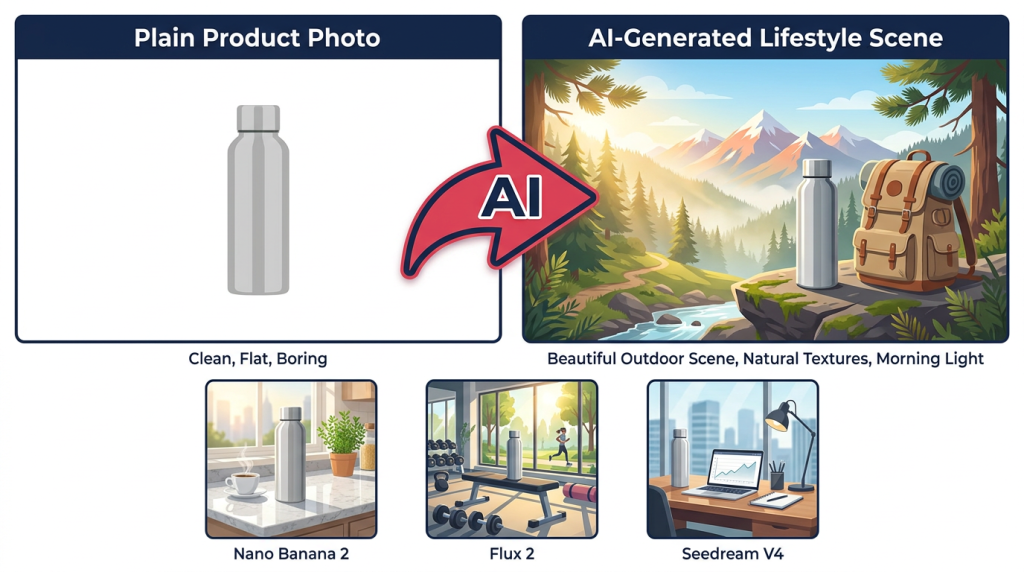
| Stage 1 Generate product photos without a studio Nano Banana 2 Flux 2 Seedream V4 Canva Pro Shutterstock |
Traditional product photography runs ₹1,500-₹12,500 per image depending on complexity. If you have a 500-SKU catalog, that is ₹7.5 lakh to ₹62.5 lakh just in photography. AI product photography brings that down to ₹8-₹166 per image, and the visual quality is good enough that it actually improves conversions by 30-40% compared to amateur photography. I was sceptical about this until I tested it myself on a client’s catalog.
Nano Banana 2 (GroupToolz exclusive) is where I start for AI product photography. Upload your product against a plain background and it generates lifestyle scenes, contextual settings, and styled compositions. The 14-image reference capability is the standout feature. You feed it multiple angles of your product and it keeps the product looking identical across dozens of generated scenes. That consistency matters when you are building a catalog.
Flux 2 handles the situation where you need the same product to look identical in 10 different lifestyle settings. Kitchen, office, outdoor, gym. Flux 2’s character consistency engine keeps your product recognisable while varying everything around it. When product fidelity across scenes is the priority, Flux 2 is what I reach for.
Seedream V4 is the detail tool. Realistic textures, accurate material rendering (glass reflections, metal sheens, fabric folds), and readable text on packaging labels. If you sell anything where the material quality is the selling point (leather goods, glassware, premium packaging), Seedream V4 produces images that honestly look like studio photography.
Canva Pro handles the design layer after generation. Add text overlays, comparison graphics, size reference images, and promotional banners around your AI product photos. Use Canva’s Brand Kit to keep colours, fonts, and logo placement consistent across your entire catalog.
Shutterstock fills the gap when you need real photography to complement AI-generated product shots. Composite your AI product into a Shutterstock lifestyle scene for the most natural-looking result.
| The 5 product photo types every listing needs Every e-commerce listing needs five image types. A clean white-background shot (marketplace compliance). A lifestyle scene (product in context). A size reference (product held in hand or next to a familiar object). A feature highlight (close-up on the key detail). And a comparison or bundle shot. AI tools ecommerce sellers can access on GroupToolz generate all five from a single product photo in under 30 minutes. |
Stage 2: AI product descriptions
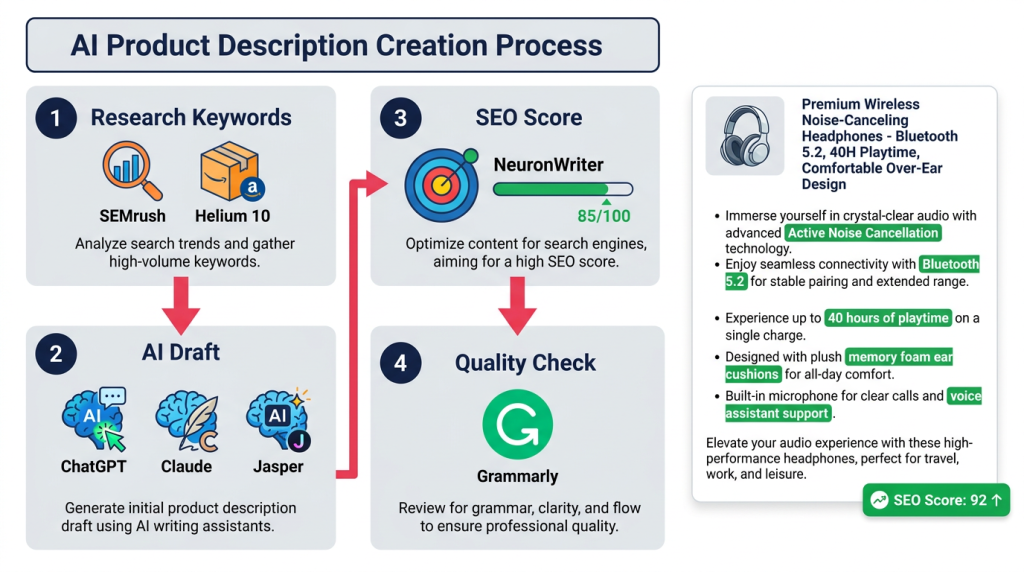
| Stage 2 Write descriptions that rank and convert ChatGPT Plus Claude AI Jasper AI NeuronWriter Grammarly |
The description workflow covered in our May 14 post applies here. Research keywords (SEMrush + Helium 10), AI draft (ChatGPT/Claude/Jasper), SEO scoring (NeuronWriter), quality check (Grammarly). What this section adds is scale.
Jasper AI is the batch production tool for large catalogs. Its Brand Voice feature learns your writing style and keeps it consistent across hundreds of descriptions. One documented case: 1,400 product descriptions regenerated in 3 weeks using Jasper, which produced a 34% increase in organic search impressions within 60 days. At 15-20 minutes per description including SEO scoring, that is roughly 350-470 hours of work. One content manager with AI tools ecommerce access did it in 3 weeks.
Claude AI is where I go for complex products. Electronics, health supplements, SaaS products, anything where the buyer needs to understand how the thing works before they will buy it. Feed Claude your product specs, target audience, and competitor descriptions (pulled from Frase.io analysis), and it writes descriptions that explain the product clearly while still pushing toward a purchase decision.
ChatGPT Plus handles volume. Quick descriptions for simple consumer products where the format stays the same: feature list, benefit statement, spec block, CTA. Use ChatGPT for the first draft, NeuronWriter for SEO scoring, Grammarly for the final pass.
Stage 3: Create ads that convert with an ai ad copy generator
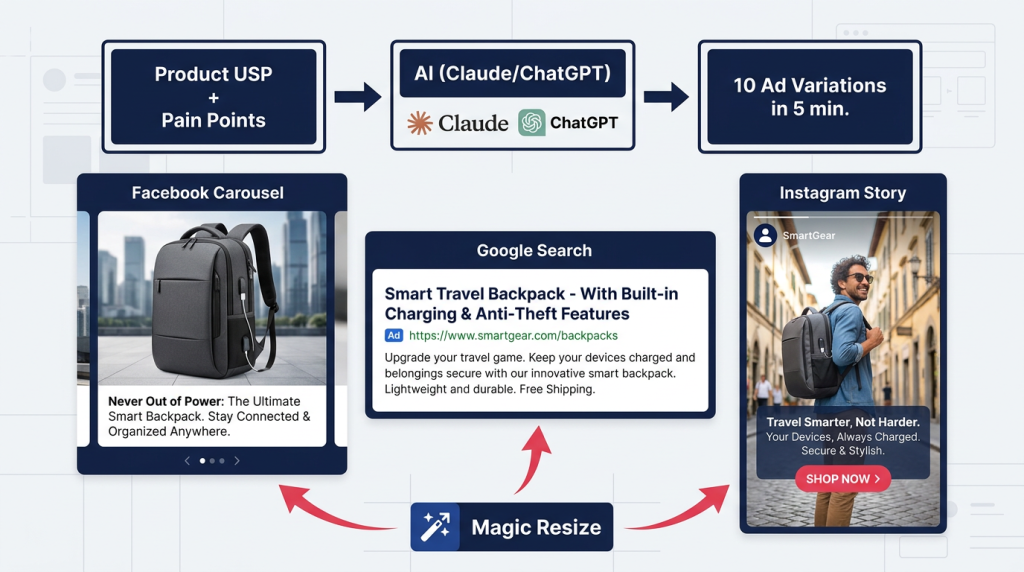
| Stage 3 Create ads that convert Claude AI ChatGPT Plus Canva Pro Envato Elements |
This is where AI gives you the fastest payback. A single Facebook or Google Ads campaign needs 5-10 ad copy variations for A/B testing. Writing 10 variations manually takes a copywriter 2-3 hours. An ai ad copy generator like ChatGPT Plus does 10 in about 5 minutes. Each with different hooks, different benefit angles, different CTAs.
Claude AI for high-stakes campaigns: When your ad budget is above ₹50,000/month, quality matters more than speed. I find Claude writes tighter, more persuasive ad copy than ChatGPT for complex products. Feed it your product USP, the specific pain points your audience has, and competitor ad copy (found through SpyFu’s ad intelligence). Claude writes variations that address specific objections rather than just listing generic benefits. That difference shows up in click-through rates.
Canva Pro for ad creatives: Design carousel ads, story ads, and banners using Canva Pro templates with your AI-generated product photos from Stage 1. Canva’s Magic Resize creates versions for every platform (Instagram 1080×1080, Facebook 1200×628, Google Display 300×250) from a single design. No manual resizing.
Envato Elements for templates: Download professional ad template packs from Envato, swap in your product photos and brand colours, export. The design quality of these templates is on par with what a ₹25,000/month graphic designer produces, because they were made by professional designers in the first place.
Stage 4: Keyword research and SEO
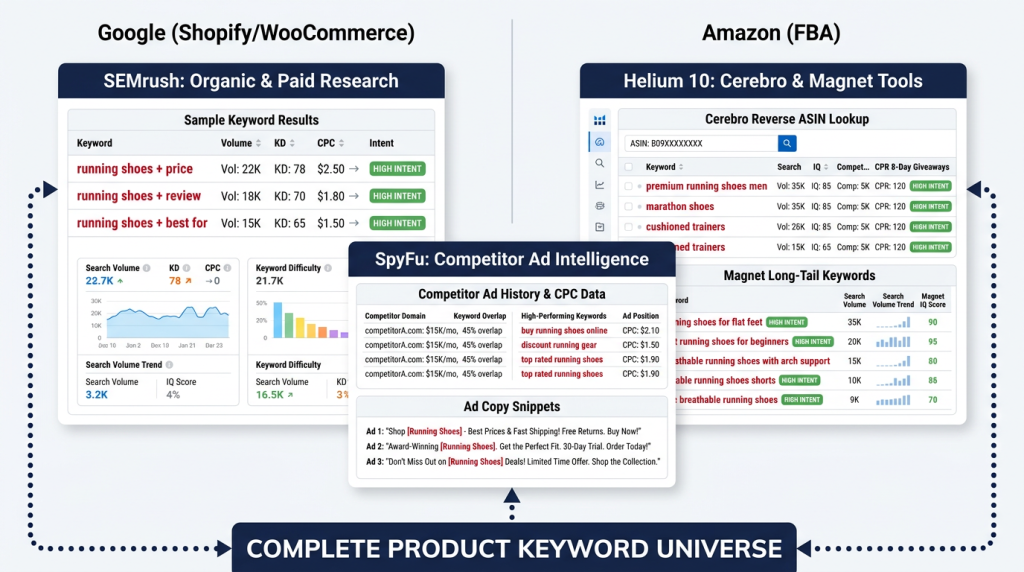
| Stage 4 Find what buyers actually search for SEMrush Helium 10 SpyFu Jungle Scout |
E-commerce keyword research happens across two separate ecosystems: Google (for Shopify, WooCommerce, and website SEO) and Amazon (for FBA sellers). These are different search engines with different keyword universes. You need tools for both.
SEMrush handles Google product keywords: search volume, keyword difficulty, competitor rankings, and SERP features (Product schema, Shopping ads, AI Overviews). I focus on transactional keywords with product modifiers, things like “[product] + price,” “[product] + review,” “[product] + vs [competitor],” “[product] + best for [use case].” These are the keywords where buying intent is high.
Helium 10 Cerebro + Magnet for Amazon keywords. Cerebro does reverse ASIN lookup, which shows every keyword a competitor product ranks for. Magnet finds long-tail keywords with buying intent that SEMrush will never show you because they exist inside Amazon’s internal search ecosystem, not Google’s. If you sell on Amazon and only use Google keyword tools, you are missing half the picture.
SpyFu for competitor ad intelligence. See what product keywords your competitors bid on in Google Ads, their estimated spend, and their ad copy variations. Any high-CPC keyword that competitors are paying for is a validated commercial-intent target for your organic product pages.
Stage 5: Store analytics and ai for Shopify sellers
| Stage 5 Track what is working SEMrush SimilarWeb Helium 10 Serpstat |
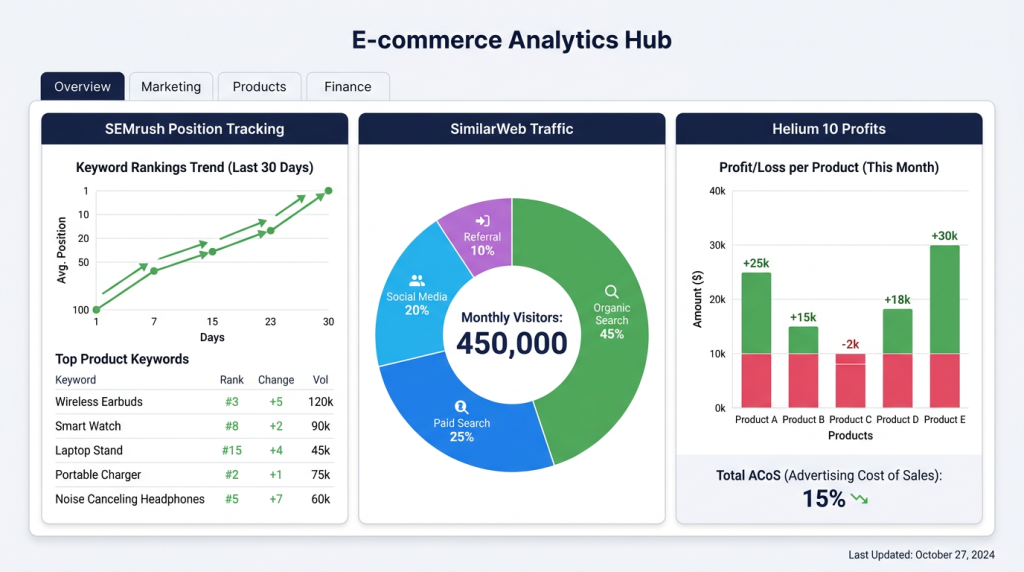
SEMrush Position Tracking monitors your product page rankings over time. Set up tracking for your top 50 product keywords and check weekly. When rankings drop, investigate: did a competitor launch a better page? Are your product reviews declining? Is there a technical SEO issue crawling broke?
SimilarWeb tracks overall store traffic, referral sources, and competitor traffic. For Shopify sellers specifically, SimilarWeb shows which marketing channels (organic, paid, social, referral) drive the most revenue. For competitive intelligence, you can see where competitors get their traffic and go after the same sources. This is one of the ai for Shopify sellers features I use most.
Helium 10 Profits + Keyword Tracker is the Amazon seller command center. Monitor profit margins per product, daily sales, keyword ranking positions, and ACoS (Advertising Cost of Sales) in one dashboard. When organic rank drops on a product, Helium 10 flags it right away so you can adjust PPC bids, update listings, or push for more reviews before the sales decline gets worse.
Stage 6: Review management
| Stage 6 Turn reviews into product intelligence Helium 10 ChatGPT Plus |
Helium 10 Review Insights uses AI to analyse hundreds of competitor reviews by sentiment and topic. It tells you what customers love about competing products (so you can mention those things in your own listings) and what they complain about (so you can highlight how your product solves those problems). I think this is one of the most overlooked features in the Amazon seller toolkit. Competitor reviews are free market research. This tool just organises it for you.
ChatGPT Plus for review responses: Generate personalised templates for positive reviews (thank the customer, encourage repeat purchase), negative reviews (acknowledge the issue, offer a fix), and question-style reviews (answer the question publicly so future buyers see it). Consistent review responses improve customer retention and send positive signals to the ranking algorithm. It is also just good customer service.ai product photography
The ROI calculation
| Task | Manual time | AI time | Time saved per product | At 100 products/month |
|---|---|---|---|---|
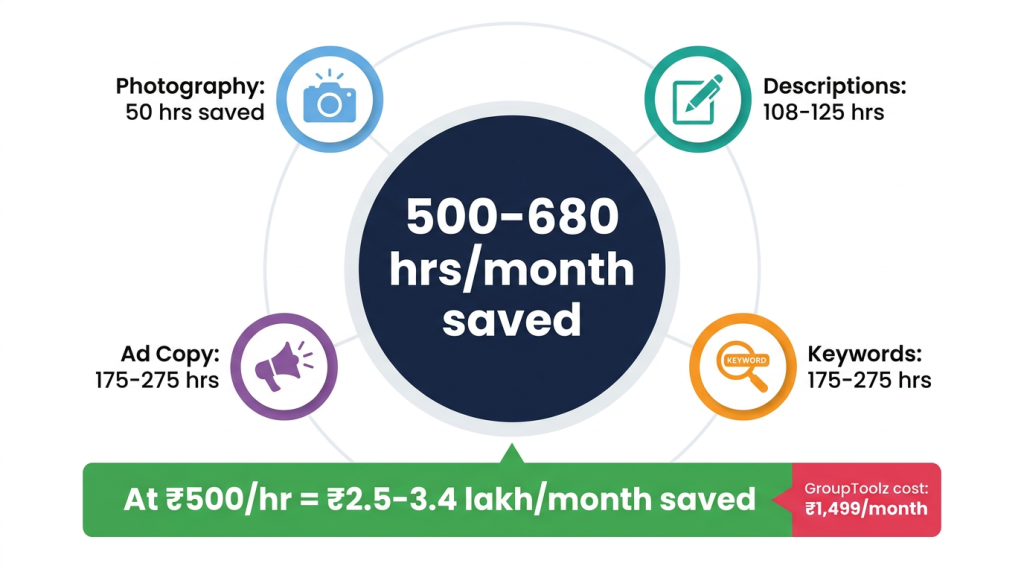
| Product photography (5 images) | 3-14 days (outsourced) | 30 min | ~99% | 50 hours saved |
| Product description (SEO-optimised) | 45-90 min | 15-20 min | 65-75 min | 108-125 hours saved |
| Ad copy (5 variations) | 2-3 hours | 15 min | 105-165 min | 175-275 hours saved |
| Keyword research | 2-3 hours | 15 min | 105-165 min | 175-275 hours saved |
| Performance review | 1-2 hours/week | 15 min/week | 45-105 min/week | ~6 hours/month saved |
| Total monthly (100 products) | 500-680 hours saved |
At a freelancer rate of ₹500/hour, 500-680 saved hours per month is ₹2.5-₹3.4 lakh in labour cost savings. At agency rates of ₹1,500/hour, that exceeds ₹7.5 lakh/month. The GroupToolz AI Power plan costs ₹1,499/month. I will let you do the math on that ROI yourself. And that is before counting the conversion rate improvements from better product images and the organic traffic bump from optimised descriptions.ai ad copy generator
AI tools ecommerce 2026: the full toolkit on GroupToolz
| Tool | E-commerce role | Plan | Retail/month |
|---|---|---|---|
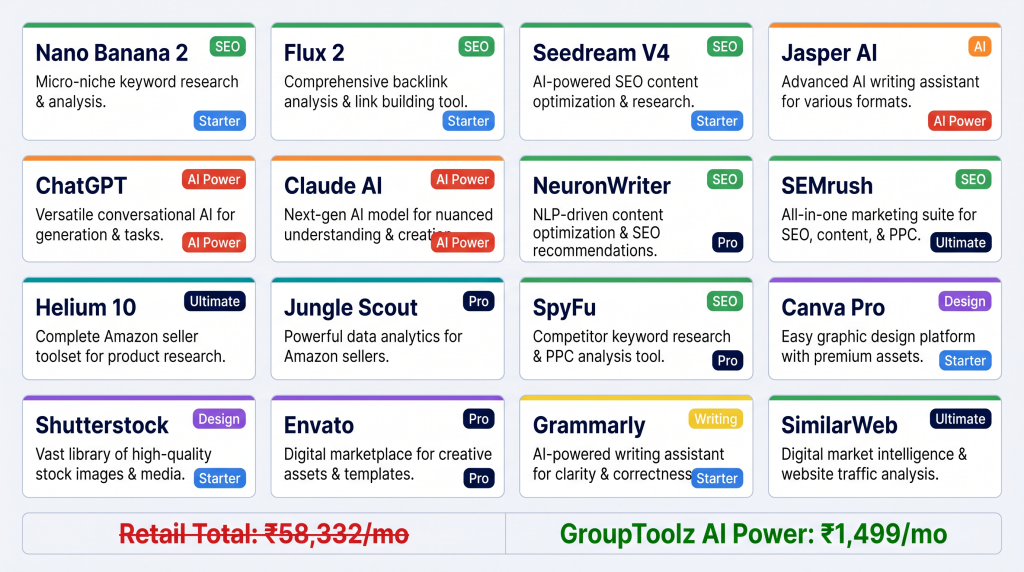
| Nano Banana 2 | AI product photography (14 reference images, lifestyle scenes) | AI Power ₹1,499 | Exclusive |
| Flux 2 | Product consistency across scenes, editing workflows | AI Power ₹1,499 | ₹1,665-₹4,165 |
| Seedream V4 | Realistic materials, textures, packaging text rendering | AI Power ₹1,499 | API-based |
| Jasper AI | Batch product descriptions, Brand Voice, ad copy at scale | Pro ₹449 | ₹4,082 |
| ChatGPT Plus | Quick descriptions, ad variations, review responses | Pro ₹449 | ₹1,665 |
| Claude AI | Complex product copy, high-stakes ad copy | Pro ₹449 | ₹1,665 |
| NeuronWriter | SEO scoring for product descriptions | Pro ₹449 | ₹1,582 |
| SEMrush | Google product keywords, competitor analysis, position tracking | Pro ₹449 | ₹11,650 |
| Helium 10 | Amazon keywords, listing optimisation, review insights, profits | Ultimate ₹699 | ₹8,244 |
| Jungle Scout | Product research, supplier sourcing, sales tracking | Ultimate ₹699 | ₹5,747 |
| SpyFu | Competitor ad intelligence, high-CPC keyword discovery | Pro ₹449 | ₹6,498 |
| Canva Pro | Ad creatives, product graphics, brand consistency | Starter ₹199 | ₹1,249 |
| Shutterstock | Professional lifestyle photography, editorial images | Ultimate ₹699 | ₹4,082 |
| Envato Elements | Ad templates, presentation designs, stock assets | Starter ₹199 | ₹1,374 |
| Grammarly | Description quality control, grammar, readability | Starter ₹199 | ₹999 |
| SimilarWeb | Store traffic analysis, competitor traffic sources | Pro ₹449 | ₹1,665 |
| Retail total (16 tools) | ₹58,332+/mo | ||
| GroupToolz AI Power | All 16 + 134 more | ₹1,499/mo |
| The ecommerce AI math 16 ecommerce AI tools cost ₹58,332/month at retail. GroupToolz AI Power includes all 16 plus 134 more for ₹1,499/month. But the tool cost savings are not even the main story. The real number is the 500-680 hours of production time saved monthly across a 100-product operation. At ₹500/hour, that is ₹2.5-₹3.4 lakh/month in efficiency gains. The ₹1,499 subscription pays for itself before lunchtime on the first day of the month. |
Run your store on AI tools
Nano Banana 2 + Flux 2 + Jasper + ChatGPT + Claude + SEMrush + Helium 10 + Canva Pro + 142 more. Everything for ecommerce AI automation. ₹1,499/month.
Frequently asked questions
Can AI product photos replace professional photography?
For most ecommerce use cases, yes. AI-generated product images cut costs by 80-95% per image and produce quality that improves conversion rates by 30-40% compared to amateur photography. For ultra-premium brands (luxury goods, high-end fashion), AI works well as a starting point with professional refinement for hero images. For standard ecommerce catalogs, AI images are production-ready.
Which GroupToolz tools are best for Shopify sellers?
Nano Banana 2 and Flux 2 for product image generation, ChatGPT/Jasper for descriptions, NeuronWriter for SEO scoring, SEMrush for Google keyword research, Canva Pro for ad creatives, and SimilarWeb for traffic analytics. The Pro plan at ₹449/month covers descriptions and SEO. The AI Power plan at ₹1,499/month adds AI product photography tools. These are the core ai for Shopify sellers features on the platform.
Which tools are best for Amazon FBA sellers?
Helium 10 for Amazon keyword research (Cerebro/Magnet), listing optimisation (Scribbles), and review management (Review Insights). Jungle Scout for product research and supplier sourcing. ChatGPT/Claude for listing copy. Nano Banana 2 for A+ Content product imagery. All on GroupToolz Ultimate (₹699) or AI Power (₹1,499).
How much time does AI save per product listing?
Photography: from 3-14 days to 30 minutes. Descriptions: from 45-90 minutes to 15-20 minutes. Ad copy: from 2-3 hours to 15 minutes. Keywords: from 2-3 hours to 15 minutes. Total per product: from 8-20 hours of combined work to about 75-90 minutes. At 100 products/month, that saves 500-680 hours through ecommerce AI automation.
Is AI-generated product photography allowed on Amazon and Shopify?
Both platforms allow AI-generated images that accurately represent the product. Amazon requires a pure white background for the main image with the actual product visible. AI background removal handles that. Secondary images (lifestyle shots) can be fully AI-generated. Shopify has no restrictions on how you make your images. The rule on both platforms: the product in the image must match what the customer receives.
What is the ROI of using AI tools for ecommerce?
At 100 products/month: 500-680 hours saved in production time. At a ₹500/hour freelancer rate, that is ₹2.5-₹3.4 lakh/month in labour cost savings. Plus 30-40% conversion rate improvements from better imagery and 34% more organic impressions from optimised descriptions. GroupToolz AI Power at ₹1,499/month covers all the ai tools ecommerce sellers need to hit those numbers.
Related GroupToolz e-commerce guides
Want more AI e-commerce guides and product optimization strategies? Find more at GroupToolz
Comments