
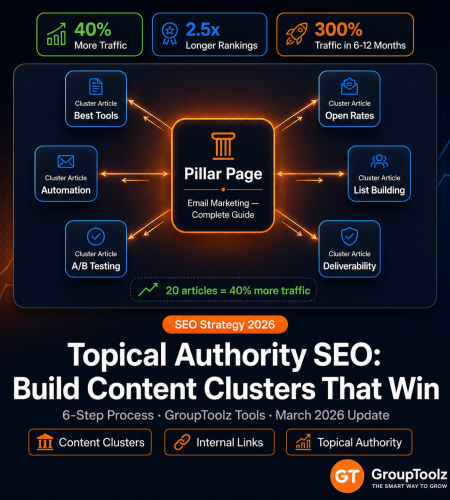
Topical authority SEO 2026 is the strategy that consistently outperforms isolated keyword targeting — this 6-step guide shows exactly how to build content clusters using GroupToolz tools.
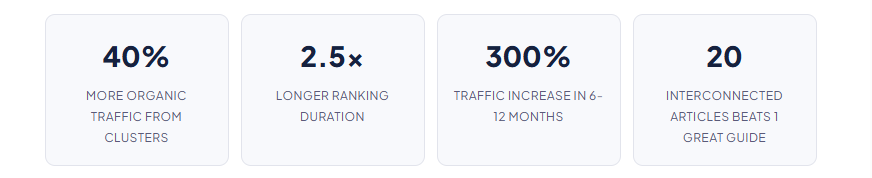
A site with 20 interconnected articles on email marketing consistently outranks a site with one 5,000-word guide. Even when that single article is technically better. Google’s March 2026 Core Update made this official. Here’s the 6-step content clusters seo process for building topical authority using GroupToolz tools.
By GroupToolz Team Updated: June 7, 2026
Why topical authority replaced keyword SEO in 2026
Until around 2022, SEO was keyword-by-keyword. Find a keyword, write a post targeting it, get some links, rank. The system rewarded individual pages. That worked. Then the 2022-2024 Helpful Content updates started shifting things. And Google’s March 2026 Core Update finished the job.
The question Google now asks about every site isn’t “does this page target the right keyword?” It’s “does this domain actually understand this topic?” That’s a different question. One that a single well-optimised article can’t answer. Only a build authority site approach with deep, interconnected coverage can.
The mechanism is the internal link graph. Google evaluates topical depth (how broadly you cover a subject), E-E-A-T signals (real expertise), and how coherently your internal links connect it all. A content cluster satisfies all of that in a way isolated articles can’t. When 20 of your articles on email marketing link to each other and back to a central pillar, Google sees a site that’s invested in this topic over time. Not a site that wrote one good post and moved on.
There’s also the AI search angle. When ChatGPT, Perplexity, or Google AI Overviews pick a source to cite, they lean toward domains with deep, interconnected topic coverage. A site with one good article is less likely to get cited than one with a full content map on the subject. The pillar content strategy that wins Google rankings is the same one that wins AI citations. You’re building for both at once.
| The compounding effect nobody talks about enough Topical authority compounds in a way keyword SEO doesn’t. Rank for one keyword, you rank for that keyword. Build a content cluster, and ranking for one article pulls the others up with it. Authority flows through internal links from strong cluster pages to weaker ones. The pillar page gets authority from every article simultaneously. Each new article you add benefits from what the cluster already built. I’ve seen new sites with tight topical focus outrank established domains with much higher DA on related searches. Depth beats breadth. Every time. |
The anatomy of a content cluster
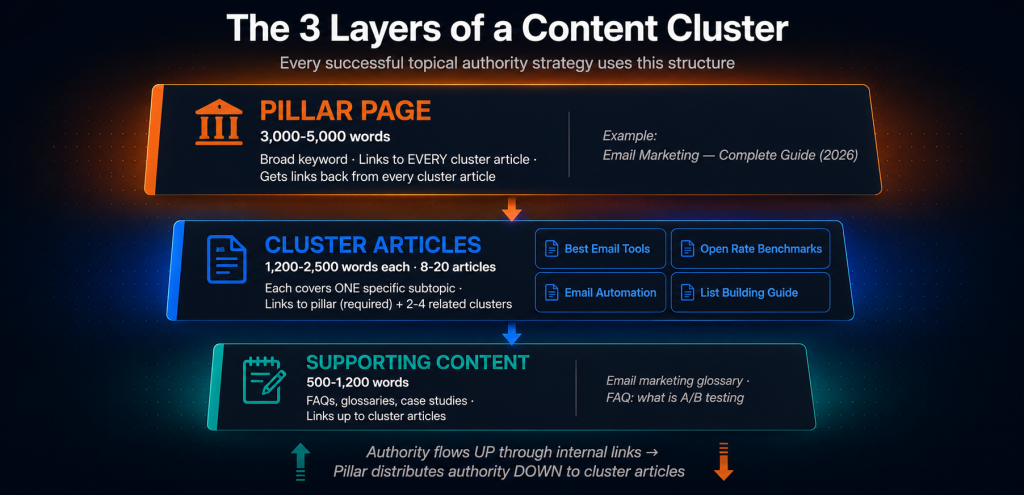
Every content cluster seo structure has three layers. They’re not complicated once you see them clearly.
| Layer | What it is | Length | Internal linking |
|---|---|---|---|
| Pillar page | High-level overview of the whole topic. Targets the broadest keyword. Links to every cluster article. | 3,000-5,000 words | Links to every cluster article. Gets links back from every cluster article. |
| Cluster articles | Deep dive on one specific subtopic. Answers a specific question or targets a sub-keyword. Links back to pillar and to related cluster articles. | 1,200-2,500 words | Links to pillar (required). Links to 2-4 related cluster articles. Gets links from pillar and related clusters. |
| Supporting content | FAQs, glossaries, case studies, tools. Addresses very specific queries. Links up to relevant cluster articles. | 500-1,200 words | Links to relevant cluster articles. Gets links from cluster articles where relevant. |
That three-layer content clusters seo structure is what makes the difference between a disconnected content library and a real topical authority signal.
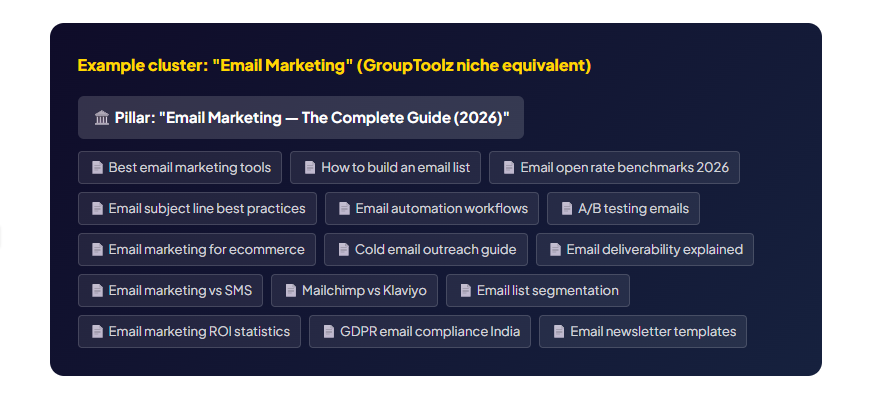
One pillar page, 15 cluster articles. Each cluster article covers one angle, links back to the pillar, and links to 2-4 related cluster articles. Google crawls this structure and sees a site that’s answered every significant question about email marketing. The pillar ranks for the broad keyword. Every cluster article ranks for its specific sub-topic. The site owns the topic instead of a single page on it. That’s the difference between a content map approach and the old way.
The 6-step content cluster process using GroupToolz
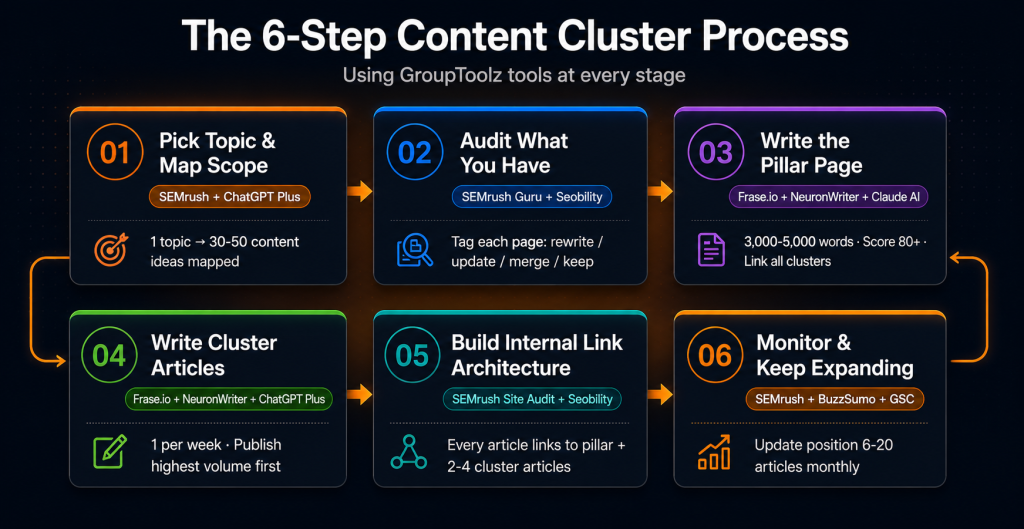
| Step 1 of 6 Pick your cluster topic and figure out the scope Semrush (Guru) ChatGPT Plus Start with one topic. Not five. The biggest mistake I see with topical authority seo 2026 strategies is building shallow content across too many topics at once. Google can’t figure out what you’re an authority on. Pick a topic you genuinely know, that has enough subtopics to support 10-20 articles, and where competitors haven’t fully covered the cluster space yet. In Semrush Keyword Magic Tool, enter your topic and filter for search volume above 100 and keyword difficulty below 60. Sort by volume. You’re looking for: one broad parent keyword (your pillar), medium-difficulty keywords with clear subtopic angles (your cluster articles), and long-tail question keywords (your supporting content). Export the full list sorted by topic cluster. Then jump into ChatGPT Plus. “List every significant subtopic, question, and angle within [your topic]. Group by: high-level overview subtopics, specific how-to questions, comparisons and alternatives, and educational terms. Aim for 30-50 distinct content ideas that would together give a reader complete coverage of this topic.” Merge the Semrush keyword list with the ChatGPT output. Remove duplicates. Group related items. Now you have a topical map. That’s your complete blueprint for the cluster. |
| Step 2 of 6 Audit what you already have before creating anything new Semrush (Guru) Seobility A lot of sites I look at already have relevant content that nobody’s connected into a cluster. Before writing anything new, check what you’ve got. In Semrush Content Audit (Guru exclusive), connect Google Analytics and Search Console. Semrush crawls your site and scores every page: organic traffic, backlinks, social shares, word count, time on page. Flag each page as: “rewrite” (thin, low performance), “update” (good topic, needs expansion into cluster format), “merge” (two thin pages on similar topics that should become one), or “keep” (already working, just add to cluster structure). Some sites find they already have half a cluster and just never connected the dots. In Seobility, run a full crawl to find duplicate content (keyword cannibalization risk), thin pages under 300 words, and orphaned pages with no internal links. Orphaned pages are invisible to Google regardless of how good the content is. Every orphaned page on your cluster topic gets connected in Step 5. |
| Step 3 of 6 Research and write the pillar page Frase.io NeuronWriter Claude AI The pillar page is the most important thing you’ll write for this cluster. It covers the whole topic at a high level and links to every cluster article. Minimum 3,000-5,000 words. Don’t shortcut this one. In Frase.io, enter the broad pillar keyword. Frase analyses the top 10-20 ranking pages and builds a topic coverage map: every heading, every subtopic, every question those pages answer. That’s your content checklist. Your pillar has to cover everything the current top results cover, plus any gaps they miss. That last part is where you can actually win. In NeuronWriter, score your draft against the target keyword. Target 80+. NeuronWriter shows missing semantic terms and entities that top-ranking pages use. Adding those closes the content gap. Don’t publish below 80 on a pillar page. It’s not worth the wasted time on everything else in the cluster. For the actual writing, use Claude AI for pillar-length documents. It maintains better internal logic across 4,000+ words than ChatGPT. Prompt by section: “Write the [section] of a pillar page about [topic]. Cover [subtopics from Frase map]. Target audience: [audience]. 400-600 words. Include specific data and real examples.” Write section by section, assemble at the end. One structural requirement that people skip: every planned cluster article needs to be mentioned and linked from the pillar page. If you have 15 cluster articles planned, your pillar has 15 internal links. Write placeholder anchor text for articles you haven’t published yet. Add the live links as they go live. |
| Step 4 of 6 Write the cluster articles, but don’t rush them Frase.io NeuronWriter ChatGPT Plus Semrush Cluster articles are narrower than pillar pages. Each one goes deep on one specific subtopic. The goal isn’t to repeat pillar content; it’s to answer one specific question better than anyone else has. For each cluster article, your brief should include: target keyword from the topical map, search intent (informational/commercial/navigational), Frase.io topic coverage from current top results, NeuronWriter target score (80+), required internal links (pillar + 2-3 related cluster articles), and word count (1,200-2,500 words for most). Keep briefs consistent. It makes the process repeatable. Publishing sequence matters more than people realise. Publish the pillar page first, even if most cluster articles are just placeholder stubs. Then publish cluster articles in order of search volume, highest first. Update the pillar with each new link as articles go live. This way Google sees a growing, coherent build authority site pattern. Not a pile of disconnected articles that appeared in random order over 6 months. Realistic velocity: one cluster article per week. A 15-article cluster takes 15 weeks at that pace. Don’t rush it to publish low-quality articles faster. One weak article in a cluster can drag neighbouring articles’ rankings. I’ve seen this happen and it’s painful to fix. Quality matters more than speed here. |
| Step 5 of 6 Build the internal link architecture deliberately Semrush Seobility Internal linking is what turns a bunch of articles into an actual cluster. Without it, you just have articles. With it, you have a topical authority signal Google’s crawlers can actually read and reward. The rules are simple. Every cluster article links to the pillar page. Every cluster article links to 2-4 related cluster articles. The pillar links to every cluster article. Anchor text uses natural variations of the target keyword, not exact-match every time. Supporting content links up to relevant cluster articles. That’s it. The complication comes from actually tracking it as the cluster grows. In Semrush Site Audit, go to Internal Linking and view the link graph. Find cluster pages with few incoming internal links — those are underlinked and losing authority they should be receiving. Find pages with lots of incoming links — those are your strongest cluster pages, and they should be linking to weaker articles to pass some authority down. In Seobility, check for orphaned pages every month. Zero internal links pointing to a page means Google effectively can’t find it, regardless of how good the content is. Every new cluster article gets linked from at least the pillar and one related cluster article before it can contribute anything to topical authority seo 2026 goals. |
| Step 6 of 6 Monitor, update, and keep expanding Semrush BuzzSumo GSC Topical authority builds over months. It’s not a one-time project. The cluster needs ongoing attention to keep compounding. Monthly review: check keyword rankings for every cluster article in Semrush Position Tracking. Articles ranked positions 6-20 are the lowest-hanging fruit for updates. Check whether competitors have published new articles on your cluster subtopics. If they have and it’s better than yours, update yours. This is the part of the pillar content strategy that most people skip after the initial build, which is exactly why it’s the most leveraged activity once you’re past Month 3. In BuzzSumo, watch for new questions about your cluster topic showing up on Reddit, Quora, and forums. New questions not covered by your current cluster articles are content opportunities. Adding articles for emerging questions demonstrates ongoing topical investment to Google. Every new article added to a mature cluster typically improves rankings for existing articles within 4-8 weeks. In Google Search Console, filter the Performance report by your pillar and cluster keywords. Look for queries generating impressions but zero clicks. Those are adjacent topics your cluster should cover. Build authority site momentum by treating these as your next content priorities. |
What actually kills topical authority (and how to fix it)
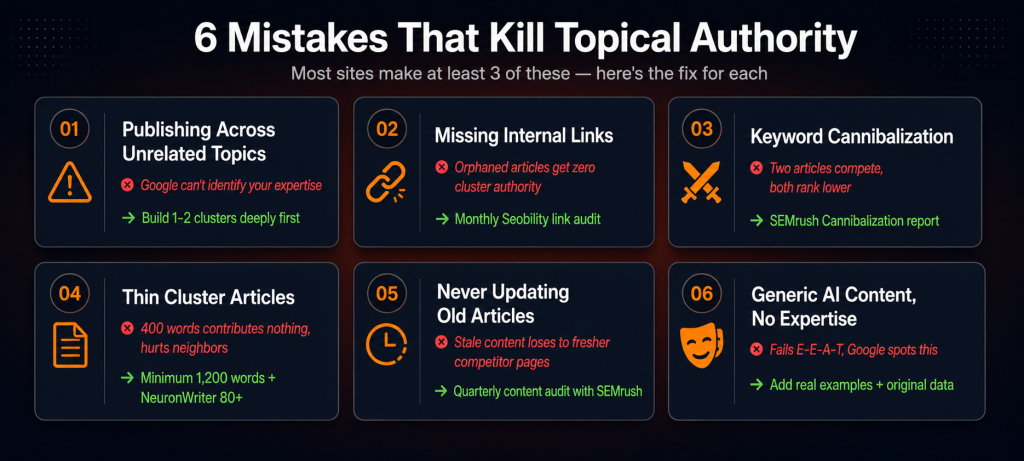
| Mistake | Why it kills authority | Fix |
|---|---|---|
| Publishing across unrelated topics | Dilutes the topical signal. Google can’t work out what your site is an expert in. | Pick 1-2 clusters and build them deeply before starting a third |
| Missing internal links | Orphaned cluster articles get no authority from the cluster structure | Monthly internal link audit in Seobility. Every cluster article needs incoming links. |
| Keyword cannibalization within the cluster | Two cluster articles targeting the same keyword compete against each other and split authority | Semrush Keyword Cannibalization report. Merge or differentiate any overlapping articles. |
| Thin cluster articles | A 400-word cluster article contributes nothing. It’s actually worse than not publishing it. | Minimum 1,200 words per cluster article, 80+ NeuronWriter score before publishing |
| Never updating old cluster articles | Stale content loses rankings as competitors publish fresher pieces | Quarterly content audit. Update any article with declining traffic or outdated info. |
| Building clusters on topics you don’t know | Generic AI content without real expertise fails E-E-A-T. Google’s gotten good at spotting this. | Add author credentials, first-hand examples, and original data to all cluster articles |
Topical authority and AI visibility: you’re building for both
Every cluster you build pulls double duty in 2026. Traditional Google rankings and AI search visibility. Same work, two payoffs.
When ChatGPT, Perplexity, or Google AI Overviews select a source on your cluster topic, their systems look for domains with deep, interconnected coverage. A domain with 15 articles on a topic, a strong pillar page, consistent internal linking, and solid E-E-A-T signals is exactly what those systems want to cite. The same structural work that makes Google rank you makes AI engines cite you. I genuinely find this one of the most exciting things about the current SEO landscape — the effort overlaps almost completely. The build authority site approach doesn’t just rank content — it makes your brand the go-to source across an entire topic.
Clusters also make your brand more recognisable within a topic domain over time. When multiple articles across your cluster show up in the same topic searches, your brand gets associated with that subject. AI systems that keep encountering your brand in the context of a specific topic build a stronger “entity salience” association. Future citations become more likely. The topical map you’re building now has compounding effects that go well beyond the articles you’re writing today.
The topical authority toolkit on GroupToolz
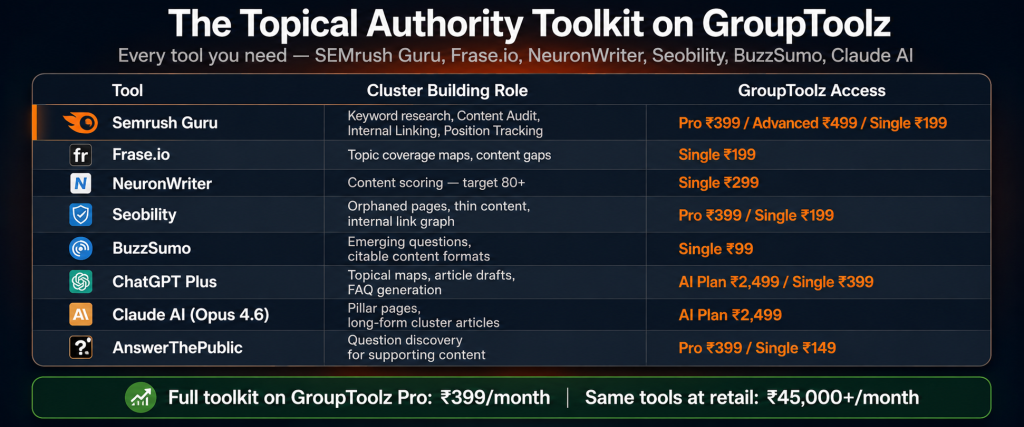
| Tool | Cluster building role | GroupToolz access |
|---|---|---|
| Semrush (Guru) | Topical keyword research, Content Audit, Internal Linking analysis, Position Tracking, Cannibalization report | Pro ₹399 / Advanced ₹499 / Single ₹199 |
| Frase.io | Topic coverage maps from current top results, content gap analysis for pillar and cluster articles | Single ₹199 |
| NeuronWriter | Content scoring (80+ target), semantic optimisation, entity coverage | Single ₹299 |
| Seobility | Crawl for orphaned pages, thin content, duplicate content, internal link graph | Pro ₹399 / Single ₹199 |
| BuzzSumo | Monitor emerging questions, find content gaps, identify citable formats | Single ₹99 |
| ChatGPT Plus | Topical map generation, cluster article drafts, FAQ generation for supporting content | AI Plan ₹2,499 / Single ₹399 |
| Claude AI (Opus 4.6) | Pillar page writing, long-form cluster articles that hold together structurally | AI Plan ₹2,499 |
| AnswerThePublic | Question-based content discovery for supporting content layer | Pro ₹399 / Single ₹149 |
| The honest summary Building one complete cluster (1 pillar + 15 articles) takes 3-4 months at a sustainable pace. The return is 40% more organic traffic, 2.5x longer ranking duration, and AI search visibility across the whole topic. When you add article 16 to a mature cluster, it benefits from the authority the first 15 built. When you start a second cluster, it benefits from the domain authority the first cluster established. It’s the only content strategy I know that keeps compounding after you stop actively working on it. GroupToolz Pro at ₹399/month gets you the full toolkit: Semrush Guru, Seobility, AnswerThePublic, Grammarly, ChatGPT Plus. For less than what Semrush alone costs at retail per month. |
Frequently asked questions
What is topical authority in SEO?
Topical authority seo 2026 means your website is recognised by search engines as a trusted expert on a specific subject. Instead of ranking a single page for a keyword, Google evaluates whether your whole site covers one topic in depth with clear internal structure. 20 interconnected articles on a topic consistently outrank one excellent article on that topic, even when the single article is technically better in isolation.
What is a content cluster?
A content cluster is a group of interconnected articles that together cover one topic well. Three layers: pillar page (3,000-5,000 words, overview of the whole topic, links to all cluster articles), cluster articles (1,200-2,500 words each, deep on one subtopic, link back to pillar), and supporting content (FAQs, glossaries, case studies). All linked together through a deliberate internal linking architecture. That structure is what makes it a cluster rather than just a collection of articles on similar topics.
How many articles does a content cluster need?
Minimum viable cluster: 1 pillar page + 8-10 cluster articles. A strong cluster: 1 pillar + 15-20 cluster articles + some supporting content. Highly competitive topics: 25-30+ articles. There’s no strict maximum. The question is whether each new article covers a genuinely distinct subtopic with real search volume. The content map you build in Step 1 tells you where the ceiling is.
How long does it take to build topical authority?
Initial results typically show within 3-6 months of completing a cluster. Sites switching from keyword-focused content to a build authority site approach report 50-300% traffic increases within 6-12 months. The timeline depends on competition in your niche, how fast you publish, your existing domain authority, and content quality. New sites with focused clusters regularly outrank high-DA established sites on related terms. That’s the part that still surprises people.
Which GroupToolz tools help build topical authority?
Semrush Guru for topical keyword research, Content Audit, and Internal Linking analysis (Pro ₹399 or single ₹199). Frase.io for topic coverage maps (single ₹199). NeuronWriter for content scoring (single ₹299). Seobility for orphaned page detection (Pro ₹399 or single ₹199). BuzzSumo for emerging question discovery (single ₹99). ChatGPT Plus and Claude AI for content creation (AI Plan ₹2,499 or ChatGPT single ₹399). The pillar content strategy comes together with these tools working in sequence across the 6 steps above.
Does topical authority help with AI search visibility?
Yes. When AI systems pick sources to cite, they prefer domains with deep, interconnected coverage on a topic. A cluster-based site scores higher on entity salience and topical depth. The same structural work that gets you ranked on Google makes AI engines more likely to cite you. It’s one of the better cases where what’s good for traditional SEO is also exactly what’s good for AI visibility. Build the content clusters seo foundation right, and it works in both directions.
Comments