
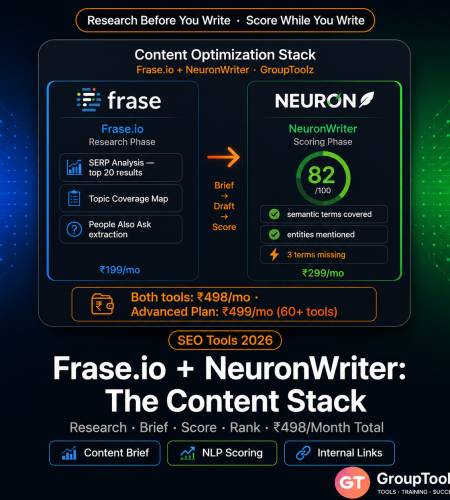
This frase io vs neuronwriter guide covers what each tool does, where they overlap, where they don’t, and the exact 5-step workflow for using them together as a complete content optimization stack.
Good content that Google ignores is a waste of time. This frase io vs neuronwriter guide breaks down what each tool actually does, where one falls short without the other, and the exact workflow for using them together. Both are available on GroupToolz. Together they’re under ₹500/month.
By GroupToolz Team Updated: June 17, 2026

Why you need both and not just one
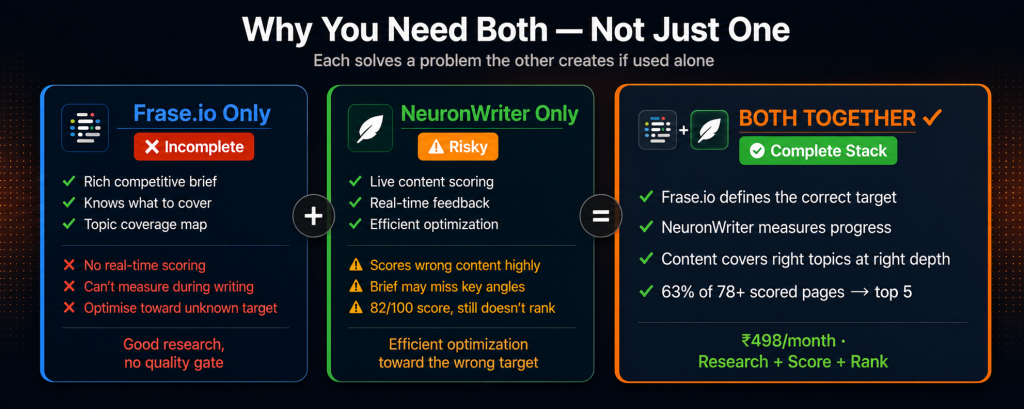
The question I hear most about this frase io vs neuronwriter combination is whether you actually need both or whether one covers enough. The honest answer: it depends on where you lose content performance. These two tools solve adjacent problems that get worse when only one is addressed.
Frase.io alone: You know what to cover but can’t measure how well you covered it. Great research brief. Solid competitive analysis. No real-time feedback while writing. After publishing, you can’t quickly tell whether your content is semantically competitive with what’s currently ranking.
NeuronWriter alone: You get a live score while writing, but the score reflects what you wrote, not what you should have written. If your original content brief missed key topics, NeuronWriter will score the wrong content highly. You optimise efficiently toward the wrong target. I’ve seen this produce articles that score 82 in NeuronWriter and still don’t rank — because the frase io review of the SERP would have shown the brief missed an entire angle the top results covered.
Both together: Frase.io defines the correct target. NeuronWriter measures your progress toward it in real time. Content that covers the right topics at the right depth. That’s it. That’s what both content optimization tools are trying to help you build.
| The 78-point benchmark that actually matters Pages scoring 78+ in NeuronWriter rank in the top 5 for their target keyword in 63% of cases (NeuronWriter’s own published data). Pages below 60 rarely make page 1 regardless of backlink profile. That threshold is your production quality gate: don’t publish below 75, aim for 80+. Frase.io defines what content earns that score. NeuronWriter measures whether you hit it. |
Frase.io: what it actually does and how to use it
Frase.io’s core job is competitive content research. Enter a keyword and it analyses the current top 20 ranking pages, pulling out the headings they use, the topics they cover, the questions they answer, the word counts at each section level, and the entities that appear frequently across all results. Then it shows you all of that in one place before you write anything.
The content brief workflow
The brief builder is where Frase.io earns its money. After entering your keyword:
Step 1 — Check the SERP overview: Frase shows every top-ranking page’s outline, word count, and domain authority. You see immediately whether long content (3,000+ words) or shorter focused content (800-1,200 words) dominates the results. This tells you the format Google has validated for this query before you write a word. I find this step alone saves an embarrassing amount of time I used to spend guessing.
Step 2 — Build the topic map: The Topic Coverage tab shows which topics appear across multiple top-ranking pages. Topics in 7 or more of the top 10 results are non-negotiable — your page has to cover them. Topics in 3-5 results are worth including. Topics unique to only 1-2 pages are optional differentiators. This is the frase io review functionality I’d miss most going back to manual research.
Step 3 — Extract the questions: Frase pulls every “People Also Ask” question, Reddit thread question, and FAQ section from the top results. These become your article’s FAQ section and H2 headings. Answering questions Google already shows for this keyword is the fastest way to improve topical coverage. Don’t skip this step.
Step 4 — Generate the brief: Frase generates a structured brief with recommended H2s, H3s, questions to answer, entities to mention, and target word count. Export it as your writing guide. Content that follows this brief covers the same topical territory as the current top results — which is the baseline for ranking competitiveness.
Frase.io AI writing
Frase includes an AI writing assistant that drafts content within its editor. It uses the research data it pulled to inform the draft — incorporating relevant topics and entities automatically. For GroupToolz subscribers, this can supplement a ChatGPT Plus or Claude draft with Frase’s research-grounded output as a reference. Honestly I don’t use the Frase AI writer as my primary drafting tool, but as a comparison against the AI-generated draft it’s useful for catching topic gaps the main draft missed.
NeuronWriter: what it does and how to use it
NeuronWriter scores content. That’s its main job. Enter a keyword, paste your content, and it gives you a 0-100 score reflecting how semantically comprehensive your content is compared to the current top-ranking pages. Higher score means better coverage of the semantic entities and NLP terms that top-ranking pages use.
What the score actually means
The score comes from comparing your content against top-ranking pages for the keyword using Natural Language Processing. NeuronWriter identifies the semantic terms, entities, and concept combinations that appear across top results, then measures how many your content includes and how well it uses them.
A score of 80 doesn’t mean your content is “80% complete.” It means your content covers roughly the same semantic territory as the current top 5-10 results. Scores above 85 are typically strong enough to compete on semantic grounds. Scores below 65 suggest missing major topical areas. And one thing worth knowing: you can score 90 in NeuronWriter and still struggle to rank if your page has no backlinks or is on a brand-new domain. seo content scoring tells you about content quality, not about domain authority or link equity. It’s one important factor, not the whole picture.
Real-time scoring while writing
The most useful thing about NeuronWriter is the live feedback. Open a new article with your target keyword. The right sidebar shows your current score, a list of recommended terms sorted by importance, and which terms are already in your content (green) versus still missing (red). Write a paragraph that naturally includes a missing term cluster. Score goes up. Remove content. Score drops. You always know whether your additions are moving in the right direction. Writers I know describe it as “writing with a compass.” That’s exactly right.
Semantic term recommendations
The term recommendations aren’t just keywords — they’re semantically related concepts, named entities, and topic areas from top results. For “content marketing strategy,” NeuronWriter might suggest terms like “buyer personas,” “content calendar,” “distribution channels,” “conversion funnel,” and “marketing automation.” These are the concepts that top content in this space consistently covers. They define the topical scope Google has validated for the keyword. Your neuronwriter review of these terms is how you find the specific gaps between your draft and what’s ranking.
Internal linking integration
NeuronWriter looks at your existing site content and surfaces internal linking opportunities — places in your current article where you could link to other pages, and existing pages that should link back to this one. This solves the orphaned page problem, which is one of the most common SEO issues on content-heavy sites. Strong internal linking is a topical authority signal. NeuronWriter surfaces these opportunities during the writing process rather than as a separate audit step. It’s a small feature but saves real time.
Frase.io vs NeuronWriter: full feature comparison
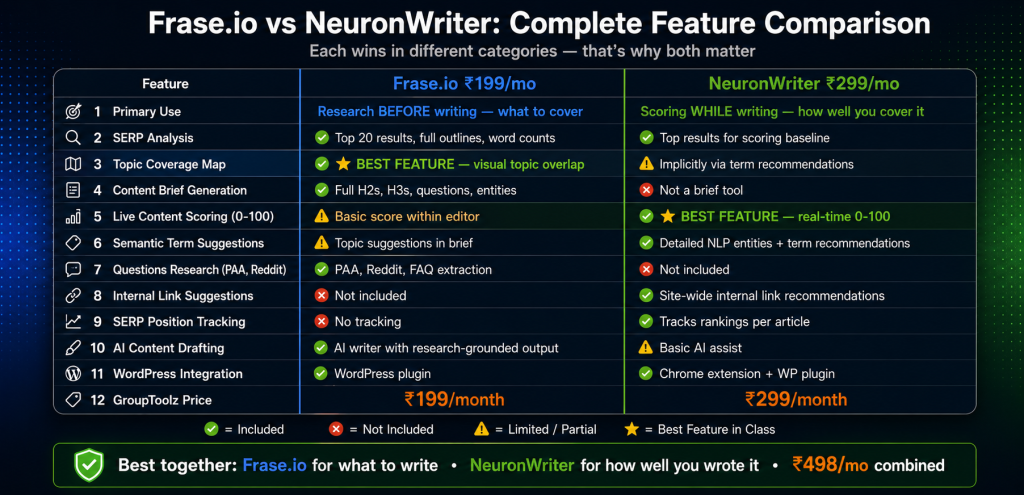
| Feature | Frase.io | NeuronWriter |
|---|---|---|
| Primary use | Research before writing — what to cover | Scoring while writing — how well you cover it |
| SERP analysis | ✅ Top 20 results, full outline, word counts | ✅ Top results for scoring baseline |
| Topic coverage map | ✅ Strongest feature — visual topic overlap | ⚠️ Implicitly via term recommendations |
| Content brief generation | ✅ Full structured brief with H2s, H3s, questions | ❌ Not a content brief tool |
| Live content scoring | ⚠️ Basic content score within editor | ✅ Strongest feature — real-time 0-100 scoring |
| Semantic term suggestions | ⚠️ Topic suggestions in brief | ✅ Detailed NLP entity and term recommendations |
| AI content drafting | ✅ AI writer built in | ⚠️ Basic AI assist available |
| Questions research | ✅ PAA, Reddit, FAQ extraction | ❌ Not included |
| Internal link suggestions | ❌ Not included | ✅ Site-wide internal link recommendations |
| WordPress integration | ✅ WordPress plugin available | ✅ Chrome extension + WP plugin |
| Google Docs integration | ✅ Google Docs extension | ✅ Chrome extension works in Google Docs |
| SERP position tracking | ❌ No position tracking | ✅ Tracks ranking of optimised articles |
| Team collaboration | ✅ Brief sharing and team workspace | ⚠️ Limited team features on lower plans |
| GroupToolz price | ₹199/month (single tool) | ₹299/month (single tool) |
| Retail price | $45-$115/month | $23-$69/month |
The complete content optimization workflow
Here’s the exact sequence for producing content that’s well-researched and semantically optimised — using both content optimization tools in combination.
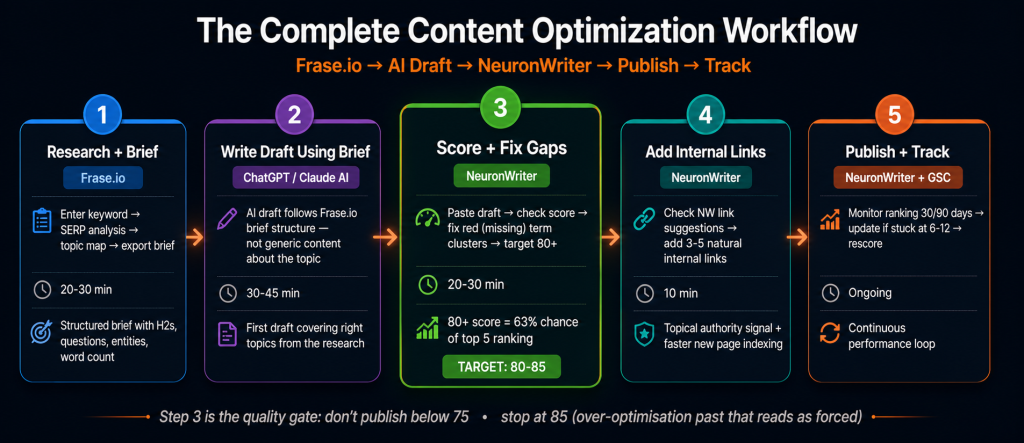
| Step 1 Research the keyword and build the brief Frase.io Enter the target keyword in Frase.io. Review the SERP analysis: average word count (your benchmark), the most common H2s (essential topics), and the People Also Ask questions. Build your brief by selecting the most relevant H2s and H3s from the competitive analysis. Export it with recommended topics, questions to answer, target word count, and key entities. Time: 20-30 minutes per article. Output: a structured brief with everything a writer needs to produce competitive content. This is where frase io review of the SERP changes what you write about, not just how you write it. |
| Step 2 Write the draft using the brief ChatGPT Plus Claude AI Use the Frase.io brief to guide AI drafting. In ChatGPT Plus or Claude: “Write [type] of [word count] words about [target keyword]. Use this content brief as the structural guide: [paste brief sections]. Cover each H2 in the brief, answer these questions [list from Frase], and make sure you mention these entities: [list from Frase].” The AI draft follows the competitive brief instead of generating generic content about the topic. This is where the frase io review research directly improves what comes out of the AI. |
| Step 3 Score and fix the gaps NeuronWriter Paste the AI draft into NeuronWriter with the target keyword. Check the initial score — a well-briefed draft typically lands at 55-70 on first paste. Review the red (missing) terms in the sidebar. These are the semantic gaps between your draft and what top-ranking pages cover. For each significant missing cluster, a sentence or paragraph that naturally incorporates the concept. This is the frase io review to NeuronWriter handoff working as intended. Don’t stuff — use terms where they make contextual sense. Target 80+. Stop at 85. I’ve over-optimised past 85 before and the content reads like it was written by someone desperately trying to hit a checklist. It doesn’t perform better. Time: 20-30 minutes of targeted additions to move from a 55-70 score to 80+. |
| Step 4 Add internal links NeuronWriter Check NeuronWriter’s internal linking recommendations. This is one of the neuronwriter review features that doesn’t get enough attention. It surfaces existing articles on your site this article should link to, and existing articles that should link back to this one. Add 3-5 natural internal links to relevant existing content. Internal links from new articles to existing ones spread authority. Links from existing articles to new ones help Google find and index the new page faster. This step takes maybe 10 minutes and solves a problem most people solve in a separate audit pass later. |
| Step 5 Publish and track NeuronWriter GSC Publish the article. NeuronWriter’s position tracking monitors the article’s Google ranking for its target keyword over time. Set a 30-day and 90-day review checkpoint. If ranking stagnates in position 6-12, return to Frase.io to check whether competitors have updated content since your last analysis. Close the new gaps, re-score in NeuronWriter, republish. That update cycle — check gaps, fix content, rescore, republish — is the ongoing performance loop. That’s seo content scoring used properly. |
GroupToolz pricing: both tools combined

| Access option | Frase.io | NeuronWriter | Combined cost | Retail equivalent |
|---|---|---|---|---|
| Single tools | ₹199/mo | ₹299/mo | ₹498/mo | ₹5,653+/mo ($68-$184) |
| Writer’s Pack | ✅ Included | ✅ Included | ₹799/mo | Plus 28 more writing tools |
| Advanced Plan | ✅ Included | ✅ Included | ₹499/mo | Plus 58 more tools (SEO, design, video, entertainment) |
The most cost-efficient way to get both on GroupToolz is the Advanced plan at ₹499/month — Frase.io and NeuronWriter alongside Semrush Guru, Envato Elements, Epidemic Sound, Netflix, VidIQ, and 55+ more tools. If your primary workflow is content writing and you need the full writing toolkit (Jasper AI, HIX AI, Writesonic, Grammarly, QuillBot, and 25 more writing tools), the Writer’s Pack at ₹799/month is more focused. Both beat the retail cost of just Frase.io alone at $45-$115/month.
| The honest verdict on this content stack Frase.io and NeuronWriter together at ₹498/month as singles, or ₹499/month in the Advanced plan, cover the complete content optimization workflow at less than the retail cost of Frase.io alone. For any site publishing more than four articles per month, the research time saved (Frase.io: 20-30 minutes vs 2+ hours manually) and the quality improvement from scoring (NeuronWriter-scored articles rank measurably better) is real. These content optimization tools don’t guarantee rankings — nothing does. But it removes “content quality and topical relevance” as the reason why good content fails to rank. If your content still doesn’t rank after this workflow, the problem is links, domain authority, or something technical. The content optimization tools have done their job. At least you’ll know. |
Frequently asked questions
What is the difference between Frase.io and NeuronWriter?
Frase.io is a research tool used before writing — it analyses what current top-ranking pages cover and builds a content brief with the topics, headings, questions, and entities your content needs to include. NeuronWriter is a scoring tool used while writing — it measures in real time (0-100) how semantically comprehensive your content is compared to top-ranking pages. Frase defines what to write. NeuronWriter measures how well you wrote it. That’s the core frase io vs neuronwriter distinction.
Do I need both, or is one enough?
For basic content optimization, NeuronWriter alone covers both functions at a surface level. For serious production work, both together produce better outcomes. Frase.io gives richer competitive research and better brief generation. NeuronWriter gives more granular real-time scoring and internal link recommendations. At ₹498/month combined vs ₹5,653/month retail, using both makes sense if you’re publishing more than a few articles a month. These are two of the better content optimization tools available at this price point.
What NeuronWriter score should I target?
Target 80+ before publishing. Pages scoring 78+ in NeuronWriter rank in the top 5 for their target keyword in 63% of cases according to NeuronWriter’s data. Stop around 85 — pushing above that often makes content feel forced and adds possible over-optimisation signals. If you can’t reach 75 with natural writing, go back to Frase.io and check whether your content structure is misaligned with what top-ranking pages actually cover. The frase io review of the SERP usually surfaces the structural problem.
Can I use Frase.io or NeuronWriter in Google Docs?
Yes, both have Chrome extensions for Google Docs. Frase.io’s extension surfaces research data and your content brief alongside the Doc. NeuronWriter’s Chrome extension overlays the scoring sidebar on your Google Doc — you see your score and term recommendations while writing without switching apps. Both work well in Google Docs; this is one of the seo content scoring features that makes daily use practical.
Which GroupToolz plan includes both Frase.io and NeuronWriter?
Both are available as single tools at ₹199 (Frase.io) and ₹299 (NeuronWriter) per month, totalling ₹498/month. The Advanced plan at ₹499/month includes both alongside Semrush Guru, Envato Elements, Epidemic Sound, VidIQ, Netflix, and 55+ more tools. The Writer’s Pack at ₹799/month includes both alongside 28 more writing-specific tools (Jasper AI, Writesonic, HIX AI, Grammarly, QuillBot).
How do Frase.io and NeuronWriter compare to Semrush’s Content Marketing Toolkit?
Semrush’s SEO Writing Assistant (Guru-exclusive) does content scoring similar to NeuronWriter. Semrush’s Topic Research covers competitive research similar to Frase.io. The differences: Frase.io produces richer, more writer-friendly content briefs. NeuronWriter’s scoring is more granular with better NLP entity recommendations. If you already have Semrush Guru on GroupToolz Pro (₹399), the Content Marketing Toolkit gives a good baseline. Add Frase.io and NeuronWriter for more detailed optimization work — the neuronwriter review vs Semrush Writing Assistant comparison is closest in the scoring function, but NeuronWriter’s term recommendations are more actionable for most writers.
Comments