
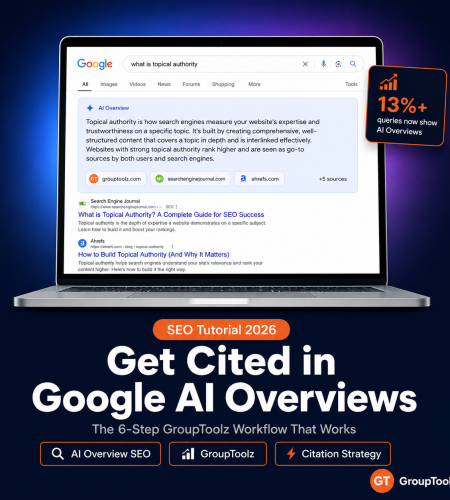
AI Overviews show up on 13%+ of Google searches now. CTR on informational queries has dropped 15-46%. But the sites getting cited inside those AI answers? Their traffic is going up. Here’s the exact Google AI overview optimization workflow using GroupToolz tools.
By GroupToolz Team Updated: May 4, 2026
| 13%+ Queries show AI Overviews | 34.5% CTR drop on those queries | 44.2% Citations from page intros | 13.3 Avg sources per overview |
What AI Overviews are and why they’ve changed SEO
Google AI Overviews are AI-generated answer blocks that appear above traditional search results. When triggered, Google’s models pull information from multiple web pages, synthesise it into one answer, and link back to sources with inline citations. The AI picks sources based on how your content is structured, how clearly you state claims, and how much authority your site has on the topic. Organic rank matters, but it’s not the only factor.
The numbers make the case for Google AI overview optimization better than I can. AI Overviews now show up on roughly 13% of all Google searches, up from 6.5% in January 2025. On informational queries, the rate is much higher. Click-through rates on queries where AI Overviews appear have dropped by 15-46%, depending on the industry. Gartner predicted 25% of organic traffic would shift to AI in 2026, and early data backs that up.
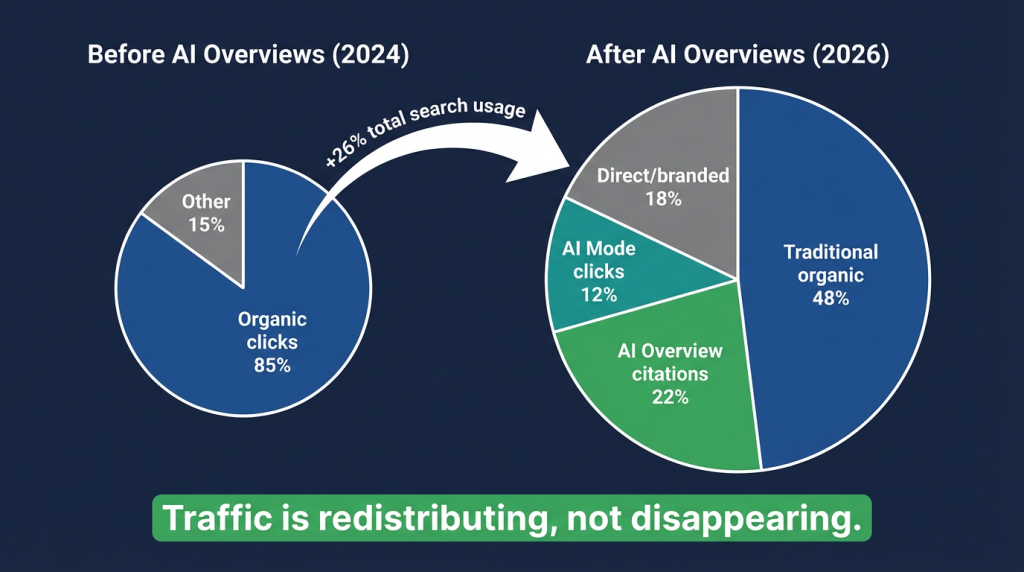
But here’s what most people writing about this topic miss. The total pie got bigger. Combined usage of search engines and AI search tools has gone up 26% worldwide. Traffic isn’t vanishing. It’s moving. Sites that earn AI citations are seeing traffic increases, sometimes beating their pre-AI-Overview numbers. The question isn’t whether AI Overviews affect your traffic. They do. The question is whether you’re on the citation side or the displacement side. That’s what Google AI overview optimization is about.
The new position one
Getting cited in an AI Overview is now worth more than ranking #1 in blue links for informational queries. Your brand name and a link appear at the top of the page, above everything else, inside a box where Google has already called your content authoritative. Google AI overview optimization is how you get there.
What Google actually pulls from your page
This part matters for Google AI overview optimization because you can’t optimise for something you don’t understand. AI Overviews aren’t random summaries. They follow patterns you can reverse-engineer.
Inside an AI Overview
The answer block
A synthesised answer combining claims from multiple sources. Each claim gets an inline citation linking to the source page. Google’s AI prefers clear, direct statements in the first 100 words of a section. If you bury your answer, the AI skips you.
Source citations (avg 13.3 per overview)
Each AI Overview cites about 13.3 sources on average. Sources are picked based on topical authority, content structure, and entity signals. Not just PageRank. Only 13.7% of citations overlap between AI Overviews and AI Mode, meaning both are separate opportunities for Google AI overview optimization.
Where citations come from on a page
44.2% of all LLM citations come from the first 30% of content. 31.1% from the middle. 24.7% from the end. Front-loading your best claims is more important than total word count. This is the single most actionable insight for Google AI overview optimization.
Which queries trigger overviews
Informational and how-to queries trigger most often. B2B tech queries see about 70% trigger rate. E-commerce queries: only 4%. Health: 17%. Comparison queries are heavily targeted. Know which of your keywords are in the trigger zone.
What gets you ignored
Long paragraphs with no clear claims. Missing schema markup. No entity signals. Answers buried deep in the page. Thin content that doesn’t add anything the top 10 don’t already say..
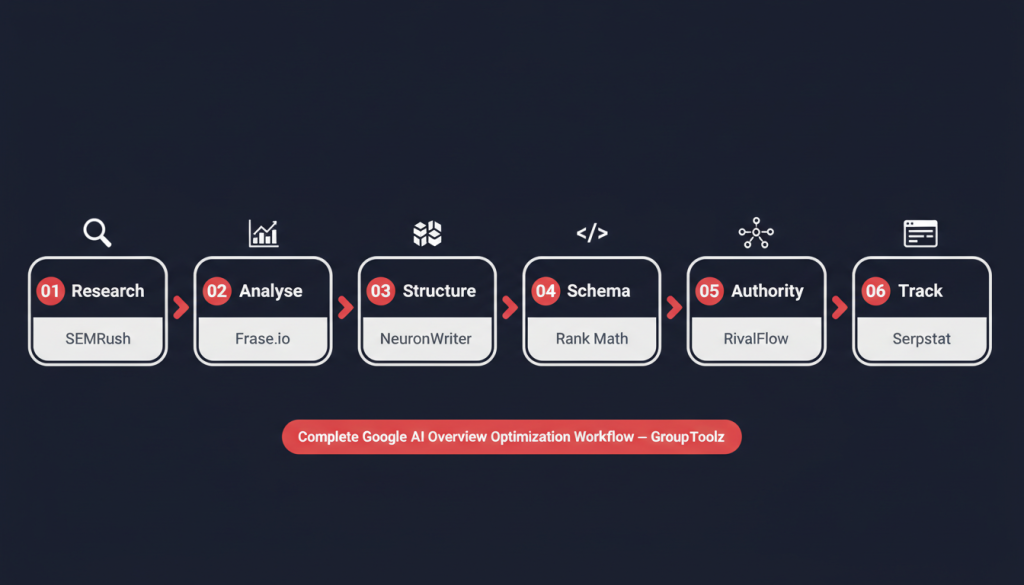
The 6-step Google AI overview optimization workflow
Every step maps to a specific tool on GroupToolz. The Pro plan at Rs 449/month covers steps 1-3 and 5-7. The Ultimate plan at Rs 699/month adds the tracking and gap analysis tools for steps 4-6. Here’s the full Google AI overview optimization process.
Step 1 of 6
Find which keywords trigger AI Overviews
SEMrush SpyFu
Not every keyword shows an AI Overview. Your first job in Google AI overview optimization is figuring out which of your target keywords already trigger them and which are likely to start soon.
In SEMrush Keyword Magic Tool: Enter your seed keyword. Filter by SERP Features and select “AI Overview” or “Featured Snippet.” Sort by search volume. That gives you a list of keywords where AI Overviews are live. These are your priority targets for Google AI overview optimization.
People Also Ask mining: SEMrush also shows PAA questions for each keyword. AI Overviews lean heavily on content that answers PAA-style questions directly. Export every PAA question for your target keywords. These become your H2 and H3 headings.
Who’s already getting cited? Use SpyFu to check which competitors show up in AI Overviews for your terms. Look at their content structure. How do they open their sections? Where’s the direct answer positioned? This competitive intel is the fastest shortcut in Google AI overview optimization.
Step 2 of 6
Study what’s getting cited right now
Frase.io BuzzSumo
Frase.io looks at the top-ranking pages for any keyword and builds a topic coverage map. It shows what the current top results cover, which questions they answer, and where the gaps are. For Google AI overview optimization, this is where you figure out what the AI is already pulling from existing pages.
In Frase.io: Enter your target keyword. Review the SERP analysis. Identify “answer blocks” where top pages give short, direct answers to specific questions. Note the content formats that show up most: definition blocks, comparison tables, numbered lists, process steps. These formats get cited more because they’re easier for AI to extract.
In BuzzSumo: Search your topic to find the most shared and linked content in your niche. Content with backlinks from DA 60+ sites has a much better shot at AI Overview citations. The top factors driving LLM citations are domain authority, quality backlinks, mentions in “best of” listicles, total backlinks, and unique referring domains.
One stat worth remembering for your Google AI overview optimization strategy: content that earns distribution across multiple publications can see AI citations increase by up to 325% compared to content only on your own site. Use BuzzSumo to find outreach targets where your content could be referenced.
Step 3 of 6
Structure your content so AI can grab it
NeuronWriter ChatGPT Plus Claude AI
This is where most content fails at Google AI overview optimization. You can have the right keywords, the right topic coverage, but if your content isn’t structured for extraction, it won’t get cited. The AI needs to grab a clear claim from your page in a single pass.
The 100-word rule: For every H2 section, put a concise, direct answer within the first 100 words below the heading. AI systems pull from section introductions disproportionately. Don’t bury your answer after three paragraphs of background. Lead with the claim. Explain it after.
In NeuronWriter: Build your content using NeuronWriter’s scoring system. It maps the semantic terms and entities your content needs to cover for Google AI overview optimization. Hit the target score while keeping your answer blocks tight and extractable.
Formats that get cited most, in order:
1. Definition blocks — “X is Y” in the first sentence under an H2. AI loves these.
2. Comparison tables — structured data the AI can extract and display directly.
3. Numbered steps — “How to” content with clear sequential instructions.
4. Stats with named sources — specific numbers attributed to specific organisations.
5. FAQ-style Q and A — question as H3, answer as the first paragraph below it.
ChatGPT Plus and Claude AI are useful for drafting answer blocks quickly. Give them the specific question from your PAA research and ask for a 2-3 sentence direct answer. Place that answer right below the relevant heading. The AI writing tools on GroupToolz Pro aren’t replacing your thinking. They’re formatting your expertise into extractable blocks faster.
Step 4 of 6
Add schema markup
Rank Math Seobility
Schema isn’t optional for Google AI overview optimization in 2026. Google’s AI uses structured data to understand what your content is, who wrote it, and whether it’s credible. Pages with proper schema are more likely to get picked as sources.
Article schema: Tells Google this is a published article with an author, date, and publisher. Rank Math auto-generates this on every blog post.
FAQ schema: If your content has a FAQ section (it should, for Google AI overview optimization), wrap each question-answer pair in FAQ JSON-LD. Google can pull these directly into AI Overviews and featured snippets. Rank Math has a built-in FAQ block for this.
HowTo schema: For step-by-step content, HowTo schema helps Google understand the sequence and extract individual steps. Particularly useful for “how to” queries.
Author and Organization schema: E-E-A-T signals matter more than ever. Define your author entities with schema linking to their credentials, publications, and profiles. Google’s AI evaluates source authority partly through entity understanding.
Validate: After adding schema through Rank Math, run your URL through Google’s Rich Results Test. Then use Seobility to check schema across your whole site, not just individual pages.
Step 5 of 6
Build topical authority
RivalFlow Storybase BuzzSumo
Single pages don’t win AI Overview citations. Topic clusters do. Google’s AI checks whether your site consistently covers a topic across multiple pages with internal linking. Sites with strong topical authority earn more stable citation placements. This is the long game of Google AI overview optimization.
In RivalFlow: Enter your target URL and keyword. RivalFlow compares your content against pages currently cited in AI Overviews and shows exactly what they cover that you don’t. Fill those gaps.
In Storybase: Research what real people are asking about your topic. Storybase shows question volume and phrasing, which helps you build supporting content that fills out the topic cluster. Each supporting article links back to your pillar page.
The cluster structure for Google AI overview optimization: One pillar page on your primary keyword. Five to ten supporting pages on long-tail questions and subtopics. Internal links from every supporting page to the pillar. Internal links between related supporting pages. This is what Google’s AI reads as “this site knows this topic.”
Step 6 of 6
Track your AI Overview citations
Serpstat SimilarWeb
Traditional rank tracking isn’t enough for Google AI overview optimization. You need to know whether your pages are being cited in AI Overviews, not just whether they rank in the blue links.
In Serpstat: Set up rank tracking for your target keywords. Serpstat’s SERP features tracking flags which keywords trigger AI Overviews and whether your domain shows up as a citation. Check weekly. A page can rank #8 organically but get cited in the AI Overview, which is often worth more than ranking #1 without a citation.
Google Search Console: GSC now tracks AI Overview impressions, though you can’t filter AI Overview clicks separately from organic clicks yet. Watch your total impressions and click data on AI-Overview-heavy keywords as a proxy.
The metrics that matter in 2026: Stop measuring success only by organic clicks. For Google AI overview optimization, track AI citation rate (how often you’re cited for target keywords), branded search volume (are more people searching your brand name as AI Overviews mention you), and on-site conversion rate (fewer visitors but more qualified ones should mean higher conversion).
Before and after: what Google AI overview optimization looks like in practice
Theory is fine. Here’s what content actually looks like before and after you apply Google AI overview optimization.
Example: “What is topical authority?”
| Before (AI ignores this) In the world of SEO, there are many factors that contribute to how well a website ranks in search engines. One of these important concepts is what experts call topical authority. Over the past few years, search engines have evolved significantly, and understanding this concept has become increasingly relevant for digital marketers… Problem: 60+ words before any actual claim. No definition. No extractable statement. AI skips it. | After (AI cites this) Topical authority is a search engine’s measure of how comprehensively and credibly a website covers a specific subject area. Sites with high topical authority rank more consistently and are more likely to be cited in Google AI Overviews. Building it requires publishing interlinked content clusters covering a topic from multiple angles. Fix: definition in sentence one. Consequence in sentence two. How-to in sentence three. Under 60 words. Extractable. |
Example: “How to do keyword research for a blog”
| Before (AI ignores this) Keyword research is probably one of the most important things you can do when starting a blog. It helps you understand what people are searching for and ensures that your content reaches the right audience. In this guide, we will walk you through everything you need to know… Problem: filler language, no specific steps, no tools named, vague promises. | After (AI cites this) Keyword research for a blog takes five steps: identify seed topics from your niche, expand into keyword lists using SEMrush Keyword Magic Tool, filter by search volume (100+/month) and difficulty (under 40 for new blogs), map keywords to content types (informational, comparison, commercial), and validate with People Also Ask questions for subtopics. The process takes 30-60 minutes per post. Fix: numbered steps, named tools, specific metrics, timeframe. Every sentence adds information AI can extract. |
The full Google AI overview optimization checklist
Run through this for every piece of content you publish. Each item maps to a GroupToolz tool.
| # | Check | Tool | Plan |
|---|---|---|---|
| 1 | Target keyword triggers AI Overview or featured snippet | SEMrush (SERP Features) | Pro Rs 449 |
| 2 | PAA questions exported, mapped to H2/H3 headings | SEMrush (Keyword Magic) | Pro Rs 449 |
| 3 | Top 10 SERP pages analysed for topic coverage | Frase.io | Pro Rs 449 |
| 4 | Content gaps vs currently cited competitors identified | RivalFlow | Ultimate Rs 699 |
| 5 | Direct answer within first 100 words of each H2 | NeuronWriter | Pro Rs 449 |
| 6 | Comparison tables for vs/comparison queries | ChatGPT/Claude for drafting | Pro Rs 449 |
| 7 | FAQ section with 5-8 questions matching PAA research | Frase.io + Storybase | Pro Rs 449 |
| 8 | Article, FAQ, Author schema added | Rank Math | Free plugin |
| 9 | Schema validated in Rich Results Test | Google + Seobility | Pro Rs 449 |
| 10 | 3+ internal links to topical cluster pages | Manual | Any |
| 11 | NeuronWriter content score target met | NeuronWriter | Pro Rs 449 |
| 12 | Grammar and readability checked | Grammarly Premium | Starter Rs 199 |
| 13 | Rank tracking with SERP feature monitoring live | Serpstat | Ultimate Rs 699 |
| 14 | Weekly AI Overview citation check scheduled | Serpstat + GSC | Ultimate Rs 699 |
GroupToolz covers the entire workflow
Every tool in this Google AI overview optimization checklist is on GroupToolz. Pro at Rs 449/month handles steps 1-3 and 5-7 (SEMrush, Frase.io, NeuronWriter, ChatGPT Plus, Claude AI, Grammarly). Ultimate at Rs 699/month adds RivalFlow, Serpstat, and BuzzSumo for the gap analysis and tracking steps. Full Google AI overview optimization stack for under Rs 700/month.
Get cited in AI Overviews. Access all the tools.
SEMrush, Frase.io, NeuronWriter, Serpstat, BuzzSumo, RivalFlow, and 140+ more. One plan.
Frequently asked questions
How do I get my content cited in Google AI Overviews?
Put a direct answer within the first 100 words of each H2 section. Use headings that match the questions people actually ask. Add FAQ and Article schema. Build topical authority with content clusters. Google AI overview optimization is about making your content easy for AI to extract and trust, not just ranking high in traditional results.
Do AI Overviews kill organic traffic?
CTR drops 15-46% on queries where AI Overviews appear. But total search usage (engines plus AI tools) is up 26% worldwide. Sites that earn AI citations often see traffic increases that beat their pre-AI-Overview numbers. Google AI overview optimization is about getting on the citation side of that shift.
Which GroupToolz tools help with Google AI overview optimization?
SEMrush for keyword research and SERP feature identification. Frase.io for SERP analysis and content briefs. NeuronWriter for content scoring. BuzzSumo for citation-worthy content research. RivalFlow for gap analysis against cited competitors. Serpstat for rank tracking and AI Overview monitoring. Plus Storybase, Rank Math, Seobility, and Grammarly. All on GroupToolz Pro (Rs 449) or Ultimate (Rs 699).
What types of queries trigger AI Overviews most often?
Informational and how-to queries trigger most. B2B tech queries see about 70% trigger rate. Health queries: 17%. E-commerce/transactional: only 4%. If your keywords are informational, Google AI overview optimization should be a priority. If they’re transactional, focus on traditional SEO.
Is answer engine optimization (AEO) different from SEO?
AEO isn’t a replacement. It sits on top of SEO. Traditional SEO handles the foundation: crawling, indexing, authority, ranking. Google AI overview optimization adds a content structure layer that makes pages easy for AI to understand, extract, cite, and trust. You need both working together in 2026.
How do I track whether my content appears in AI Overviews?
Serpstat tracks rank positions with SERP feature flags, so you can see when your domain gets cited. Google Search Console now shows AI Overview impressions. Also watch your branded search volume. If Google AI overview optimization is working, more people will search your brand name directly because they keep seeing you cited.
More SEO guides
How to Run a Technical SEO Audit Without Paying ₹10,000/Month (GroupToolz Method)
How to Do a Complete Backlink Audit Using Ahrefs & Majestic — Group Buy Guide
How to Spy on Competitor Keywords Using SpyFu, SEMrush & SimilarWeb
Want more SEO guides? Browse all GroupToolz blog posts
Comments