This answer engine optimization 2026 guide covers how to get your content cited by ChatGPT, Perplexity, Gemini, and Google AI Overviews — the 7-step AEO workflow I run with GroupToolz tools. ChatGPT handles 2 billion queries a day. Google AI Overviews show up in 55% of searches. Gartner says traditional search volume drops 25% by 2026. Your content doesn’t just need to rank anymore. It needs to get cited. This is the AEO workflow I use with GroupToolz tools.
By GroupToolz Team Updated: June 2, 2026
| 883M ChatGPT monthly users | 55% Searches show AI Overviews | 527% AI referral traffic growth YoY | 12% Overlap: AI citations vs Google top 10 |
What is answer engine optimization, actually?
Answer engine optimization (AEO) is about structuring your content so AI platforms pick it as a source when they’re generating answers. Traditional SEO gets you rankings and clicks. AEO gets you citations and mentions. Different thing.
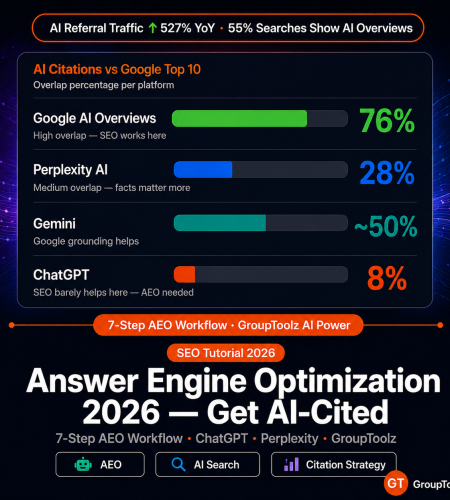
Here’s the number that should bother you. Ahrefs Brand Radar analysed 15,000 prompts and found that only 12% of the content AI engines cite also appears in Google’s top 10 results. ChatGPT’s overlap is even lower. 8%. Perplexity sits at 28%. Only Google AI Overviews have high correlation at 76%, which makes sense since they’re pulling from Google’s own index.
That 12% figure is what made me start taking aeo seo seriously. It means 88% of what AI engines cite doesn’t come from the traditional top 10. The stuff that makes content citable by AI is different from what makes it rank on Google. You need both strategies now. SEO for the organic traffic that pays your bills today. AEO for the ai search optimization that protects your visibility as more people shift to AI-powered search.
| This shift isn’t theoretical anymore AI-driven referrals to websites jumped over 1,000% between July 2024 and February 2025 (Adobe data). HubSpot says customers using their AEO tools drove 20% more traffic from AI than those who weren’t optimising for it. And 42% of CRM software buyers now use AI search as part of their buying process. If AI answer engines aren’t citing your content, you’re invisible to a growing slice of your market. I’ve watched this happen to competitors in real time. It’s not slow. |
SEO vs AEO: what’s actually different
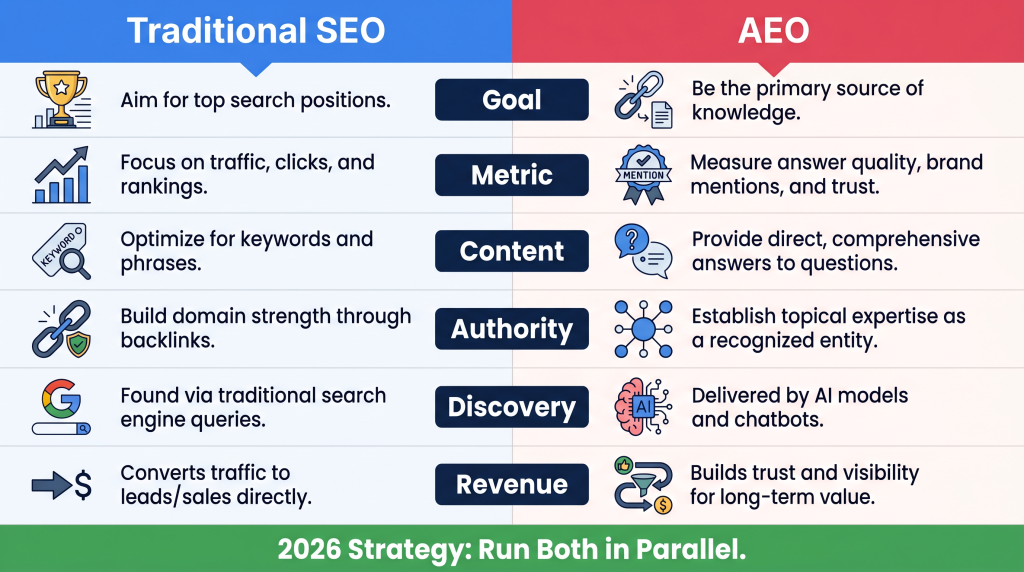
| Factor | Traditional SEO | Answer engine optimization (AEO) |
|---|---|---|
| Goal | Rank higher in search results, drive clicks | Get cited in AI-generated answers, build brand visibility |
| Success metric | Rankings, CTR, organic traffic, conversions | Mentions, citations, brand sentiment in AI answers |
| Content structure | Keyword-optimised, backlink-supported, long-form | Answer-first, self-contained sections, citable facts, structured data |
| Authority signal | Backlinks, domain authority, page authority | Entity salience, third-party consensus, E-E-A-T, knowledge graph |
| How AI finds you | Google’s ranking algorithm (PageRank + 200 signals) | RAG pipeline: semantic matching > ranking > synthesis > citation |
| Keyword matching | Exact and phrase match | Semantic/conceptual (AI understands meaning, not just words) |
| User experience | User clicks through to your site | User reads AI answer citing your content (may or may not click) |
| Revenue path | Direct: traffic > conversion | Indirect: brand mention > trust > eventual conversion |
A Google spokesperson recently confirmed that traditional SEO is still the main way to rank in AI Overviews. Fine. But AI Overviews are just one answer engine. ChatGPT, Perplexity, and Gemini use different criteria entirely. The teams winning in 2026 do both: SEO for organic traffic that pays today, and AEO strategies for the brand authority that keeps them visible as AI search grows. You can’t pick one and ignore the other anymore.
How answer engines actually decide what to cite
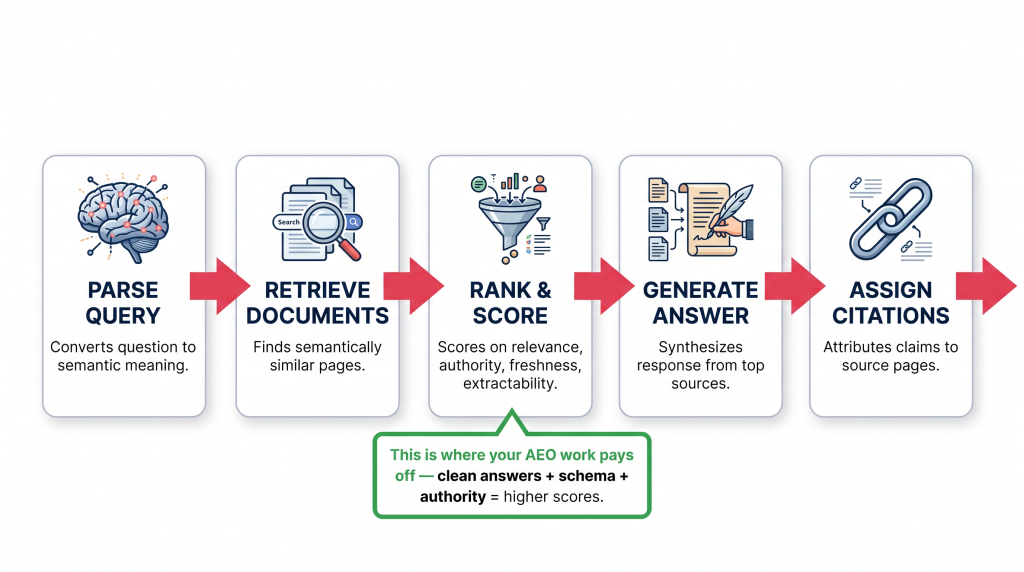
If you want to optimize for chatgpt and other AI engines, you need to understand how they pick sources. Every answer engine runs some version of this pipeline. I’ll keep it practical.
Stage 1: They figure out what you’re asking. The AI parses your question and converts it into something it can work with semantically. This isn’t keyword matching. “Best CRM for small teams” and “affordable team collaboration software” can pull from the same sources even though they share zero words. That’s why keyword stuffing doesn’t work here.
Stage 2: They go find relevant pages. The system searches its index for documents that are conceptually close to what you asked. A page about “getting your content cited by AI” can surface for a query about “answer engine optimization” without that exact phrase ever appearing. Semantic similarity, not keyword density.
Stage 3: They rank and pick winners. This is where it gets interesting for ai search optimization. Retrieved pages get scored on relevance, authority, how recently they were updated, and how easy it is to extract clean answers from them. Pages with clear, extractable answers beat pages that bury good information in long rambling paragraphs. Schema markup and self-contained sections help a lot here.
Stage 4: They write the answer. The AI reads the top sources and puts together a response. It pulls out key facts, stats, and explanations, then rewrites them. It doesn’t copy your text word-for-word.
Stage 5: They decide who gets credit. The engine links specific claims to their source pages. Content with clear, specific, verifiable facts gets cited. Vague general statements don’t. This is where aeo seo work pays off. The more specific and attributable your content is, the more likely you get the citation.
The 7-step AEO workflow on GroupToolz
| Step 1 of 7 Find the questions your audience asks AI Semrush AnswerThePublic ChatGPT Plus AEO starts with questions, not keywords. People don’t type keyword phrases into ChatGPT. They ask things like “what’s the best CRM for small businesses in India” or “how do I make my website faster.” Those are your targets. In Semrush, use the Keyword Magic Tool and filter by “Questions.” That isolates all the who/what/when/where/why/how queries. These map directly to what people type into ChatGPT and Perplexity. I usually export the top 50 questions in a niche and work from there. AnswerThePublic (GroupToolz Pro ₹399 or single ₹149) is great for this too. Enter your topic and it spits out every question variation people search for. I find stuff in there that Semrush misses. I also just ask ChatGPT directly: “What questions do people ask about [topic]? List 20 specific ones.” Feels meta, but it works. You’re getting questions from the AI’s own perspective. |
| Step 2 of 7 Structure content so AI can actually extract answers Frase.io NeuronWriter AI engines are lazy in the best possible way. They want content that answers the question fast. The Inverted Pyramid works perfectly for AEO: core answer in the first 40-60 words, then supporting data and context after. The rule I follow: if your H2 heading asks a question, the very first sentence under it must answer that question directly. Not background. Not history. Not a story. Answer first. Elaborate second. I’ve tested this on my own content and the difference in AI citation rates is noticeable. Each section also needs to make sense on its own. Answer engines extract passages, not full articles. If an AI pulls your paragraph about “AEO vs SEO,” that paragraph has to be a complete, useful answer without the reader seeing anything else on your page. Self-contained sections. That’s the goal. Frase.io (GroupToolz single ₹199) shows what topics and answer structures the top-ranking content uses. NeuronWriter (single ₹299) scores your content against the current winners. Between the two, you can see exactly where your content falls short before you publish. |
| Step 3 of 7 Add facts AI engines can actually cite BuzzSumo Semrush This is where a lot of content fails. AI engines cite content with specific, verifiable facts. Not opinions. Not vibes. “Email marketing has a high ROI” doesn’t get cited. “Email marketing returns $36 for every $1 spent according to the 2025 DMA report” does. The specificity and the source attribution are what make it citable. Original data is even better. Run a survey. Analyse your own datasets. Aggregate numbers from public sources into something new. Content with original data earns citations because AI engines need sources they can point to for specific claims. If you’re just restating someone else’s stats, the AI cites them, not you. BuzzSumo (GroupToolz single ₹99) helps you find the most-cited content in your niche. Sort by backlinks to see what’s already being used as reference material. Look at what makes those articles citable, then make something better. This is the optimize for chatgpt approach that actually produces results. |
| Step 4 of 7 Get your schema markup right Rank Math Seobility Schema markup is how AI engines understand the relationship between your content and the real world. In 2026, it’s not optional for AEO. It’s the difference between being parseable and being invisible to AI crawlers. Add FAQPage schema to every Q&A section. HowTo schema for step-by-step content. Article schema with author, datePublished, dateModified. Product schema for product pages with pricing, availability, features. For data studies, consider Dataset schema. The more structured data you give AI engines, the easier you make it for them to extract facts confidently. When an AI cross-references claims, the site with the cleanest JSON-LD wins. I’ve seen this play out repeatedly with ai overviews seo specifically. |
| Step 5 of 7 Build entity authority (not just domain authority) Semrush Majestic This is where AEO gets different from traditional link building. AI engines don’t care about “Domain Authority” the way Google does. They track something closer to “Entity Salience.” Is your brand a recognised player in your space? Does the broader internet confirm that? A hundred directory backlinks won’t build entity salience. Ten mentions in respected industry publications will. Get featured in places AI engines trust. Maintain consistent brand information across your website, social profiles, and third-party mentions. Publish case studies with real outcomes that other sites reference. That’s what makes AI engines treat your brand as authoritative. Semrush tracks your brand mentions across the web. Majestic (GroupToolz single ₹349) measures the quality of sites linking to you. Trust Flow matters more for aeo seo than raw backlink count. |
| Step 6 of 7 Let AI crawlers in (you might be blocking them) robots.txt llms.txt This sounds basic but I’ve seen it happen more than you’d expect. Companies accidentally block AI bots in robots.txt and then wonder why ChatGPT never mentions them. Check your robots.txt. Make sure you’re explicitly allowing GPTBot (OpenAI), ClaudeBot (Anthropic), PerplexityBot, and GoogleBot. There’s also llms.txt, a newer standard that’s worth knowing about. It’s a file at your domain root that gives AI crawlers specific instructions on how to parse your site, what your core entities are, and how you want to be cited. Think of it as robots.txt but for AI crawlers specifically. It’s early days for this, but the sites implementing it are making it easier for AI to understand and cite them correctly. |
| Step 7 of 7 Monitor what AI says about you and keep iterating Semrush Perplexity AI ChatGPT Plus Traditional SEO metrics don’t measure AEO performance. Rankings and CTR won’t tell you whether ChatGPT is citing you. You need different tracking. Here’s what I do monthly: search my brand name and core topics in ChatGPT, Perplexity, and Gemini. Document when my content gets cited, when competitors show up instead, and what format the cited content uses. Takes about 30-60 minutes. It’s manual but it gives you ground truth about your AI visibility that no automated tool currently provides. In Semrush, use Position Tracking with SERP feature filters to watch where ai overviews seo appears for your tracked keywords and whether your content is in them. AI Overviews have 76% overlap with traditional rankings, so Semrush tracking is actually useful here. One more thing: update content quarterly. AI engines penalise stale pages. Content updated in the last 90 days gets cited more than identical content that hasn’t been touched. Freshness isn’t just a Google signal. It’s an AEO signal across every platform. |
Each AI platform works differently
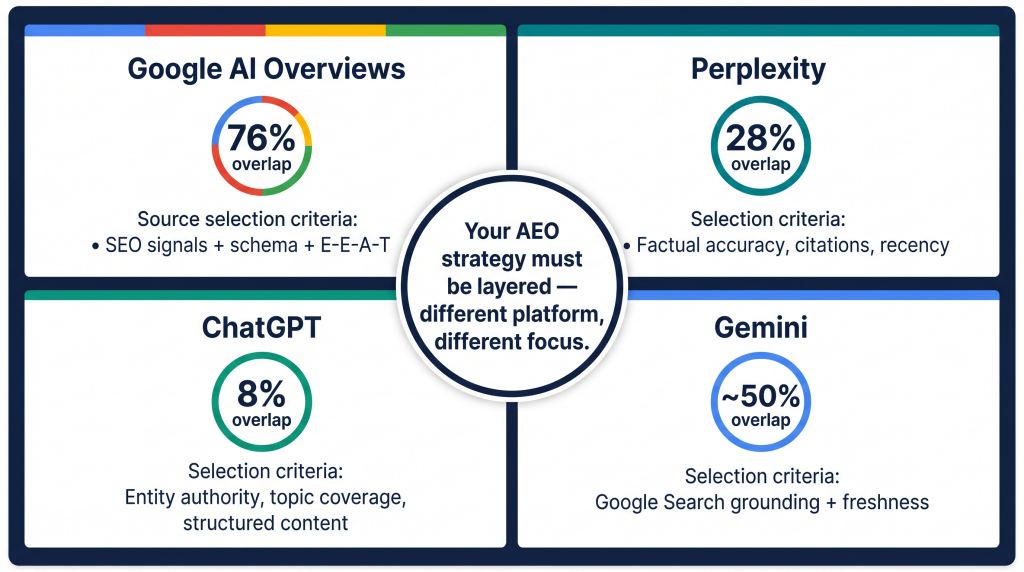
| Answer engine | What it favours | Overlap with Google rankings | Your focus |
|---|---|---|---|
| Google AI Overviews | Traditional SEO signals + structured data + E-E-A-T | 76% | Standard SEO + schema + answer-first format |
| Perplexity | Factual accuracy, strong citations, recency | 28% | Data-heavy content, original research, clear sources |
| ChatGPT | Topic coverage, entity authority, conversational format | 8% | Entity authority, third-party consensus, structured content |
| Gemini | Google Search grounding, real-time accuracy | ~50% | Google SEO + freshness + cited factual claims |
The practical takeaway here: if you want to optimize for chatgpt specifically, traditional SEO won’t get you far. Only 8% overlap with Google’s top 10. You need entity authority and structured content. For ai overviews seo, standard SEO work covers most of it (76% overlap). Perplexity rewards factual accuracy and original research above everything else. You can’t use the same ai search optimization strategy for all four. It needs to be layered.
The AEO toolkit on GroupToolz
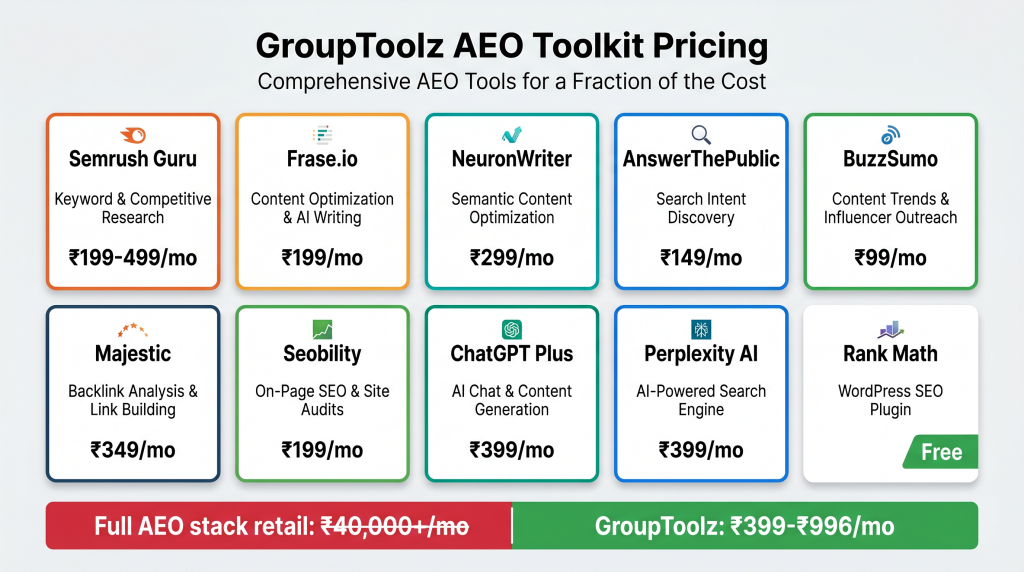
| Tool | AEO role | GroupToolz access |
|---|---|---|
| Semrush (Guru) | Question keyword research, brand monitoring, AI Overview tracking, competitor intel | Pro ₹399 / Advanced ₹499 / Single ₹199 |
| Frase.io | Answer structure analysis, topic coverage, competitor content gaps | Single ₹199 |
| NeuronWriter | Content scoring, semantic coverage, entity check | Single ₹299 |
| AnswerThePublic | Question discovery for every variation your audience asks | Pro ₹399 / Single ₹149 |
| BuzzSumo | Find most-cited content in your niche, spot citable formats | Single ₹99 |
| Majestic | Entity authority tracking, Trust Flow, citation quality | Single ₹349 |
| Seobility | Schema validation, technical audit, structured data checks | Pro ₹399 / Single ₹199 |
| ChatGPT Plus | Prompt-based question research, content drafting, AI visibility testing | AI Plan ₹2,499 / Single ₹399 |
| Perplexity AI | Test how Perplexity cites your content, watch competitor visibility | AI Plan ₹2,499 / Single ₹399 |
| Rank Math | Schema implementation: FAQ, HowTo, Article, Product | Free (WordPress plugin) |
| What this costs vs what it saves AEO isn’t replacing SEO. It runs alongside it. GroupToolz Pro at ₹399/month covers Semrush Guru, AnswerThePublic, Seobility, and ChatGPT Plus. That handles question discovery, content scoring, schema validation, and AI visibility testing. Add Frase.io (₹199), NeuronWriter (₹299), and BuzzSumo (₹99) as singles for the full AEO stack. Total: ₹399-₹996/month on GroupToolz. The same tools at retail run ₹40,000+/month. The investment is low enough that there’s no good reason not to start. |
Get your content cited by AI
Semrush Guru + Frase.io + NeuronWriter + AnswerThePublic + BuzzSumo + ChatGPT Plus + Perplexity AI. Full answer engine optimization 2026 toolkit. From ₹399/month.
Frequently asked questions
What is answer engine optimization (AEO)?
Answer engine optimization 2026 is the practice of structuring content so AI platforms like ChatGPT, Perplexity, Gemini, and Google AI Overviews choose it as a cited source when they generate answers. Unlike traditional SEO which chases rankings and clicks, AEO chases citations and mentions. The overlap between AI citations and Google’s top 10 is just 12%, which means AEO needs different tactics than standard SEO.
Is AEO replacing SEO?
No. The relationship is additive, not a replacement. Google confirmed SEO is still the main way to rank in AI Overviews (76% overlap). But for ChatGPT (8% overlap) and Perplexity (28%), you need AEO-specific work. The smart move in 2026 is doing both. SEO for organic traffic today. AEO for brand visibility as ai search optimization becomes more important. Ignoring either one costs you.
How do I get cited by ChatGPT?
To optimize for chatgpt, focus on entity authority (is your brand recognised?), topic coverage (do you answer questions comprehensively?), third-party consensus (do reputable sites mention you?), and structured content with clear extractable answers. Publish original data, get coverage in industry publications, keep your brand info consistent across the web, and use answer-first formatting with self-contained sections.
What is the “answer-first” content structure?
Lead with the core answer in the first 40-60 words of each section. Background, history, and stories come after. AI engines prefer content that gets to the point fast. If your heading is a question, the very next sentence should answer it directly. I’ve tested this against my own content and the sections that follow this format get cited noticeably more often.
Which GroupToolz tools help with AEO?
Semrush Guru for question-based keyword research and ai overviews seo monitoring (Pro ₹399 or single ₹199). Frase.io for answer structure (single ₹199). NeuronWriter for content scoring (single ₹299). AnswerThePublic for question discovery (single ₹149). BuzzSumo for finding citable content (single ₹99). Seobility for schema validation (Pro ₹399 or single ₹199). ChatGPT Plus and Perplexity AI for testing visibility (AI Plan ₹2,499 or singles ₹399).
What is an llms.txt file?
It’s a file at your domain root (yoursite.com/llms.txt) that tells AI crawlers how to parse your site, what your core entities are, and how you’d like to be cited. Think of it as robots.txt but for AI specifically. It’s relatively new, but sites implementing it are giving AI engines cleaner signals about their content and seeing better citation accuracy as a result.
Comments