

How to Use ChatGPT & Ahrefs Together for SEO Content That Actually Ranks 2026
Using ChatGPT and Ahrefs together for SEO content in 2026 is the most efficient content production workflow available for Indian bloggers, freelancers, and content agencies. Ahrefs finds the keywords worth targeting, reveals what the top-ranking content covers, and shows the competitive landscape. ChatGPT turns that data into well-structured, readable drafts in a fraction of the time manual writing takes. Together they produce ChatGPT Ahrefs SEO content that ranks because it combines real keyword intelligence with fast AI-assisted writing — rather than relying on either tool alone.
This guide covers the complete ChatGPT Ahrefs SEO content workflow step by step: how to extract the right data from Ahrefs, how to feed that data into ChatGPT prompts that produce ranking-ready drafts, how to optimise the output before publishing, and the specific mistakes that cause AI-assisted content to fail in search despite solid keyword research. Both tools are available on GroupToolz from ₹449/month.
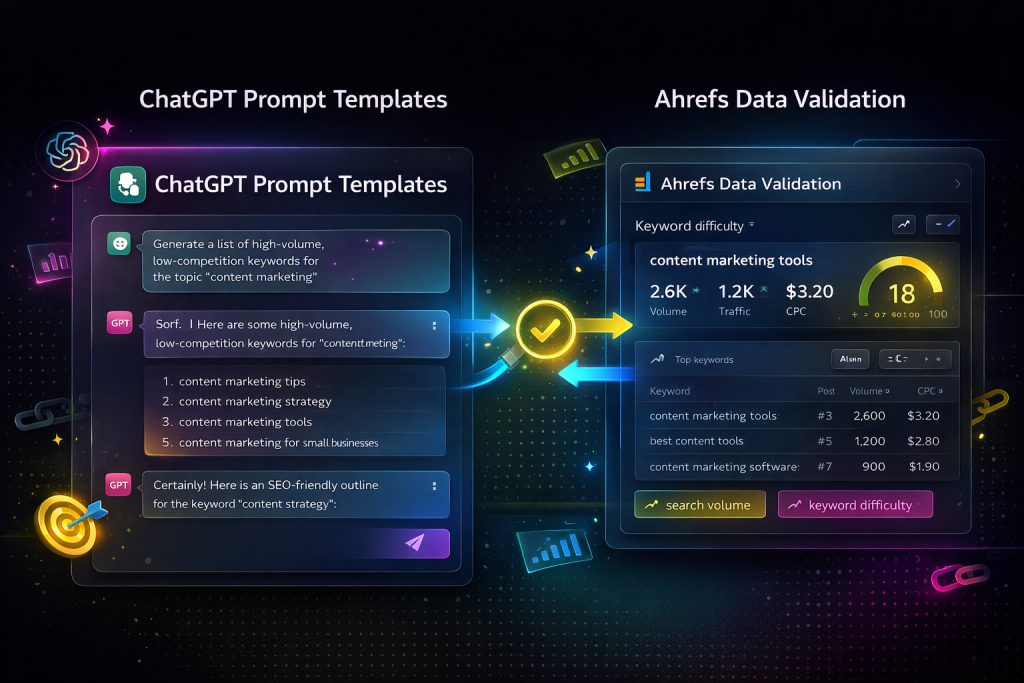
Why ChatGPT Ahrefs SEO Content Works Better Than Either Tool Alone
The most common failure mode for AI-generated SEO content in 2026 is writing without data. ChatGPT produces fluent, convincing content on any topic — but without Ahrefs data feeding it, the output targets the wrong keywords, misses the topics Google expects to see covered, and produces content that competes with nothing because it wasn’t designed to compete with anything specific.
The second most common failure mode is data without writing efficiency. Many Indian SEO professionals use Ahrefs expertly but spend 4–6 hours writing each article manually. The competitive landscape in 2026 rewards content teams that publish consistently, not those that publish perfectly once a month. ChatGPT Ahrefs SEO content solves both problems simultaneously.
| Working Method | Quality | Speed | Ranking Potential |
|---|---|---|---|
| ChatGPT alone (no keyword data) | Good writing | Fast | ❌ Low — wrong topics |
| Ahrefs alone (manual writing) | Good data | Slow | ⚠️ Medium — slow output |
| ChatGPT + Ahrefs together | Good writing + data | Fast | ✅ High — data-driven, consistent |
Tools You Need for ChatGPT Ahrefs SEO Content on GroupToolz
The complete ChatGPT Ahrefs SEO content workflow uses these tools from GroupToolz:
| Tool | Role in Workflow | GroupToolz Plan |
|---|---|---|
| Ahrefs | Keyword research, competitor analysis, content gaps | Ultimate ₹699/mo |
| ChatGPT Plus | Content drafting, outline creation, FAQ writing | Pro ₹449/mo |
| NeuronWriter | NLP optimisation scoring after draft | Pro ₹449/mo |
| Frase.io | Content brief and heading structure | Pro ₹449/mo |
| Grammarly Premium | Editing and clarity check before publishing | Starter ₹199/mo |
| SEMrush | Keyword validation and intent confirmation | Pro ₹449/mo |
The ChatGPT Ahrefs SEO content core workflow uses Ahrefs and ChatGPT Plus. The supporting tools — NeuronWriter, Frase.io, and Grammarly Premium — improve the output quality and optimisation depth. All are available on GroupToolz from ₹449/month.
Phase 1 — Ahrefs Keyword Research for ChatGPT Content
Phase 1 of the ChatGPT Ahrefs SEO content workflow is entirely in Ahrefs. Before ChatGPT opens, you need five specific data points that will directly shape every prompt you use.
Step 1 — Find Your Target Keyword in Ahrefs Keywords Explorer
Open Ahrefs Keywords Explorer and enter a broad seed keyword related to your niche. Set the location to India if you’re targeting Indian audiences. Look at the keyword suggestions and apply these filters to find ChatGPT Ahrefs SEO content opportunities worth pursuing:
- Keyword Difficulty (KD) below 40 for new or medium-authority sites
- Monthly search volume above 200 to ensure meaningful traffic potential
- Traffic Potential above 500 — this shows the total traffic a top-ranking page earns for the keyword cluster, not just the primary keyword
Traffic Potential is the most important filter for ChatGPT Ahrefs SEO content strategy because it accounts for the full keyword cluster a single page can capture. A keyword with 300 monthly searches but 2,000 Traffic Potential means the top-ranking page earns 2,000 visitors by ranking for the primary keyword plus dozens of related variations — all from one well-optimised piece.
Step 2 — Check Search Intent Before Writing
Click the SERP overview for your chosen keyword in Ahrefs. Look at the top 10 results and identify the dominant content type — are the results all blog posts, YouTube videos, product pages, or comparison articles? This search intent check is critical for ChatGPT Ahrefs SEO content because ChatGPT will write whatever format you ask for — but if you ask for a blog post on a keyword where Google only ranks product pages, your content will not rank regardless of quality.
Record the content type, average word count of top-ranking pages, and the presence of featured snippets, People Also Ask boxes, or video carousels. These SERP features tell you the format your ChatGPT Ahrefs SEO content needs to target — structured lists rank in featured snippets, how-to formats rank in PAA boxes, and comprehensive guides dominate competitive informational keywords.
Step 3 — Extract Top Competitor Headings
Click through to the top 3–5 ranking pages for your keyword and note their H2 and H3 heading structure. You don’t need to read the full content — just the headings. These headings tell you the specific sub-topics Google considers relevant for this keyword and that your ChatGPT Ahrefs SEO content must cover to be competitive.
Paste the competitor headings into a document alongside your target keyword. This becomes the structural input for your ChatGPT prompt in Phase 2 — the most important data point for producing an outline that matches Google’s topical expectations rather than ChatGPT’s generic response to an unguided prompt.
Step 4 — Find Related Keywords and Long-Tail Variations
In Ahrefs Keywords Explorer, go to the Related Terms tab for your primary keyword. Export or note the top 15–20 related keywords by search volume. These are the semantic variations and long-tail questions your ChatGPT Ahrefs SEO content should incorporate naturally — they represent the full keyword cluster your article can rank for, not just the primary term.
Pay particular attention to question-based keywords (how, what, why, when) — these directly map to H2 headings and FAQ sections in your article structure and are the keywords most likely to trigger featured snippet positions for well-structured ChatGPT Ahrefs SEO content.
Step 5 — Check Competitor Domain Rating
Note the Domain Rating of the top 5 ranking pages in Ahrefs SERP overview. If sites with DR 20–35 are ranking in positions 1–5, your ChatGPT Ahrefs SEO content has a genuine ranking opportunity regardless of your own site’s authority. If all top 5 results are DR 60+, the keyword requires significant domain authority before content quality alone will move rankings — focus your efforts on lower-competition keywords in the meantime.
Phase 2 — Building ChatGPT Prompts From Ahrefs Data
Phase 2 is where most ChatGPT Ahrefs SEO content workflows fail. Generic prompts produce generic content. The quality of your ChatGPT output is directly proportional to the quality and specificity of the Ahrefs data you feed into the prompt. Here are the specific prompt structures that produce ranking-ready content.
The Outline Prompt — Use Ahrefs Headings as Structure Input
Do not ask ChatGPT to create an outline from scratch. Instead, feed it the competitor headings you extracted in Step 3 and ask it to build a better, more comprehensive version:
Prompt template: “I am writing an article targeting the keyword [your keyword] for Indian readers. The top-ranking competitor articles use these headings: [paste competitor headings]. Create a better, more comprehensive article outline that covers all these topics and adds 2–3 additional angles competitors have missed. The article should be approximately [word count from Ahrefs average] words. Format as H2 and H3 headings only.”
This prompt produces a ChatGPT Ahrefs SEO content outline that starts from competitive data rather than from ChatGPT’s generic understanding of the topic. The output will cover what Google expects while adding differentiating angles that help your piece stand out from the pages you’re targeting to outrank.
The Section Writing Prompt — Feed Related Keywords as Must-Include Terms
Once you have the outline, write each section individually rather than asking ChatGPT for the full article in one prompt. Section-by-section writing produces higher quality ChatGPT Ahrefs SEO content because ChatGPT maintains better focus and accuracy within a single topic rather than across 2,500 words simultaneously.
Prompt template: “Write the section ‘[H2 heading]’ for an article targeting [keyword] for Indian readers. This section should be approximately [word count] words. Naturally include these related terms where relevant: [related keywords from Ahrefs]. Write in a direct, conversational tone. No em dashes. Keep sentences under 20 words where possible.”
The related keywords from Ahrefs’ Related Terms report fed directly into this prompt is what makes ChatGPT Ahrefs SEO content naturally incorporate keyword variations rather than repeating the primary keyword. This produces semantic richness that NeuronWriter’s content scoring rewards and that Google’s NLP systems recognise as comprehensive topic coverage.
The Introduction Prompt — Target Featured Snippets
The introduction and first 100 words of your article carry disproportionate SEO weight. Google reads the opening content to confirm the page matches the target keyword. For ChatGPT Ahrefs SEO content introductions, use this prompt structure:
Prompt template: “Write an introduction for an article targeting [keyword]. The introduction must: 1) Include [keyword] in the first sentence, 2) Explain what the article covers in 2–3 sentences, 3) Include a specific stat or benefit to hook the reader, 4) Be under 120 words total. Write for Indian readers who are [describe target audience].”
The FAQ Prompt — Use Ahrefs Questions Data
From the Ahrefs Keywords Explorer Questions tab for your target keyword, export the top 8–10 question-based keywords. Use these directly in your FAQ prompt:
Prompt template: “Write FAQ answers for these questions about [topic]. Keep each answer to 80–120 words. Write in first or third person — no ‘I’ phrasing. Questions: [paste Ahrefs question keywords]. Make each answer complete enough to stand alone as a featured snippet response.”
Using Ahrefs question data as the FAQ input for ChatGPT Ahrefs SEO content is one of the most direct featured snippet opportunities in the entire workflow. People Also Ask boxes pull answers from FAQ sections that directly match the question format — and Ahrefs shows you exactly which question formats are appearing in Google’s SERP for your target keyword.
Phase 3 — Editing and Optimising the ChatGPT Draft
The ChatGPT draft is a starting point — not a finished piece. ChatGPT Ahrefs SEO content that ranks requires a specific editing pass before it’s ready to publish. This phase takes 20–40 minutes but accounts for the majority of the quality difference between AI content that ranks and AI content that doesn’t.
The Humanization Edit
Read through the full ChatGPT draft and make these specific edits:
- Remove generic openings: Any paragraph starting with “In today’s digital landscape”, “In the world of”, or “As we navigate” should be rewritten with a specific, direct statement
- Add specific numbers and examples: ChatGPT produces correct-sounding but vague statements. Replace “many users report improvements” with specific data from your Ahrefs research or published studies
- Add Indian context: Replace generic global examples with India-specific references — INR pricing, Indian platforms, Indian market conditions. ChatGPT Ahrefs SEO content targeting Indian readers ranks better when it speaks directly to the Indian context throughout rather than as an occasional aside
- Break up long paragraphs: ChatGPT tends to write 4–5 sentence paragraphs. Break any paragraph over 3 sentences into two shorter ones for better mobile readability
- Remove em dashes: ChatGPT uses em dashes constantly. Remove all of them and replace with commas, colons, or rewritten sentences
The NeuronWriter Optimisation Pass
Paste the edited ChatGPT draft into NeuronWriter and check the content score. For ChatGPT Ahrefs SEO content, target a NeuronWriter score 5–10 points above the average of the top 5 competitor pages. Work through the missing Primary Terms list in NeuronWriter — these are the Google NLP entity terms most strongly associated with your keyword that ChatGPT may have missed despite the Ahrefs-informed prompts.
The NeuronWriter pass typically adds 10–15 specific terms to a ChatGPT draft that improve the semantic completeness of the content without requiring significant rewriting — just natural insertions in relevant paragraphs. This step is what consistently elevates ChatGPT Ahrefs SEO content from decent AI output to genuinely competitive optimised content.
The Grammarly Edit
Run the completed, optimised draft through Grammarly Premium for a final clarity and grammar check. Grammarly Premium catches tone inconsistencies that appear when you’ve edited a ChatGPT draft extensively — sections written in slightly different styles that resulted from editing some paragraphs more heavily than others. The tone consistency check specifically is the most valuable Grammarly feature for ChatGPT Ahrefs SEO content that has been heavily edited.
Phase 4 — On-Page SEO Before Publishing
The final phase before publishing ChatGPT Ahrefs SEO content covers the on-page elements that Rank Math or Yoast checks — and that Google uses to confirm page relevance before ranking.
Title Tag and Meta Description
Write the title tag yourself — do not use ChatGPT’s suggested title. A title tag for ChatGPT Ahrefs SEO content should include the primary keyword within the first 60 characters, contain a number or power word, and have a positive or negative sentiment word that Rank Math checks for. Use Ahrefs SERP overview to check what title formats the top-ranking pages use — click-through rate signals from existing successful titles tell you what works for this specific keyword.
Write the meta description to include the focus keyword in the first sentence, promise a specific benefit, and stay under 160 characters. Use ChatGPT to generate 3–4 meta description options and choose the most compelling — this is one task where ChatGPT’s copywriting ability is more useful than its writing ability.
Internal Links From Ahrefs Link Opportunities
In Ahrefs Site Explorer, go to Site Audit (or use the Link Opportunities feature if available on your plan) to find existing pages on your site that are relevant to the new article. Add 3–5 internal links to related posts within the body of your ChatGPT Ahrefs SEO content. Every published piece should link to older related content — this passes authority to older pages and helps Google understand the relationship between your content pieces.
Image Alt Text Using Ahrefs Keywords
Every image in your ChatGPT Ahrefs SEO content should have alt text that includes the focus keyword or a closely related keyword from the Ahrefs related terms list. The featured image alt text should exactly match your Rank Math focus keyword. Secondary images can use related keyword variations from the Ahrefs Keywords Explorer data collected in Phase 1.
ChatGPT Ahrefs SEO Content — The Full Workflow at a Glance
| Phase | Steps | Tools | Time |
|---|---|---|---|
| Phase 1 — Research | Keyword selection, intent check, competitor headings, related keywords, DR benchmark | Ahrefs Keywords Explorer + SERP | 20–30 min |
| Phase 2 — Drafting | Outline prompt, section prompts with related keywords, introduction, FAQ | ChatGPT Plus | 30–45 min |
| Phase 3 — Editing | Humanisation edit, NeuronWriter optimisation, Grammarly pass | NeuronWriter + Grammarly Premium | 30–45 min |
| Phase 4 — On-Page SEO | Title tag, meta description, internal links, image alt text | Ahrefs + Rank Math | 15–20 min |
| Total Time | 95–140 min per article |
A complete ChatGPT Ahrefs SEO content piece from keyword research to publish-ready takes under 2.5 hours. Manual research and writing of the same article without this workflow typically takes 5–8 hours. The efficiency gain allows Indian content teams to publish 3–4x more frequently without sacrificing the data-driven quality that produces rankings.
ChatGPT Ahrefs SEO Content — Common Mistakes That Kill Rankings
Using ChatGPT Without Ahrefs Data First
The most common mistake in ChatGPT Ahrefs SEO content production is opening ChatGPT first and Ahrefs second — or not at all. ChatGPT asked to “write an article about keyword research” will produce a competent article that targets no specific keyword, matches no specific search intent, covers no specific competitor gaps, and competes with nothing. The Ahrefs research phase is not optional — it’s the entire reason the content ranks.
Publishing Without the NeuronWriter Step
ChatGPT produces readable, well-structured content but consistently misses specific NLP entities that Google’s algorithm uses to assess topical authority. Publishing ChatGPT Ahrefs SEO content without the NeuronWriter optimisation pass leaves ranking potential on the table — the content is close to competitive but missing the semantic completeness that pushes pages from positions 8–15 to positions 1–5.
Not Adding Indian Context
ChatGPT defaults to global, primarily US-centric examples and data. ChatGPT Ahrefs SEO content targeting Indian audiences that reads as generically global underperforms content that specifically addresses Indian markets, pricing in INR, Indian platforms, and Indian search behaviour. The editing phase must systematically replace generic examples with India-specific ones for content targeting Indian Google search results.
Targeting Keywords Too Competitive for Your Site
ChatGPT can write on any topic at any quality level — but it cannot overcome a Domain Rating gap of 40+ points. New and medium-authority Indian sites using the ChatGPT Ahrefs SEO content workflow must respect the KD and DR filters in Phase 1. Producing excellent content for KD 75 keywords when your site is DR 25 produces rankings at positions 40–60, not positions 1–10. The Ahrefs keyword selection phase is where strategic discipline determines whether the content workflow produces traffic or just content.
Not Updating ChatGPT Ahrefs SEO Content After Publishing
Ahrefs Position Tracking on published ChatGPT Ahrefs SEO content shows ranking movements over time. Posts that reach positions 8–15 and stall are candidates for a content refresh — running the Ahrefs keyword data again, checking whether competitor headings have changed, and updating the content with new NeuronWriter optimisation. Content updates on near-ranking pages consistently produce faster ranking improvements than publishing new content targeting the same keyword from scratch.
ChatGPT Ahrefs SEO Content — Advanced Prompting Techniques
The Competitor Differentiation Prompt
After reviewing competitor content in Ahrefs Top Pages, identify one angle or subtopic that none of the top-ranking pages cover adequately. Add this as a specific requirement in your ChatGPT Ahrefs SEO content prompt:
Prompt: “The section on [topic] should specifically address [unique angle] which competitors have ignored. Include 2–3 specific examples or data points on this angle that are not covered in generic articles on this topic.”
This differentiation instruction is what creates editorial uniqueness in ChatGPT Ahrefs SEO content — the difference between an AI article that technically covers everything and one that offers genuine insight beyond competitor pages.
The Featured Snippet Optimisation Prompt
When Ahrefs shows a featured snippet position is available for your target keyword — indicated by a featured snippet block in the SERP overview — use this prompt structure for the definition or answer section:
Prompt: “Write a 40–60 word definition of [keyword] that directly answers the query ‘[exact keyword]’. Start with ‘[keyword] is’ or ‘[keyword] refers to’. Include the most important attribute or benefit in the first sentence. This will be used as a featured snippet target.”
Ahrefs shows which keywords have featured snippets that can be displaced — keywords where the current featured snippet has a low DR source are the highest-value ChatGPT Ahrefs SEO content targets for direct snippet capture.
The Table Creation Prompt
Ahrefs SERP analysis shows when comparison tables rank for specific keywords. For ChatGPT Ahrefs SEO content that should include a comparison table, this prompt produces better output than asking ChatGPT to create a table generally:
Prompt: “Create a comparison table for [keyword] comparing [list of items from Ahrefs top pages research]. Include these specific columns: [columns that appear in top-ranking comparison tables for this keyword]. Format as a markdown table. Include no more than 8 rows.”
ChatGPT Ahrefs SEO Content — Scaling to a Content Team
For Indian content agencies and SEO teams producing ChatGPT Ahrefs SEO content at scale, the workflow needs defined roles to maintain quality across multiple writers and editors simultaneously:
Role 1 — Keyword Strategist (Ahrefs)
One team member runs all Ahrefs research — keyword selection, competitor heading extraction, related keyword lists, and DR benchmarking. This person delivers a completed Phase 1 data package to each writer. Centralising Ahrefs access through one strategist ensures consistent keyword selection standards and maximises the 50 credits/day available on GroupToolz Ultimate at ₹699/month.
Role 2 — Content Writer (ChatGPT Plus)
Writers receive the Phase 1 data package and produce drafts using the prompt frameworks from Phase 2. Writers are responsible for the humanisation edit and India context additions but not for keyword research or NLP optimisation. This role specialises in prompt engineering and editing rather than SEO strategy — a skill set most content writers can develop quickly with the ChatGPT Ahrefs SEO content prompt templates.
Role 3 — SEO Editor (NeuronWriter + Grammarly)
One SEO editor handles all Phase 3 passes — NeuronWriter scoring, missing term additions, and Grammarly review. This person also handles Phase 4 on-page SEO setup before publishing. Centralising the optimisation pass ensures every published piece meets the NeuronWriter score target set in the content brief, regardless of which writer produced the initial draft.
ChatGPT Ahrefs SEO Content — Cost on GroupToolz vs Retail
| Tool | Retail Price/Month | INR Equivalent |
|---|---|---|
| ChatGPT Plus | $20 | ~₹1,665 |
| Ahrefs Standard | $249 | ~₹20,750 |
| NeuronWriter Silver | $37 | ~₹3,082 |
| Frase.io Basic | $45 | ~₹3,748 |
| Grammarly Premium | $12 | ~₹999 |
| SEMrush Pro | $139.95 | ~₹11,650 |
| Full Stack Retail Total | $502.95/mo | ~₹41,894/mo |
| GroupToolz Ultimate | ₹699/mo | |
| Monthly Saving | ~₹41,195/mo |
The complete ChatGPT Ahrefs SEO content tool stack costs over ₹41,000/month at retail. GroupToolz Ultimate at ₹699/month includes every tool in this workflow — ChatGPT Plus, Ahrefs, NeuronWriter, Frase.io, Grammarly Premium, and SEMrush alongside 94+ more tools. The annual saving for an Indian content creator running this full workflow is over ₹4.9 lakh.
Final Verdict — ChatGPT Ahrefs SEO Content 2026
The ChatGPT Ahrefs SEO content workflow is the most efficient path to consistent rankings for Indian content creators in 2026. Ahrefs provides the keyword intelligence, competitive analysis, and topical data that makes content strategically correct. ChatGPT converts that data into well-structured drafts 3–4x faster than manual writing. NeuronWriter ensures the output meets Google’s NLP entity requirements. Grammarly ensures it reads professionally. The combination produces ChatGPT Ahrefs SEO content that ranks because every component — keyword selection, content structure, semantic optimisation, and on-page setup — is data-driven rather than guesswork-based.
All tools in the workflow are available on GroupToolz from ₹449/month. At retail the same stack costs over ₹41,000/month. For Indian bloggers, freelancers, and agencies producing content at scale, the ChatGPT Ahrefs SEO content workflow on GroupToolz is the clearest competitive advantage available in the Indian content market in 2026.
Frequently Asked Questions — ChatGPT Ahrefs SEO Content
Can ChatGPT really produce SEO content that ranks?
Yes — when fed with real Ahrefs keyword data. ChatGPT alone produces generic content that rarely ranks. ChatGPT Ahrefs SEO content that starts with Ahrefs keyword research, competitor heading analysis, and related keyword data consistently produces drafts that rank after NeuronWriter optimisation and a humanisation edit. The data input is what determines ranking potential, not the AI writing quality alone.
Does Google penalise AI-generated content?
Google’s Helpful Content guidelines target low-quality, unhelpful content — not AI-generated content specifically. ChatGPT Ahrefs SEO content that is accurate, comprehensive, and genuinely useful for readers is treated the same as manually written content by Google’s algorithm. The editing, humanisation, India-specific context additions, and NeuronWriter optimisation in Phase 3 of this workflow produce content that meets Google’s helpful content standards consistently.
How many articles can I produce per day with the ChatGPT Ahrefs workflow?
One person following the complete ChatGPT Ahrefs SEO content workflow can produce 3–4 publish-ready articles per day consistently. With the team structure outlined in this guide — keyword strategist, writer, and SEO editor as separate roles — a 3-person team can produce 8–12 articles per day while maintaining the quality standards that produce rankings.
Is ChatGPT Plus available on group buy in India?
Yes. ChatGPT Plus is included on GroupToolz Pro at ₹449/month. Ahrefs is included on GroupToolz Ultimate at ₹699/month. For the complete ChatGPT Ahrefs SEO content workflow, GroupToolz Ultimate at ₹699/month gives you both tools alongside NeuronWriter, Frase.io, Grammarly Premium, SEMrush, and 95+ more tools. Retail cost for ChatGPT Plus and Ahrefs together is over ₹22,000/month.
What is the most important step in the ChatGPT Ahrefs SEO content workflow?
The Ahrefs keyword research phase is the most important step. Every other phase — prompting, drafting, editing, optimising — depends on the quality of the keyword data collected in Phase 1. Choosing the wrong keyword, targeting the wrong search intent, or misjudging the competitive difficulty produces content that fails to rank regardless of how well it’s written or optimised. The Phase 1 Ahrefs research is where ranking potential is determined — everything else is execution.
How does Ahrefs improve ChatGPT content quality?
Ahrefs improves ChatGPT Ahrefs SEO content quality in five specific ways: it identifies the exact keyword worth targeting, confirms the correct content format for the search intent, provides competitor headings that ensure topical completeness, supplies related keyword variations that create semantic richness, and benchmarks competitive difficulty so effort is directed at winnable opportunities. Without Ahrefs data, ChatGPT produces content that may be well-written but is strategically blind.
Looking for more SEO content creation guides and AI writing tutorials? Find more such blogs at GroupToolz →
Comments