
How to Build a Perfect Content Brief with Frase & NeuronWriter 2026 — Ultimate Guide
Building a content brief with Frase and NeuronWriter in 2026 is the fastest way to go from a target keyword to a fully optimised piece of content that Google actually ranks. Most Indian bloggers, freelancers, and content teams skip the content brief stage entirely and wonder why their well-written posts sit on page 3 permanently. The answer is almost always missing NLP terms, wrong content depth, or misaligned search intent — all problems a proper content brief prevents before you write a single sentence.
This guide covers the complete process of building a content brief with Frase and NeuronWriter step by step: what a content brief actually contains, how each tool contributes to a different part of the brief, how they compare to Surfer SEO, and how to use them together for a workflow that produces ranking content consistently. Both tools are available on GroupToolz Pro at ₹449/month.
What Is a Content Brief and Why Does It Matter for SEO?
A content brief is a structured document that tells a writer exactly what a piece of content needs to include to rank for a target keyword. It covers the recommended word count, target keyword and related terms, headings structure, questions to answer, competitor content analysis, and NLP term requirements — everything a writer needs to produce an SEO-optimised draft without guessing.
Without a content brief, writers make decisions based on personal preference rather than what Google’s algorithm rewards. They write the length they feel is appropriate rather than the length the top-ranking pages use. They include headings that seem logical rather than the specific subheadings Google associates with search intent. They miss semantic terms that are present across all top-ranking pages because nobody told them those terms mattered.
Building a content brief with Frase and NeuronWriter takes 15–20 minutes per article. That investment consistently produces better rankings than writing content without one, because the brief removes guesswork at every stage of the writing process.
Content Brief with Frase NeuronWriter vs Surfer SEO — Which Tools to Use
Before getting into the workflow, here’s where each tool fits and how they compare. This matters because the content brief with Frase and NeuronWriter approach is slightly different from a Surfer SEO workflow, and understanding the differences helps you use each tool to its strengths.
| Feature | Frase.io | NeuronWriter | Surfer SEO |
|---|---|---|---|
| SERP Analysis | ✅ Top 20 pages | ✅ Top 30 pages | ✅ Top 10 pages |
| Content Brief Generation | ✅ Best in class | ✅ Strong | ⚠️ Basic outline |
| NLP Term Suggestions | ✅ Yes | ✅ Yes (Google NLP) | ✅ Yes |
| Content Score | ✅ Yes | ✅ 0–100 score | ✅ Yes |
| AI Writing Integration | ✅ Built-in AI writer | ✅ AI writing support | ✅ Surfer AI |
| Competitor Headers | ✅ Aggregated view | ✅ Competitor view | ⚠️ Limited |
| PAA Questions | ✅ Auto-collected | ✅ Yes | ⚠️ Manual |
| Internal Linking | ⚠️ Basic | ✅ Internal link suggestions | ✅ Topical map |
| Price/Month | $15–$115 | $19–$97 | $89–$219 |
| Available on GroupToolz | ✅ Pro ₹449/mo | ✅ Pro ₹449/mo | ❌ Not available |
Surfer SEO is a well-known content optimisation tool but it is not available on GroupToolz. Frase.io and NeuronWriter together cover every function Surfer SEO provides — and in several areas, particularly content brief generation and PAA question research, Frase.io specifically goes deeper than Surfer. Building a content brief with Frase and NeuronWriter on GroupToolz Pro at ₹449/month delivers the same optimisation output as Surfer SEO at $89–$219/month, at a fraction of the cost.
What a Complete Content Brief Contains
A content brief built with Frase and NeuronWriter should contain these specific elements before a writer starts:
| Brief Element | What It Covers | Tool That Provides It |
|---|---|---|
| Target keyword | Primary keyword the content targets | KWFinder / SEMrush research |
| Search intent | Informational, commercial, transactional | Frase.io SERP analysis |
| Recommended word count | Average word count of top-ranking pages | Frase.io competitor analysis |
| Recommended H2 and H3 headings | Heading structure from top-ranking content | Frase.io headers tab |
| Questions to answer | People Also Ask and user questions | Frase.io questions tab |
| NLP terms to include | Semantic terms Google associates with topic | NeuronWriter content score |
| Competitor URL analysis | What top pages cover and how they’re structured | Frase.io overview tab |
| Internal link opportunities | Related pages on your own site to link to | NeuronWriter internal links |
| Content score target | Minimum NeuronWriter score to aim for | NeuronWriter |
Every element in this table is produced by the content brief with Frase NeuronWriter workflow — nothing requires external tools or manual SERP research beyond what both tools automate.
Step-by-Step: Building a Content Brief with Frase and NeuronWriter
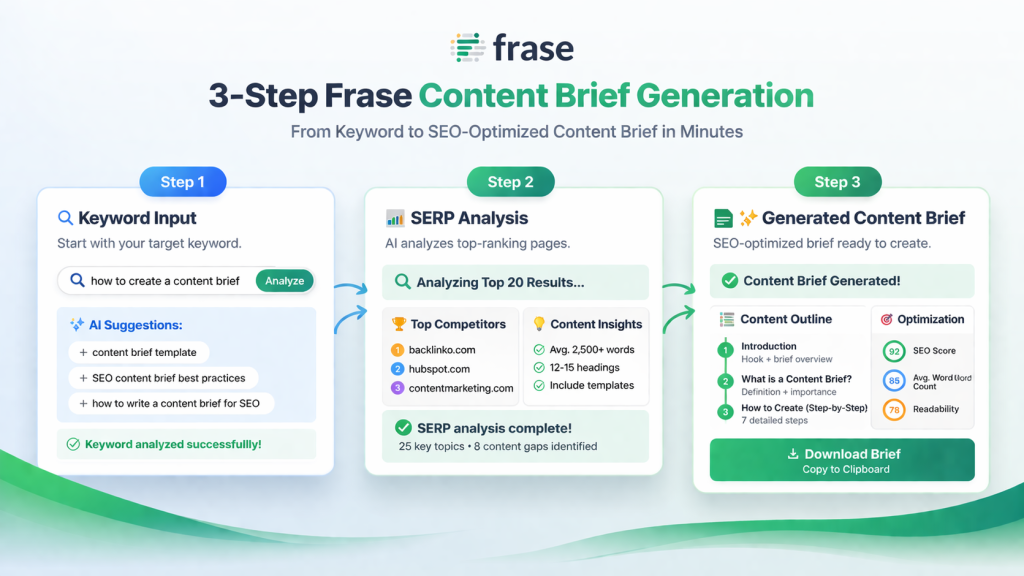
Step 1 — Start Your Frase.io Document
Open Frase.io and click New Document. Enter your target keyword in the search field. Select Google India as your search location if you’re targeting Indian audiences — this pulls SERP data specific to Google India search results rather than global averages, which matters for keywords where Indian search intent differs from global patterns.
Frase.io will immediately analyse the top 20 ranking pages for your keyword. This analysis forms the foundation of the content brief with Frase and NeuronWriter workflow. Every element of your brief comes from this data rather than from guesswork about what Google might want.
Step 2 — Analyse SERP Data and Set Word Count Target
In the Frase.io document overview, look at the Average Word Count metric at the top of the page. This shows the average word count across the top-ranking pages for your keyword. Your content brief should target this number as the minimum — not the maximum.
A common mistake in content brief creation is targeting the average rather than the top performers. In the content brief with Frase and NeuronWriter workflow, set your word count target at the average of the top 5 ranking pages rather than the top 20. The top 5 are ranking highest for a reason and their content depth is a more relevant benchmark than the broader average which includes weaker pages.
Check the domain authority distribution of the top-ranking pages in Frase. If pages with lower DA are ranking in the top 5, this is a signal that content quality and comprehensiveness are outweighing pure domain authority for this keyword — making it a good target for new or medium-authority sites.
Setting the right word count target is the first practical output of the content brief with Frase NeuronWriter process — and it’s the step most Indian content teams skip entirely.
Step 3 — Extract Competitor Headings for Your Brief Structure
Click the Headers tab in Frase.io. This shows every H2 and H3 heading used across all top-ranking pages for your keyword, organised by frequency. Headings that appear across multiple competitor pages are the topics Google considers most relevant to this keyword’s search intent.
For your content brief with Frase and NeuronWriter, select the headings that appear in 3 or more of the top-ranking pages. These are near-essential heading topics for a competitive piece. Add them to your brief’s recommended structure section. Then review the remaining headings and add any that cover angles none of the mandatory headings address — these become differentiation opportunities in your content.
The heading structure in your brief does not need to replicate competitor structure exactly. The brief should tell the writer which topics to cover — the specific heading wording can be more compelling or original. What matters is that the topics are covered, not that the headings are identical to competitors.
The heading structure extracted in Step 3 forms the skeleton of every content brief with Frase NeuronWriter document your team produces going forward.
Step 4 — Collect Questions From the Frase Questions Tab
Click the Questions tab in Frase.io. This aggregates People Also Ask questions from Google, questions from Quora, Reddit, and other Q&A platforms, and questions extracted from competitor content — all related to your target keyword.
This is one of the most valuable parts of building a content brief with Frase and NeuronWriter. Questions tell you exactly what your target reader wants to know beyond the primary keyword — the follow-up questions they’re likely to search after reading your article. Answering them within your content increases time-on-page and signals to Google that your content is comprehensive for the topic.
For your content brief, include the 5–8 most relevant questions as a required FAQ section at the end of the article. These should be questions that appear multiple times across different sources in Frase — indicating consistent demand from real users rather than questions specific to one platform.
Step 5 — Extract NLP Terms and Topics From Frase
Click the Topics tab in Frase.io. This shows the NLP terms — words, phrases, and concepts — that appear most frequently across top-ranking pages. These are the semantic signals Google uses to understand what a page is about beyond just the primary keyword.
Sort the topics list by Frequency to see which terms appear most consistently across competitor pages. The top 20–30 terms by frequency are your must-include NLP terms. Add these to your content brief with Frase and NeuronWriter document as a required terminology list. Your writer should incorporate these terms naturally throughout the content — not stuffed or forced, but present in the way they appear in the top-ranking pages.
Each term in Frase shows how many of the top-ranking pages include it. A term appearing in 8 out of 10 top-ranking pages is essentially mandatory — its absence from your content is a gap that competitors are filling and you aren’t.
The NLP terms from Frase are the first layer of semantic optimisation in the content brief with Frase NeuronWriter workflow — NeuronWriter adds the second layer in Steps 6 and 7.
Step 6 — Open NeuronWriter and Run Your Keyword
Open NeuronWriter and create a new analysis for the same target keyword. NeuronWriter uses Google’s Natural Language API to extract semantic entities and terms from top-ranking content — a different methodology from Frase’s frequency analysis that provides a complementary layer of optimisation intelligence.
Building a content brief with Frase and NeuronWriter together is more powerful than using either alone because Frase focuses on content structure and topical coverage while NeuronWriter focuses specifically on the NLP entity optimisation that Google’s algorithm scores most directly. The two tools answer different optimisation questions from the same keyword.
Step 7 — Build Your NeuronWriter Term List
In NeuronWriter, look at the Content Score breakdown on the right side of the editor. NeuronWriter shows a target score from 0–100 and breaks down which specific terms and entities are contributing to or missing from your score. The terms are categorised by importance — Primary Terms that carry the most weight, Secondary Terms that contribute significantly, and Additional Terms that add depth.
For your content brief with Frase and NeuronWriter, document the Primary and Secondary NeuronWriter terms alongside the Frase topic list. When a term appears on both lists, it has double validation — both frequency-based and Google NLP-based evidence that it belongs in your content.
Set a NeuronWriter score target in your brief. For competitive keywords where top-ranking pages score 65–75, aim for 70 as your target. For lower-competition keywords where top pages score 45–55, targeting 55–60 is usually sufficient to be competitive. The brief should specify the target score so the writer knows what threshold to reach during editing.
Documenting the NeuronWriter score target in the brief is what makes the content brief with Frase NeuronWriter process measurable — writers know exactly what threshold to hit before submitting.
Step 8 — Check NeuronWriter’s Competitor Content Analysis
NeuronWriter shows the content score of each top-ranking page alongside your own content score as you write. In the brief stage, look at the scores of competitor pages to understand the score landscape for your keyword.
If all top-ranking pages score between 55–65 in NeuronWriter, writing content that scores 70+ gives you a meaningful optimisation advantage. If top pages already score 75–85, you need to match that threshold rather than assuming a lower score is sufficient to compete. This competitive scoring context belongs in every content brief with Frase and NeuronWriter that a serious SEO team uses.
Step 9 — Identify Internal Link Opportunities in NeuronWriter
NeuronWriter’s internal linking feature suggests pages on your own site that are semantically related to the content you’re creating and should be linked from the new article. For the content brief, note 3–5 recommended internal links from your existing content that the writer should include naturally within the article body.
Internal links are a ranking factor that is consistently underused in Indian content workflows. Every new piece of content should link to 3–5 related existing posts on your site. NeuronWriter’s suggestions remove the manual research required to identify which pages are most semantically relevant to link from each new article.
Internal links specified in the content brief with Frase NeuronWriter document should be non-negotiable for writers — they are a ranking factor, not an optional extra.
Step 10 — Compile the Final Content Brief Document
With all the data collected from Frase.io and NeuronWriter, compile your complete content brief document. A properly structured content brief with Frase and NeuronWriter data looks like this:
- Target keyword: The exact primary keyword
- Search intent: Informational / Commercial / Transactional (from Frase SERP analysis)
- Target word count: Average of top 5 ranking pages (from Frase)
- Required headings: H2 and H3 topics from Frase headers tab (appearing in 3+ competitor pages)
- Questions to answer: Top 5–8 questions from Frase questions tab
- Frase NLP terms: Top 20–30 terms by frequency from Frase topics tab
- NeuronWriter primary terms: Primary and Secondary terms from NeuronWriter analysis
- Target NeuronWriter score: Specific score target based on competitor landscape
- Internal links to include: 3–5 specific pages from NeuronWriter suggestions
- External link suggestions: 2–3 authoritative sources to reference
- Content format notes: Whether top pages use tables, lists, step-by-step formats, etc.
This compiled document is the finished content brief with Frase NeuronWriter output — everything a writer needs to produce a ranking piece without making a single independent SEO decision.
Content Brief with Frase NeuronWriter — Using the Brief During Writing
A content brief is only as useful as the process for checking it during writing. Here’s how to use the content brief with Frase and NeuronWriter data during the actual drafting process:
Writing in Frase.io’s Editor
Write or paste your draft directly in the Frase.io editor. The right-side panel shows your current topic coverage in real time — terms turning green as you include them. This live feedback makes building the content brief with Frase and NeuronWriter data into the actual content faster than checking a static document constantly.
The Frase editor also shows your current word count against the target, your heading structure against the recommended headings, and which questions from the Questions tab you’ve addressed. For writers following a content brief, this real-time brief tracking significantly reduces editing time after the first draft.
Writing directly in Frase while referencing the content brief with Frase NeuronWriter term list in the same session is the fastest way to hit both Frase and NeuronWriter score targets in a single draft.
Optimising in NeuronWriter
After completing the first draft in Frase.io, paste the content into NeuronWriter for final NLP optimisation. The content score shows immediately how the current draft scores against the target. The missing terms panel shows exactly which NeuronWriter Primary and Secondary terms are absent from the current draft.
Work through the missing terms in order of importance — Primary Terms first, then Secondary. For each missing term, find a natural sentence or paragraph where it fits without forcing it. A term that reads awkwardly is worth less than a naturally integrated one even if the insertion technically improves the score.
Stop when you hit the target NeuronWriter score from your brief. Chasing a perfect score of 100 produces over-optimised content that reads unnaturally and can trigger Google’s content quality filters. The target score in your content brief with Frase and NeuronWriter should be calibrated to be competitive, not maximum possible.
The NeuronWriter optimisation step is what separates a content brief with Frase NeuronWriter workflow from a basic Frase-only process — the entity coverage difference consistently shows in rankings within 60–90 days.
Using ChatGPT Plus to Fill Brief Gaps
ChatGPT Plus (included on GroupToolz Pro alongside Frase.io and NeuronWriter) is useful for filling specific content brief gaps efficiently. If the Frase brief identifies a heading topic you’re not confident writing comprehensively, feed that heading and the relevant NeuronWriter terms to ChatGPT Plus and prompt it to draft that specific section. This keeps the human-written quality of the overall piece while covering all required brief topics without gaps.
Content Brief with Frase NeuronWriter — For Different Content Types
Blog Posts and Articles
The standard content brief with Frase and NeuronWriter workflow described above is designed for blog posts and articles. The heading structure extraction, question collection, and NLP term list are all most relevant for long-form written content targeting informational keywords. For a 2,000–3,500 word article, the full 10-step brief process is appropriate and the ROI on ranking improvement justifies the 15–20 minute investment.
The standard content brief with Frase NeuronWriter article workflow produces the most consistent ranking improvements for informational keywords in competitive Indian niches.
Product Pages and Commercial Content
For commercial or transactional pages, the content brief with Frase and NeuronWriter approach adjusts slightly. Word count targets are typically lower for product pages — top-ranking commercial pages often run 500–1,200 words rather than 2,000+. The NeuronWriter score target is more important than word count for commercial content — Google weighs entity coverage heavily for transactional queries.
For product pages specifically, the Frase headers analysis is most useful for identifying the specific product attributes, comparisons, and FAQs that commercial searchers need answered before making a purchase decision. These differ significantly from the informational headings that dominate educational content briefs.
Comparison and Review Pages
Comparison and review pages are where building a content brief with Frase and NeuronWriter produces the most consistent ranking improvements for Indian affiliate marketers and content sites. The Frase competitor analysis reveals exactly which comparison angles top-ranking pages cover — pricing comparisons, feature tables, use case breakdowns — and the NeuronWriter entity analysis identifies the specific product attributes Google considers most relevant for the query.
For review content, the Frase Questions tab is particularly valuable — it surfaces the specific questions buyers have about a product category that most review pages miss, creating differentiation opportunities for a well-briefed piece.
Category Pages for E-Commerce and Directories
Category pages are systematically under-optimised on most Indian e-commerce sites. Building a content brief with Frase and NeuronWriter for category page content follows a compressed version of the full article workflow — primarily focused on the NLP term list, the recommended intro paragraph structure, and the specific questions to address in category page copy. For a GroupToolz subscriber using Helium 10 and Jungle Scout alongside Frase and NeuronWriter, combining Amazon product research data with NeuronWriter’s entity analysis produces category page briefs that competitors running standard WordPress category pages can’t match.
Content Brief with Frase NeuronWriter — Common Mistakes to Avoid
Treating the Brief as a Template Rather Than a Research Output
The most common mistake in content brief creation is using generic templates rather than keyword-specific SERP research. A content brief built on a template tells a writer what content briefs generally contain. A content brief with Frase and NeuronWriter data tells a writer what Google specifically rewards for that exact keyword. The difference in ranking outcomes is significant and consistent.
A keyword-specific content brief with Frase NeuronWriter data outperforms any generic template because it reflects what Google currently rewards for that exact query — not what SEO best practices suggest in general.
Targeting the Wrong Word Count
Many Indian content teams target word counts based on general SEO advice (“longer is better”) rather than actual competitor data. For some keywords, top-ranking pages average 800 words. For others, they average 4,500 words. The content brief with Frase and NeuronWriter workflow produces keyword-specific word count targets rather than blanket length rules, which reduces both under-writing and unnecessary padding.
Skipping the NeuronWriter Step
Some content teams use Frase.io alone and skip NeuronWriter, treating the Frase topics tab as sufficient NLP coverage. Frase’s frequency-based analysis and NeuronWriter’s Google NLP API-based analysis overlap significantly but not completely. Terms that appear in NeuronWriter’s Primary category but not prominently in Frase’s frequency list are terms Google’s algorithm specifically weights for entity recognition — missing them costs ranking positions even when the Frase score looks complete.
Over-Optimising for Score
A NeuronWriter score of 100 does not mean a piece will rank. Chasing a maximum score produces content that inserts terms in unnatural positions, disrupts reading flow, and can trigger Google’s Helpful Content quality signals negatively. The target score in a content brief with Frase and NeuronWriter should be set at 5–10 points above the average competitor score — competitive but not artificially inflated.
Not Including Internal Links
Indian content teams consistently under-invest in internal linking. The NeuronWriter internal link suggestions in the content brief are not optional extras — they are a ranking factor. Every brief produced through the content brief with Frase and NeuronWriter workflow should include 3–5 required internal links with the anchor text and target URLs specified. Writers should not be making internal linking decisions independently without guidance from the brief.
Content Brief with Frase NeuronWriter — Team Workflow for Indian Content Agencies
For Indian content agencies and SEO teams producing content at scale, the content brief with Frase and NeuronWriter process needs to be systematised rather than done ad hoc per article. Here’s a scalable team workflow:
Role 1 — Brief Creator (SEO Lead or Content Strategist)
One person per team should own the content brief creation process. This person runs keyword research in SEMrush or KWFinder, builds the brief in Frase.io, pulls the NeuronWriter term list, and delivers a complete brief document to the writer. Brief creation should take 15–20 minutes per article at this proficiency level. A dedicated brief creator can produce 10–15 briefs per day, supporting a larger writing team.
Role 2 — Writer
Writers receive the brief and draft content in Frase.io’s editor, using the real-time topic tracking to hit Frase coverage targets. Writers should not be doing their own keyword research or competitor analysis — the brief provides all of this. Writer responsibility is to produce quality, readable content that covers all brief requirements, not to interpret SERP data independently.
Role 3 — SEO Editor
After the writer submits a draft, an SEO editor pastes it into NeuronWriter to check the content score. If the score is below target, the editor identifies missing Primary Terms and returns the draft to the writer with specific addition instructions. If the score meets or exceeds target, the editor reviews for readability and internal links before approving for publication.
Cost of Content Brief Tools — Retail vs GroupToolz
| Tool | Retail Price/Month | INR Equivalent |
|---|---|---|
| Frase.io Solo | $15 | ~₹1,249 |
| Frase.io Basic | $45 | ~₹3,748 |
| NeuronWriter Bronze | $19 | ~₹1,582 |
| NeuronWriter Silver | $37 | ~₹3,082 |
| Surfer SEO Essential | $89 | ~₹7,412 |
| ChatGPT Plus | $20 | ~₹1,665 |
| Grammarly Premium | $12 | ~₹999 |
| SEMrush (for keyword research) | $139.95 | ~₹11,650 |
| Frase + NeuronWriter + ChatGPT + Grammarly + SEMrush (Retail) | $245.95/mo | ~₹20,493/mo |
| GroupToolz Pro (all included) | ₹449/mo | |
| Monthly Saving | ~₹20,044/mo |
The content brief with Frase NeuronWriter combination replaces Surfer SEO at a fraction of the cost — and both tools are on GroupToolz Pro at ₹449/month.
The content brief with Frase NeuronWriter stack on GroupToolz Pro at ₹449/month saves Indian content teams over ₹20,000/month compared to retail subscriptions — making professional content optimisation accessible at any budget level.
The full content brief with Frase and NeuronWriter tool stack including ChatGPT Plus, Grammarly Premium, and SEMrush for keyword research costs over ₹20,000/month at retail. GroupToolz Pro at ₹449/month includes all of these tools on one plan. For Indian content creators and SEO teams, this saving compounds significantly over 12 months — over ₹2.4 lakh saved per year on content production tools alone.
Final Verdict — Content Brief with Frase NeuronWriter 2026
Building a content brief with Frase and NeuronWriter is the most reliable method for producing SEO content that ranks consistently in 2026. Frase.io handles the structural brief — word count, heading topics, questions to answer, and NLP term frequency. NeuronWriter handles entity-level optimisation using Google’s own NLP signals. Together they cover every aspect of what Google evaluates when ranking content for a given keyword.
For Indian content creators, bloggers, and SEO teams, both tools are available on GroupToolz Pro at ₹449/month — alongside ChatGPT Plus, Jasper AI, Writesonic AI, Grammarly Premium, QuillBot, SEMrush, KWFinder, and SpyFu on the same plan. The retail cost of the same stack exceeds ₹20,000/month. The content brief with Frase and NeuronWriter workflow on GroupToolz Pro delivers agency-level content optimisation at a price point that any Indian blogger or freelancer can sustain.
Systematising the content brief with Frase NeuronWriter process across a team is what transforms good SEO from an individual skill into a repeatable agency workflow.
Frequently Asked Questions — Content Brief with Frase NeuronWriter
What is a content brief and why do I need one for SEO?
A content brief is a structured document that tells a writer exactly what to include in a piece of content to rank for a target keyword. It covers word count target, recommended headings, NLP terms to include, questions to answer, and internal link opportunities. Without a content brief, writers make decisions based on preference rather than SERP data, which consistently produces content that underperforms competitors who use brief-driven workflows.
Is Frase.io or NeuronWriter better for content briefs?
They serve complementary functions. Frase.io is better for building the structural brief — word count targets, heading extraction, question research, and competitor overview. NeuronWriter is better for NLP entity optimisation using Google’s Natural Language API. Building a content brief with Frase and NeuronWriter together gives you both structural and entity-level optimisation that either tool alone doesn’t fully cover. Both are available on GroupToolz Pro at ₹449/month.
Can I use GroupToolz to access Frase.io and NeuronWriter?
Yes. Both Frase.io and NeuronWriter are included on GroupToolz Pro at ₹449/month. The same plan also includes ChatGPT Plus, Jasper AI, Writesonic AI, Grammarly Premium, QuillBot, SEMrush, KWFinder, SpyFu, and more — covering the complete content brief and writing workflow on one subscription.
Is NeuronWriter better than Surfer SEO?
NeuronWriter uses Google’s Natural Language API for entity extraction which provides a direct signal from Google’s own understanding of content relevance. Surfer SEO uses a proprietary algorithm. For NLP-based content optimisation, NeuronWriter’s Google NLP foundation is arguably a more direct signal. From a practical standpoint, NeuronWriter and Frase.io together on GroupToolz Pro at ₹449/month replicate and extend Surfer SEO’s functionality at a fraction of Surfer’s $89–$219/month retail cost. Surfer SEO is not available on GroupToolz.
How long should a content brief take to create?
A complete content brief with Frase and NeuronWriter takes 15–20 minutes for an experienced user. For someone new to both tools, allow 30–45 minutes for the first few briefs as the workflow becomes familiar. Once the process is routine, a single brief creator can produce 10–15 briefs per day supporting a larger writing team.
What NeuronWriter score should I target for my content?
Check the NeuronWriter scores of the top 5 ranking pages for your keyword in the competitor analysis view. Target a score 5–10 points above the average of these pages. If top-ranking competitors score 55–65, targeting 70 is competitive without over-optimising. Avoid chasing scores above 85 — at that point, additional term insertion typically damages readability without proportional ranking improvement.
Looking for more SEO tutorials and content creation guides? Find more such blogs at GroupToolz →
Comments