
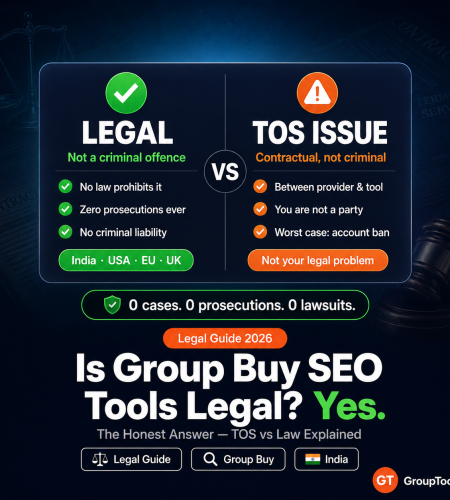
This question comes up in every Facebook group, every Reddit thread, every Telegram channel. And the answers are almost always wrong. Either “it’s totally fine, don’t worry about it” or “you’ll get arrested.” Neither is true. Here’s what actually happens when you ask is group buy SEO tools legal, with no sugarcoating and no fearmongering.
By GroupToolz Team Updated: May 12, 2026
The short answer: is group buy SEO tools legal?
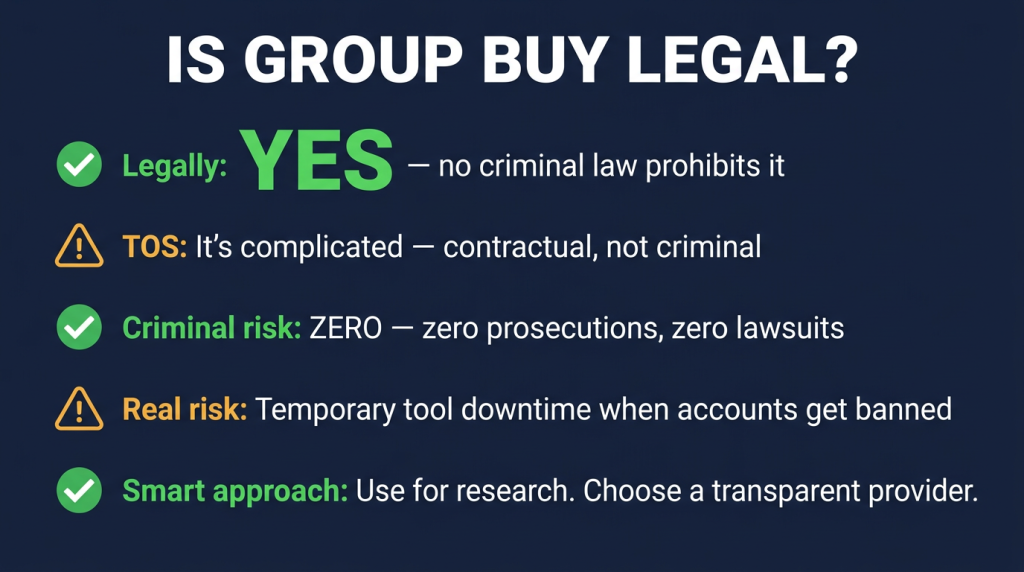
Using a group buy SEO tool is not illegal. Not in India, not in the US, not in the EU, not in the UK, not in Australia. No criminal law in any of these places specifically prohibits using a shared software subscription. Zero people have been prosecuted for it. Zero people have been sued for it. Zero people have gone to jail for it.
But. And there is a but.
It can violate the terms of service of individual tool providers. SEMrush’s TOS says one account per person. If 50 people use one SEMrush account through a group buy, that violates SEMrush’s rules. That’s a contractual issue between the group buy provider and SEMrush. It is not a crime. The question “is group buy SEO tools legal” has a boring answer: legally yes, contractually complicated.
Most articles about this topic mash these two things together. They say “it’s against the terms of service” and imply that means “it’s against the law.” Those are not the same thing. Not even a little bit. Understanding the difference is the whole point of asking is group buy SEO tools legal in the first place.
The gym membership analogy
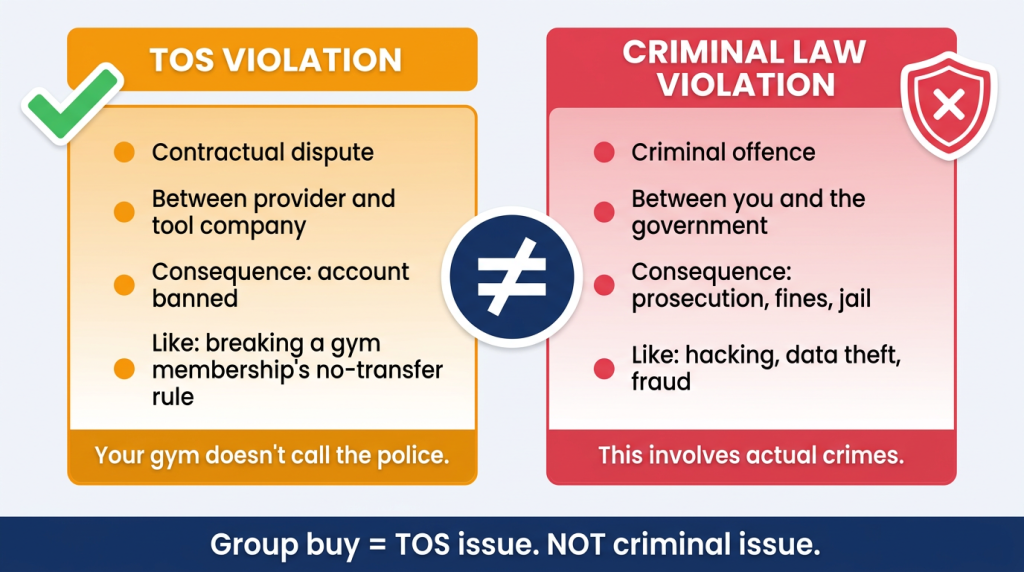
A TOS violation is like a contractual dispute over a gym membership that says “non-transferable.” If your friend uses your gym pass, the gym can cancel your membership. But your friend does not go to jail. Nobody calls the police. The gym revokes access, and that’s the end of it. Group buy works the same way. The tool provider can ban the shared account. That’s the consequence. The question is group buy SEO tools legal gets answered right here: legal yes, against some rules yes, criminal no.
TOS violation versus actual law: the thing everyone confuses
I want to hammer this point because it’s where most of the fear comes from. Someone reads “group buy violates SEMrush’s terms of service” and their brain fills in “so I could get in legal trouble.” No. A TOS is a contract between the group buy provider and the tool company. You, the end user, are not a party to that contract. You did not agree to SEMrush’s TOS. The group buy provider did.
When people ask is group buy SEO tools legal, what they really want to know is: “can anything bad happen to me personally?” The answer is: the worst thing that happens is temporary loss of access to a tool when an account gets banned. The provider sets up a new account. Access comes back. That’s it. No legal letters. No lawsuits. No criminal record.
Could a tool provider theoretically sue a group buy provider for breach of contract? Sure. Has it happened? Not that anyone can point to. The economics don’t make sense. Banning the account costs the provider nothing and solves the problem. Hiring lawyers to sue a group buy provider costs tens of thousands of dollars and creates publicity that drives more people to group buys. Tool companies are smart enough to know this.
What the actual laws say (I checked)
India
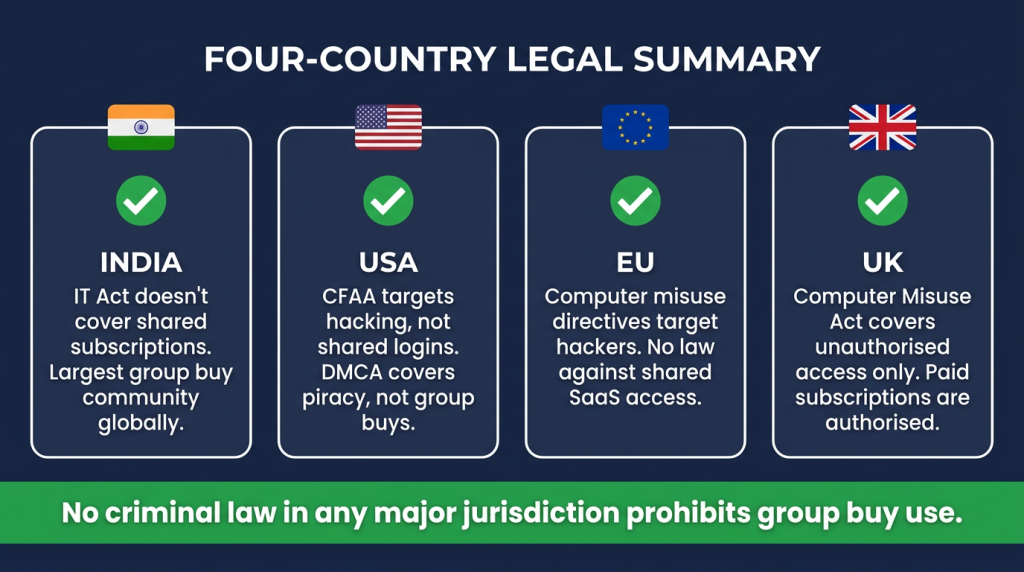
The Information Technology Act of 2000 covers hacking, unauthorised computer access, and data theft. Using a group buy tool does not fit any of these. The subscription is paid for. The account is real. Nobody hacked anything. Nobody stole data. India has one of the biggest group buy communities in the world, with dozens of providers operating openly for years. If it were illegal, at least one case would have surfaced by now. None has. When Indian users ask is group buy SEO tools legal, the IT Act gives a clear answer: this is not covered.
United States
The Computer Fraud and Abuse Act (CFAA) targets unauthorised access to computer systems. Logging into a paid account with provided credentials is not “unauthorised access” under any reasonable reading of the CFAA. The Digital Millennium Copyright Act (DMCA) covers software piracy and cracking. Group buy services buy real subscriptions. Nothing is pirated, cracked, or reverse-engineered. Different thing entirely.
European Union
EU computer misuse directives go after hackers and data thieves. GDPR protects personal data. Neither has anything to do with sharing access to a legitimately purchased SaaS subscription. There is no EU law that makes shared software access a criminal act.
Across every jurisdiction I’ve looked at: the subscriptions are purchased and paid for, access happens through real credentials on active accounts, no software gets modified or cracked, no security systems get bypassed, and no personal data gets stolen. The only issue is a contractual TOS matter between the provider and the tool company. Not your problem. That’s the answer to is group buy SEO tools legal in every country that matters.
What actually happens when a shared account gets banned
Let’s say SEMrush detects unusual activity on a shared account. Maybe 15 different IP addresses hit it in one day. Maybe the query volume looks way higher than a single user would generate. SEMrush bans that account. Here is exactly what happens next, and exactly what does not happen.
| What actually happens | What does NOT happen |
|---|---|
| The group buy provider’s shared account gets suspended | Your identity is not revealed to the tool company |
| You lose access to that specific tool for a few hours or days | Your website gets no penalty from Google (Google can not see how you use SEO tools) |
| The provider creates a new account and restores access | Nobody gets charged with anything |
| You might miss a day or two of that tool’s data | No lawsuit gets filed against you or anyone else |
| The provider absorbs the cost of the lost account | Your client work stays unaffected (you already exported the data) |
Tool providers go after group buy providers by banning accounts. They do not go after end users. Why? Because end users are potential future paying customers. Banning an end user’s personal data or website would be pointless and would create terrible PR. No tool company wants the headline “SEMrush sues freelancer for Rs 11,000 subscription dispute.” That’s the practical reason why asking is group buy SEO tools legal matters less than people think. Even the tool companies don’t treat it as a legal issue.
The real risks, ranked honestly
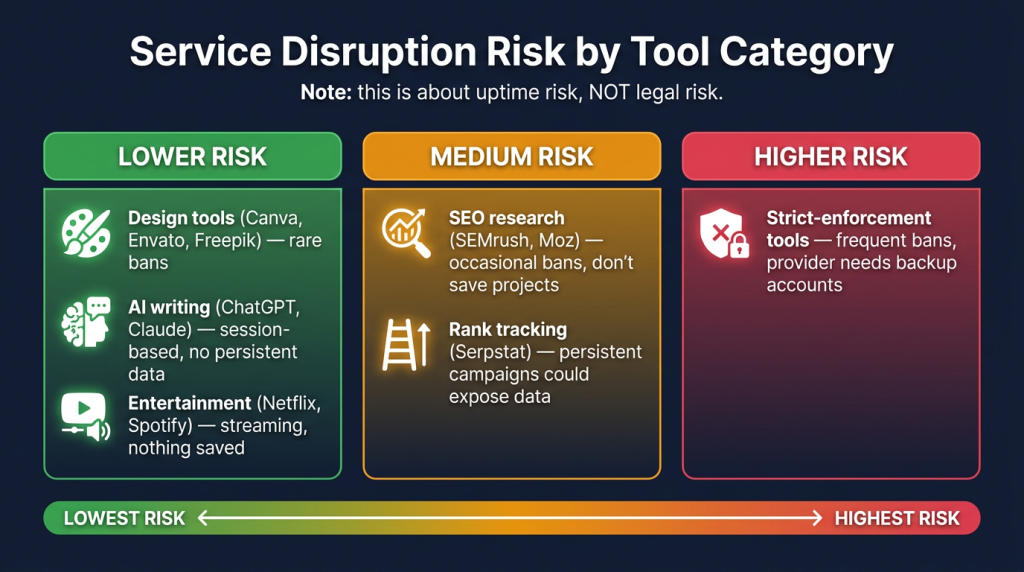
Different tools carry different levels of service disruption risk. Notice I said “service disruption,” not “legal.” Because when someone asks is group buy SEO tools legal, the actual risk is about uptime, not about courts.
| Lower risk Design and creative Canva Pro, Envato Elements, Freepik. You download files. Minimal account tracking. Bans are rare. | Lower risk AI writing tools ChatGPT Plus, Claude AI, Jasper. Query-based, no persistent data, sessions are independent. | Lower risk Entertainment and learning Netflix, Coursera, Spotify. Streaming. Nothing saved. Session-independent. |
| Medium risk SEO research tools SEMrush, Moz, SpyFu. On-demand lookups are fine. Don’t save projects or campaigns on the shared account. | Medium risk Rank tracking Serpstat, keyword monitoring. Persistent campaign features could expose data to other users. Use for research only. | Higher risk Strict-enforcement tools Some tools ban aggressively. Account turnover is faster. Provider needs backup accounts ready at all times. |
The data safety question (this is what you should actually worry about)
Forget the “is group buy SEO tools legal” question for a moment. The thing that actually deserves your attention is data privacy on shared accounts.
On a shared SEMrush account, other users could theoretically see saved projects, tracked keywords, and campaign data. If you create a project for a client’s website on a shared account, someone else using that same account might see it. That is a real concern.
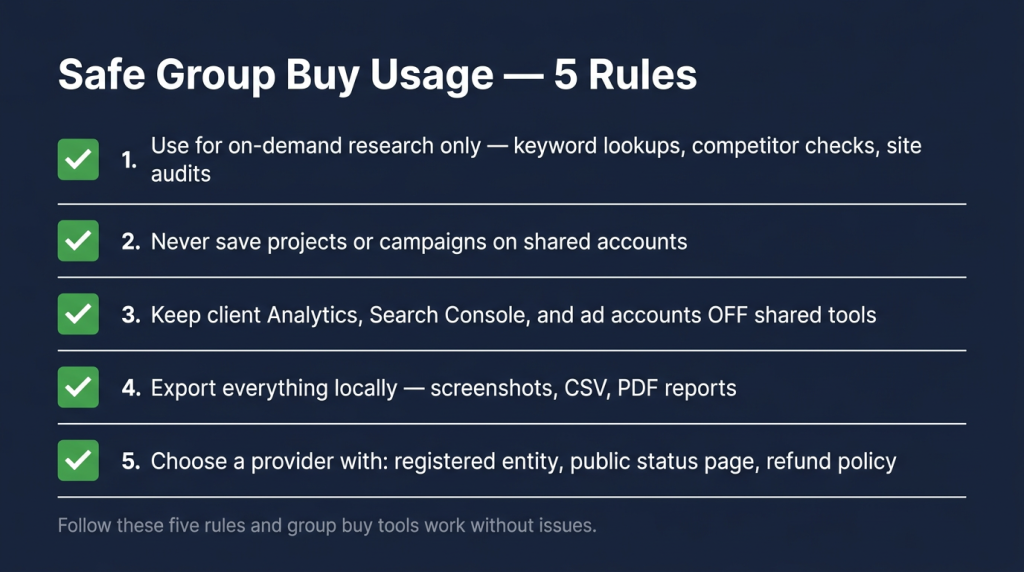
The fix is simple. Don’t save anything on shared accounts. Use group buy tools for on-demand research: keyword lookups, competitor analysis, domain authority checks, SERP analysis. Pull the data. Export it. Work with it locally. Treat the shared account like a library computer. You use it to look things up. You don’t store your personal files on it.
The practical rule
Never enter client Google Analytics, Search Console, or ad account credentials into a shared tool account. Never create persistent projects or campaigns. Never save tracked keyword lists. Use group buy tools for public data analysis only: keyword volumes, competitor domains, SERP features, site audits. The question is group buy SEO tools legal is less important than the question “am I using it safely?” Follow this rule and data safety is a non-issue.
What GroupToolz does that most providers don’t
I’ll be direct about something: not all group buy providers are equal, and some of them are genuinely sketchy. Anonymous operators. No company name. No registration. Take your money and vanish. Those exist, and they’re the reason people worry about whether this whole thing is legitimate.
GroupToolz operates differently. Here’s what that looks like in practice.
| Registered Indian entity Legally registered business. Accountable under Indian consumer protection law. | Public status page Real-time uptime data anyone can check. Not just a “99.9%” claim with nothing behind it. | INR pricing + UPI GPay, PhonePe, Paytm. No international card needed. No forex fees. |
| Documented refund policy If tools don’t work, you can get your money back. Your financial risk is capped at one month. | WhatsApp support (IST) Live humans during Indian business hours. Not a contact form that goes nowhere. | Dashboard access Managed through GroupToolz dashboard. Not raw shared login credentials you’re left to figure out. |
The registered entity part matters more than people think. If an anonymous Telegram group takes your Rs 500 and disappears, you have zero recourse. If a registered Indian company does the same, you can file a consumer complaint. That’s not a theoretical difference. It’s a practical one. When evaluating whether is group buy SEO tools legal and safe, the provider’s transparency signals matter more than the legal question itself.
How to use group buy tools without causing yourself problems
Research mode only. Keyword lookups. Competitor checks. Site audits. Domain authority. SERP analysis. Pull the data, export it, work with it on your own computer. That’s how you use shared accounts.
Keep client data off shared accounts. No connecting client Analytics. No connecting Search Console. No linking ad accounts. Group buy tools are for public data analysis. Client dashboards belong on your own accounts or your client’s accounts.
Export as you go. If the shared account gets banned tomorrow, you want all your research already saved locally. Screenshots, CSV exports, PDF reports. Your output belongs to you. The shared account is just the tool you used to create it.
Design tools are worry-free. Canva Pro, Envato Elements, Freepik: you download files. There’s no shared workspace state. No data privacy issue. The commercial license covers your use. These are the easiest tools to use on group buy without thinking twice.
Pick a provider you can hold accountable. Registered entity. Public status page. Refund policy. Named support channels. If they won’t tell you their company name, walk away. That’s more important than whether is group buy SEO tools legal. The legal answer is settled. The provider quality answer is what varies.
Things people keep saying that are wrong
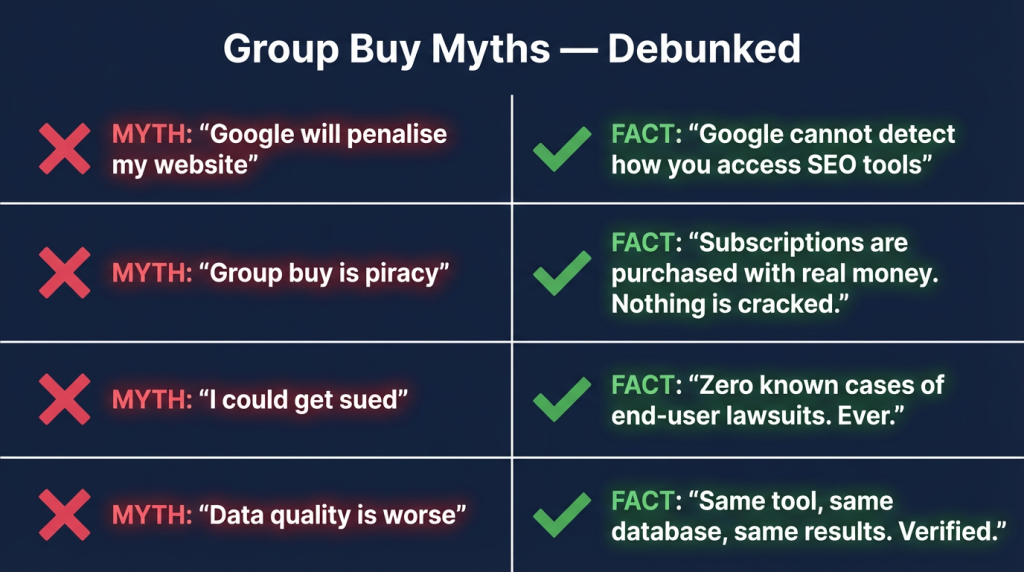
“Google will penalise my website.” I hear this one weekly. It’s wrong. Google has no way of knowing how you access SEO tools. Whether you use SEMrush through a $139 retail plan, a group buy, a free trial, or your friend’s login doesn’t change what Google sees of your website. SEO tools look at Google’s publicly available data. They don’t report back to Google about who’s using them. The question is group buy SEO tools legal has nothing to do with Google rankings. Nothing.
“Group buy is piracy.” Piracy means cracking software, breaking copy protection, or distributing unauthorised copies. Group buy services buy real subscriptions with real money. The software is not modified, cracked, or redistributed. It’s a TOS violation, which is a contract issue. Not piracy, which is a criminal issue. Very different.
“I could get sued.” Could you theoretically be named in a lawsuit? Anything is theoretically possible. Has it ever happened? No. Not once. Not in any country. Tool providers go after group buy providers by banning accounts. Going after individual users would cost a fortune in legal fees, create terrible publicity, and alienate potential customers. It doesn’t happen because it doesn’t make business sense.
“The data quality is worse on group buy.” This one irritates me because it’s so easy to disprove. Type a keyword into SEMrush on a group buy account. Type the same keyword into SEMrush on a retail account. The numbers are identical. Same database. Same results. SEMrush does not serve different data based on your subscription method. The question is group buy SEO tools legal has no bearing on data quality. The data is the same.
Transparent provider. Registered entity. Refund policy.
GroupToolz: 150+ tools. INR pricing. UPI payment. Public status page. From Rs 199/month.
Questions people ask about group buy legality
Is group buy SEO tools legal in India?
Yes. India’s IT Act covers hacking, unauthorised access, and data theft. None of that applies to using a legitimately purchased shared subscription. TOS violations are contractual disputes, not criminal offences. India has one of the largest group buy user communities in the world.
Can someone sue me for using a group buy?
No known case exists of an individual user being sued for using group buy tools. The TOS contract is between the group buy provider and the tool company. You are not a party to it. Tool providers deal with group buys by banning shared accounts, not by pursuing end users.
Will Google penalise my site if I use group buy SEO tools?
No. Same tool, same database, same results. SEMrush serves identical keyword volumes and competition scores regardless of your subscription type. The question is group buy SEO tools legal has nothing to do with data quality.
Is the data quality different on group buy?
No. Same tool, same database, same results. SEMrush serves identical keyword volumes and competition scores regardless of your subscription type. The question is group buy SEO tools legal has nothing to do with data quality.
What’s the actual risk?
Service interruption when shared accounts get banned, and potential data privacy if you save projects on shared accounts. Both are manageable. Use tools for on-demand research, export data locally, and pick a provider with a public status page and refund policy.
Why is GroupToolz safer than other providers?
Registered Indian entity (legal accountability), public status page (verifiable uptime), INR pricing with UPI (no forex fees, no international card needed), documented refund policy (financial risk capped), and WhatsApp support during IST hours. Most group buy providers offer none of these.
Should I tell clients I use group buy tools?
Your call. The tools produce identical output regardless of subscription method. Reports, audits, keyword data, designs: same quality. Many freelancers and agencies don’t disclose their specific tool subscriptions, just as they don’t disclose which plan tier they’re on for any professional software.
More guides
GroupToolz Pricing Explained — Which Plan is Right for You? (2026 Breakdown)
Is GroupToolz Legit? Real Uptime Data, User Reviews & Full Transparency Report
Best Group Buy SEO Tools for E-Commerce & Dropshipping — Amazon, Shopify & Beyond
Want more group buy guides? Browse all GroupToolz blog posts
Comments